
Home / After dark / Keys for pickup trucks on ranches
Ranch truck keys
Keys for pickup trucks that work on ranches
A ranch pickup lives a hard life. Its keys get wet, dusty and dropped in the field. Here is how to plan for a night key problem, far from the road, with a steady head.
A truck that works for a living
A ranch truck is not a commuter car. It crosses fields, hauls feed and tools, pulls trailers and sits for hours in sun, dust or cold. Its key lives in a jacket, a work glove or a pocket full of other small items. It gets knocked about every day.
That wear matters. A key that has been bent, soaked and dropped many times is closer to failure than a key from a desk drawer. The metal may be worn smooth. The plastic head may be cracked. A key fob may have taken in water and dust.
None of this means trouble is certain. It means a ranch owner is wise to plan before a problem. The rest of this page covers what to check, what to say on a call and how to stay safe when you are a long way from a paved road.
Consider the other side of a hard working truck: it is often the only way off the property. If the key fails, there may be no second vehicle to borrow. That makes planning more valuable on a ranch than in town, where a neighbour or a ride app is close at hand.
Ranch life also means several people may drive the same truck: a family member, a hired hand, a neighbour who borrows it for a day. Agree on one place where the key lives when it is not in use. A hook inside a closed shed or a drawer in the house is better than the dash.
Where a ranch key problem usually happens
Key trouble on a ranch is rarely at a tidy curb. It can be at a gate far from the house, beside a stock tank, near a barn or on a dirt track at dusk. The truck may be parked on soft ground or on a slope. There may be no signal at the exact spot.
Think ahead about the phone. If you lose a signal at the gate, walk to the place where you do have one, if that is safe. Do not go into the dark with a failing light. If you are alone, tell someone at the house where you are and when you will check in.
The page on rural road lockouts after dark covers the planning that suits country stretches. For a ranch, add the practical side: gates, animals and equipment all matter when you decide where a technician will park.
Write the location in words that a stranger could follow. Use the road name from the signs, the nearest gate and a landmark that will still be visible at night, such as a large barn with a light. Avoid directions that rely on local habit, like turn where the old tree used to be.
Lost keys in the field
Keys fall out of pockets in tall grass, in mud and in feed bins. Before you call, retrace your steps. Check the seat, the floor mats, the cup holder and the bed of the truck. Check the pockets of work clothes in the wash. Check the ground by the gate.
A metal detector or a small magnet on a stick can help on soft ground, though it will not find plastic fobs. A second person with a light is more useful than any gadget. Keep a calm pace and search in a pattern.
If the key is truly gone, stop searching in the dark and think about the next step. The truck is probably safe on your own land, and the search can wait for daylight. The page on vehicle key replacement explains how a new key is made.
Keep a small flashlight with a spare battery in the house, and a second light in the truck if the truck is not the problem. A head torch keeps both hands busy with the search itself, which is a real help when you search through grass or mud. Keep the light low so you do not blind a person helping you.
If you search on foot at night, wear boots and a warm layer, and tell the person at the house how long you will be. Stop if you reach a drop, a creek or any ground you cannot see. A key is never worth a fall.
Locked out with the key inside
A ranch truck may lock when you close the door, either from a setting or from a button pressed in a hurry. A key left on the seat or in the ignition then becomes a lockout. It is a common event, and it is calmer to solve than a lost key.
Do not break a window. A broken side window in a working truck lets in dust, rain and cold, and the repair costs more than a locksmith visit. A skilled technician can open the door without damage in most cases.
If the engine is running, tell the dispatcher. If a person or animal is inside, call emergency services first. Our night car lockout page and the guide on keys locked inside a running car give the details.
Many ranch trucks carry tools, tack, feed or fuel. A locked door with these items inside is a worry, but not a reason to hurry. Wait for a professional entry. A forced door or a smashed window will cost more than anything you saved by acting alone.
Before the technician starts, move the truck if it can be moved, or at least clear the area around the door. Mud around the door makes the work harder and the entry less tidy. Check that the parking brake is set if the truck sits on a slope.
What to tell the dispatcher
Give the year, make, model and trim of the truck. Say whether it is a standard cab, extended cab or crew cab, since this helps the technician picture the vehicle. Give the vehicle identification number, found on a plate at the base of the windshield and on the registration.
Then give the location in plain terms, using the checklist in what to tell the dispatcher, a location checklist. For a ranch, mention the nearest highway or road, any gates that must be opened, whether the ground is soft, and whether there are dogs or livestock near the truck.
Mention if the road is rough or steep. A service van is a normal vehicle, and a rutted track may need care. If a gate has a lock or code, the technician must be able to pass it, so arrange access before they come.
If a gate is locked behind you, arrange for someone to open it for the technician, or leave a clear note of where the gate code or key is to be found. Do not leave a gate key in plain sight outside. Share any code by voice with the person who will use it, not by a sign or a written note on the fence.
Older trucks and newer trucks
Ranches often run both. An older truck may have a plain key with no chip. A newer truck may have a key with a chip, or a fob with buttons, or a push button start. Each of these is a different job.
A plain key is a cutting job. A chip key is a cutting and programming job. A fob or push button truck may need extra steps. The dispatcher will ask for the year, make and model to sort out which one applies. Do not guess the type from the look of the truck.
Our pages on keys for older vehicles from before transponder chips and transponder keys explained for night emergencies describe the two ends of the range in plain words.
If you have a truck with a trailer hitch, a locking hitch pin or a locked cap on the bed, mention them. These small locks use their own keys. A lost bed cap key or hitch lock key is a different job from the engine key, and it helps the technician to know.
Ask the dispatcher if the van can bring parts for your type of lock. Truck door lock cylinders and ignition cylinders are not all the same. If a new cylinder is needed, the technician may be able to match it to your existing key, so you do not carry a second one.
Keeping keys alive in dust, mud and water
Dust gets into key blades and small locks. Over time it works like grit paper, wearing the pins and the key. A key that feels gritty in the lock needs attention. Blow dust out of the lock with a puff of air, and avoid oil, which can attract more grit.
Water is a problem for fobs. If a fob has been in a puddle or a wash, dry it and open the case if you can. Let it dry completely before use. A damp fob can fail a day later.
Use a key ring that sits flat and is not heavy. A big bunch of keys on a heavy ring wears the ignition. Consider a separate ring for the truck key alone. The page on worn key symptoms helps you spot trouble early.
Wash the key now and then with a damp cloth and let it dry. Do not soak it. A clean key slides in cleanly and wears the lock less. A fob with a cracked shell can be protected with a small silicone sleeve, if one fits.
Do not store keys in a hot dash or in direct sun. Heat can warp plastic and weaken a chip's solder. A glove box or a shaded pocket is kinder to a key through summer.
Cold, frost and frozen locks
A ranch in colder country faces frost, frozen door seals and stiff locks. Ice can form around the door handle and inside the lock. Forcing a frozen handle can break it.
Do not pour hot water on a frozen lock or window. It can refreeze and can crack glass. Wait, warm the area gently if you can, and call for help if the lock will not respond. Read frozen car door locks on winter nights and ice and snow around door handles for more.
Keep a spare key somewhere warm and dry, not in the truck. A key hidden in a magnetic box under the bumper is a risk, since it can be found, and it is often frozen to the metal when you need it.
On a ranch the cold nights do more than freeze locks. They stiffen plastic and make cracked key heads snap. If you notice a crack, replace the key before winter. A key that breaks in the cold is a bigger problem than one that breaks in summer.
Keep a small cloth in the truck to wipe moisture off the handle and the lock area. A dry lock is less likely to freeze overnight.
If a lock has frozen and you must get in, a gentle approach works better. Warm the key in your hand, not with a flame. A flame can melt the plastic head and ruin the chip. Slide the key in slowly and do not force it to turn.
Staying safe and checking who arrives
Stay near the house or in a lit area while you wait. Keep your phone charged and let someone know where you are. Do not walk long distances in the dark. Keep dogs and livestock away from the area so the technician can work.
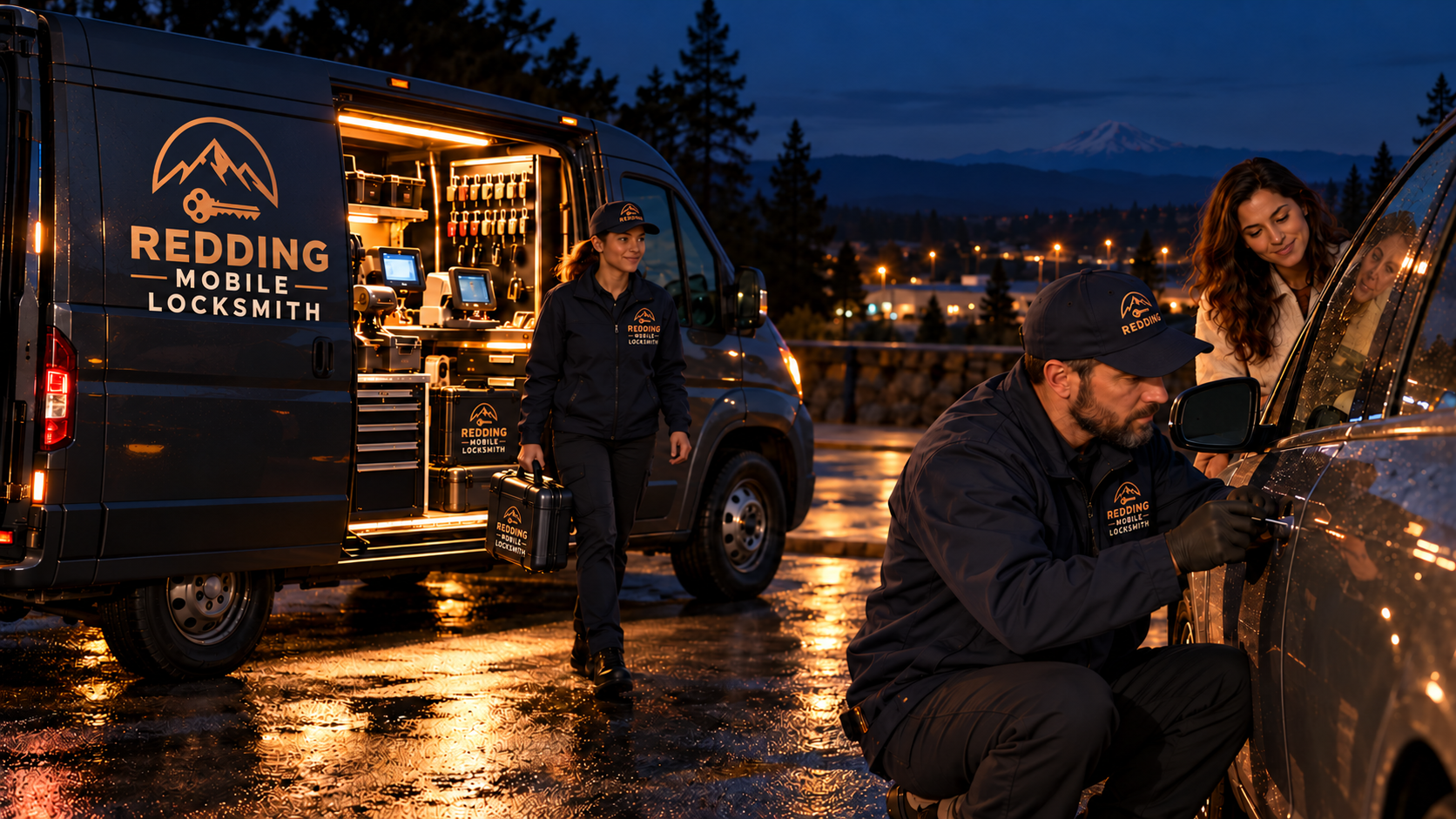
When the service van arrives, check who it is. A real team arrives in uniform with a branded van and shows identification when asked. Compare the company name with what the dispatcher told you.
The guide on confirming who is arriving gives a short script. Expect to be asked for your identification and papers. The page on why a locksmith may ask for identification explains why.
Plan for the arrival. Turn on a porch light or a yard light, move livestock away from the access route and keep dogs inside. A technician arriving at night in unfamiliar country needs a clear path and a safe place to park. If you have a gate man or a neighbour who can guide the van in, ask them to help.
After the work: spares and a simple routine
Once the truck runs, plan a spare. A spare made before the last key is lost is easier and calmer than one made at night. Read why a spare key matters before you need it.
Keep one spare at the house in a safe place and another with a trusted person off the property if you can. Test each key on every lock and in the ignition. Mark the date of the test on a calendar.
When you need help, use the request form on the contact page. Include the truck details and a clear description of the location. Our vehicle locksmith page gives an overview of the work.
Last, think about a written plan for the property. Where are the spare keys, who has authority to call a locksmith, which gates need codes and what the nearest road is called. Put it on a card on the fridge. When a bad night comes, a family member or a hired hand can follow the card.
It is also worth asking about a second key for the farm gate, the barn and any padlocks, kept on a separate ring from the truck key. Keeping them apart limits the damage if one ring is lost.
Common questions
Can a mobile locksmith reach a truck on a ranch?
Possibly, depending on the access and the road. Tell the dispatcher about gates, soft ground and any rough track so the van can plan its approach. Where the road is not suitable for a service van, you may be asked to meet at a safer spot on firm ground.
What do I need to tell the dispatcher about my truck?
Give the year, make, model and trim, the cab style and the vehicle identification number. Say whether the key is a plain metal key, a key with a chip or a fob. Add where the truck is, how to reach it, and any hazards such as dogs or livestock.
My key got wet and now the fob does not work. What now?
Dry the fob fully and open the case if you can, then let it sit somewhere dry before you try again. Many fobs recover once dry. If it still fails after a new battery, tell the dispatcher, since the fob may need repair or replacement.
Is it safe to wait alone in the dark on my land?
Stay near the house or a lit area, keep your phone charged and tell someone where you are. Avoid long walks in the dark and keep animals away. If anything feels wrong, go inside and call someone you trust. Safety comes before the truck.
Should I keep a spare key in the truck bed or under the bumper?
It is better not to. Hidden boxes can be found by others and can freeze or rust. Keep a spare in the house in a safe place and, if you can, another with a trusted person elsewhere. Test each key on a regular schedule.
What if the truck is a very old one with a plain key?
A plain key with no chip is usually a cutting job. The details depend on the truck, so give the dispatcher the year, make and model. Ask what can be done on site and what the next step would be if the lock itself is worn or damaged.