
Home / Services / Business Door Hardware
Business door hardware
Business Door Hardware: Keeping Busy Doors Adjusted and Working
A shop door may open hundreds of times a day. Closers weaken, hinges sag, latches wear and strikes drift. Regular attention to the hardware keeps the door reliable and the building secure at closing time.
Why busy doors are a different problem
A home front door opens a handful of times each day. A shop, clinic or restaurant entrance may open hundreds or thousands of times. Every one of those cycles moves the hinges, the closer, the latch and the lock. Wear that takes ten years at home can build up in one or two at a busy business.
That changes how hardware should be treated. Maintenance is not an extra. It is part of owning a building. Small problems grow with traffic. A door that drags a little on Monday can fail to latch by Friday, and a door that fails to latch at closing time leaves a building open overnight.
This page is about the care and adjustment of hardware on busy doors. It complements our page on business security, which looks at the larger picture, and our page on installing new locks, which covers fitting new hardware. Here the focus is on keeping what you have working.
Rules for commercial doors, such as those about exits and accessibility, vary by place and building type. We do not state them here. Ask your building authority or advisor what applies to your doors.
The parts on a typical business door
Knowing the parts helps you describe a problem. A commercial entrance usually has hinges, a closer, a lock or latch, a strike in the frame, a threshold, and weatherstripping. Some doors add an exit device, also called a panic bar, a door viewer, or an electric strike.
The hinges carry the weight and let the door swing. The closer pulls the door shut in a controlled way after it opens. The lock or latch holds the door closed. The strike is the metal piece in the frame that receives the latch. The threshold is the strip on the floor. Weatherstripping seals the gaps.
On glass doors with a metal frame, the hardware may be built into the door edge, with a pivot at the top and bottom rather than hinges on the side. These doors have their own adjustments, and a careful hand is needed.
Each part can fail on its own, and each can cause trouble that looks like another part. A closer that is too strong can seem like a latch problem. A hinge that has dropped can seem like a bad strike. Diagnosis comes first.
Door closers: the part that works hardest
A closer is a spring and a small hydraulic chamber in a housing, usually mounted at the top of the door. When you open the door, the spring winds. When you let go, the spring pushes the door closed, and the hydraulic fluid slows the motion so it does not slam.
Closers have adjustment screws, usually two or three. One sets the closing speed through the main swing. One sets the final latching speed, the last few inches before the door meets the frame. Some also have a back check, which slows the door if someone throws it open hard. The right settings let the door close fully, latch positively, and still be easy to open.
Closers wear. Seals age, fluid leaks, arms loosen. Signs include oil on the housing, a door that slams, a door that closes too slowly to latch, or a door that stops short. Weather changes the fluid's thickness, so a closer that works in summer may be slow in a cold mountain winter and need a small adjustment.
A closer that has failed should be repaired or replaced, not ignored. A door that does not close is a door that does not lock.
- Look for oil leaking from the closer housing.
- Watch whether the door latches fully every time.
- Check that the closer arm and mounting screws are tight.
- Adjust speed for seasonal changes in temperature.
- Replace a closer that slams or will not close the door.
Hinges, pivots and sagging doors
Heavy doors pull on their hinges all day. Over time, screws loosen and hinge pins wear. The door drops at the latch edge. It begins to rub at the bottom or the strike side. The latch no longer lines up with the strike, and the lock sticks or fails to catch.
The cure often begins with tightening hinge screws. Stripped holes are rebuilt so screws can grip. Long screws that reach the framing replace short ones. Worn hinges are replaced. If the door has dropped, shimming the hinge can raise it and restore alignment.
Glass doors with floor pivots need a different check. The pivot point can wear or shift, and the door then hangs slightly crooked. The top pivot may need adjustment as well. These are small mechanical changes that a trained hand can make.
If a door rubs on the floor, do not file the door bottom first. Find the cause. A sagging door that is filed down can leave a gap that lets in cold and pests. Fix the hinge, then trim only if needed.
Latches, locks and strikes on commercial doors
Latches wear where the bolt slides against the strike thousands of times. The beveled end of the latch bolt rounds off. The strike opening gets scarred. The bolt begins to catch unevenly, or fails to enter. Visible scratches and bright polished spots show where metal is rubbing.
Adjustment can fix many cases. The strike can be moved slightly, its opening filed, or the plate shimmed to bring the latch back to center. If the parts are badly worn, replacing the latch and the strike restores a smooth action.
Commercial locks come in several forms. Cylindrical locks in a bored hole are common on interior and light duty doors. Mortise locks sit in a deep pocket in the door edge and handle heavy use well. Deadbolts add security. Each wears in its own way. Mortise locks have more parts, and the faceplate screws can loosen. Cylindrical locks can loosen on the door and wobble.
Latch bolts on busy doors can also be tested for dead locking. Many latches have a small guard pin beside the bolt that stops the bolt being pushed back with a card or a tool once the door is closed. If that guard pin is stuck, bent or missing, the door is easier to defeat than it should be. A routine check looks at it, and a locksmith can replace a worn latch where it has stopped working as designed.
If the key is stiff, the cylinder may need cleaning or replacement. A key that must be wiggled in a commercial lock is a warning. Staff will use it hurriedly and may force it. See broken lock repair for the causes.
Panic bars and exit devices
An exit device is a push bar across the inside of a door. Pressing it retracts the latch so people can leave without fumbling for a handle. It is common on doors that serve many people or that lead out of a building.
These devices have more moving parts than a plain lock. The push bar, the latch mechanism, the springs, the rods on doors that latch at top and bottom, and the trim on the outside all need care. A bar that sticks, a latch that does not retract, or a trim that does not engage are warnings.
Maintenance means checking that the bar moves freely, the latch retracts fully, and the door latches when it closes. Dirt and dust gather in the mechanism. A light dry lubricant on moving parts, the right adjustment of the latch, and tightened screws extend the life of the device.
An exit device is a safety item. Do not disable or block it. Rules about exit hardware vary, and we do not give legal advice. If you have questions about what your building requires, ask the authority that governs your property. We handle the hardware, and we keep it working as designed.
Thresholds, weatherstripping and gaps
The edges of a door tell a story. Light visible around the edges means a gap. Drafts, dust, pests and water enter through gaps. In the heat of a valley summer, gaps let cooled air out. In the winter of the mountain towns, they let snow melt and cold in.
Weatherstripping wears, tears and compresses. It also changes how the door closes. Worn stripping lets the door close more loosely. New stripping can make a door harder to latch because it pushes back. Adjust the closer and latch after changing it.
Thresholds can lift or sink. A threshold that has risen drags on the door bottom. One that has sunk leaves a gap. Both affect locking, because a door that cannot close fully cannot latch.
When we visit, we look at the edges of the door as well as the lock. A well fitted door closes with even gaps on three sides and a seal at the bottom, and it latches without a push.
A maintenance routine for busy doors
A routine beats an emergency. A short check, done on a schedule, finds problems early. Decide who does it. Put it on a calendar.
Each week, someone should open and close each public door and watch it. Does it close fully on its own? Does it latch? Does it make unusual noises? Each month, a closer look: tighten visible screws, check the closer arm, look for oil leaks, test the lock with the key. Each season, a deeper check: lubricate moving parts with a suitable dry lubricant, adjust closers for the weather, and examine weatherstripping and thresholds.
Keep a short log. Note the door, the date, what you saw, and what you did. A pattern, such as one door that needs the strike adjusted every few months, points to a deeper cause such as a sagging frame.
Ask a locksmith to inspect the whole set of doors once a year. A professional eye sees wear that daily users overlook.
When you describe a door problem, use plain observations. Say what the door does, when it happens, and whether it depends on weather, time of day or how hard the door is pushed. A door that sticks only on hot afternoons points to swelling or a closer setting. A door that fails only when the building is busy points to a closer that cannot keep up. Details like these save time on site.
Plan for spares. A busy site benefits from a spare closer arm, a spare strike, or at least a known source for them. If a part on a heavily used door is hard to find, tell the locksmith early, so a replacement can be ready before the old part fails.
After hours problems at a business
The worst moment for a hardware failure is closing time. A door will not latch. A key will not turn. A closer has given up. The building cannot be left open, and the owner is tired.
Stay calm and make a plan. Do not force a stuck lock with pliers or a hammer. Do not leave a door propped or taped. Move valuables to a safer place if you can. Note exactly what the door is doing, and tell the dispatcher.
Our after hours emergency service covers urgent work at night, and the guide on a store owner locked out at closing time lays out a clear sequence. Related guides include a commercial building lockout after hours and restaurant closing time key problems.
A locksmith can often secure the door temporarily, then complete the permanent repair in daylight. Ask what is possible tonight and what can wait.
Keys, access and who holds them
Business hardware is also about people. Who holds a key to the front door? To the stock room? To the office? Over time, keys spread among staff, contractors and former workers. It is common for no one to know how many copies exist.
A rekey, or a master key system, can reset the situation. Each lock keeps its own key, and a master key opens them all for the owner or manager. Staff carry only what they need. If a worker leaves, the relevant lock can be rekeyed without disturbing the others. Our rekey locks page explains how to plan the count and the key sets.
Track keys in writing. Note who has which key and when it was issued. Collect keys at the end of employment. Do not mark keys with the business name or address, because a lost ring then points to the door.
These habits matter more than any hardware, because the strongest lock fails if the key is in the wrong hands.
Where we work and how to arrange a visit
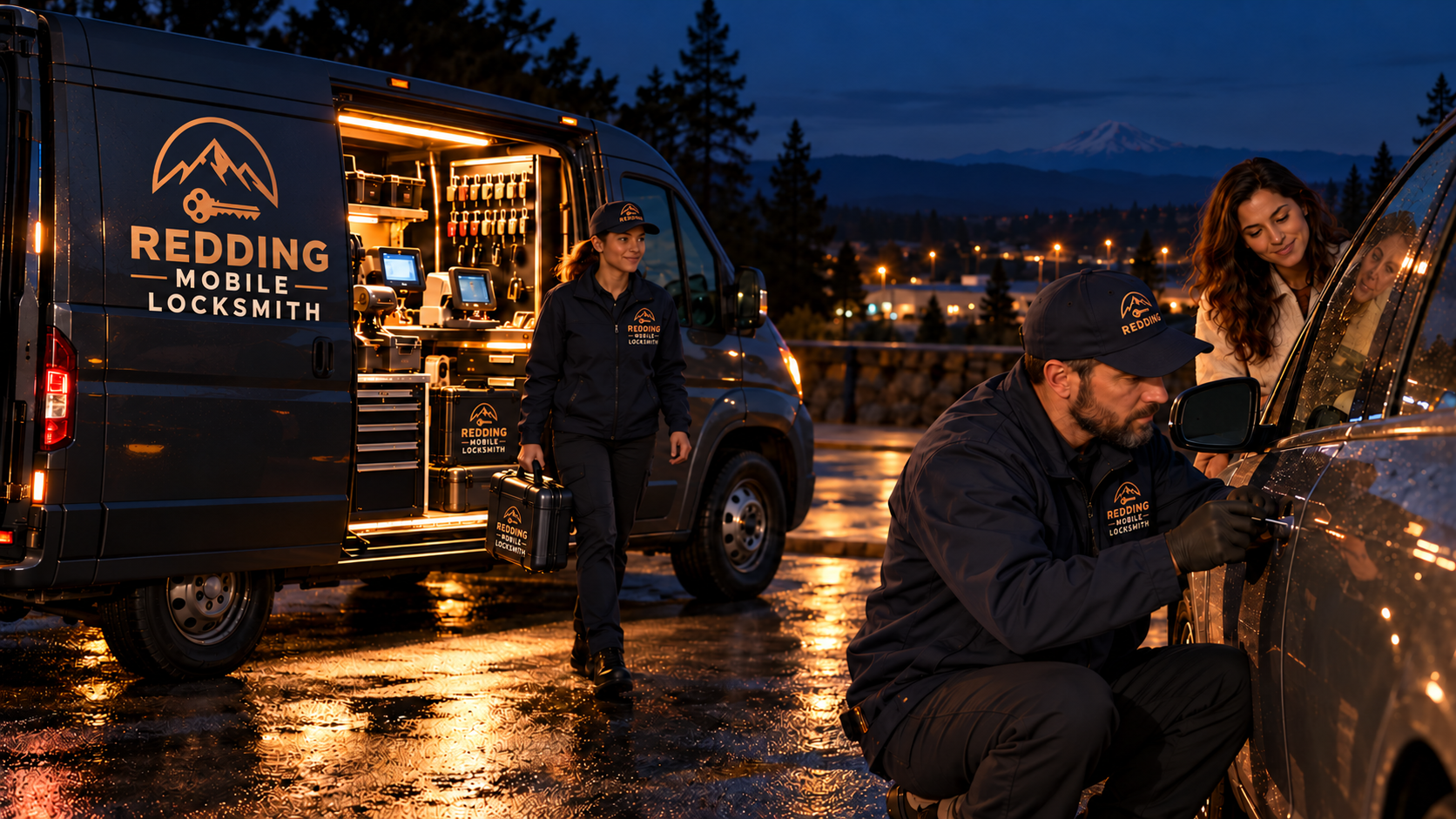
The team travels to you. A branded team in uniforms arrives in a branded service van that carries professional tools, key cutting equipment, and common hardware. We work on business doors across Shasta County and Siskiyou County, in towns from Redding and Anderson to Mount Shasta, Yreka and Weed. See the coverage pages for every community.
Local pages show how this applies in practice, such as business security in Redding and business security in Yreka.
Send a request through our contact page. A phone line is coming soon, and no number is published yet. Describe the door, what it does, and how often it is used. Tell us whether it is glass, metal, or wood, and whether it has a closer or an exit device. A few clear details let us plan the visit and bring the right parts.
Common questions
How often should a business door closer be checked?
Watch each public door weekly to see that it closes and latches on its own. Look closer monthly at screws, the arm and any oil leaks. Adjust seasonally, since cold thickens the fluid and slows closing. Replace a closer that slams or fails to close the door.
Why does my business door fail to latch?
Common causes are a weak or mis set closer, a sagging door, a worn latch, a drifting strike plate or worn weatherstripping pushing back. Diagnosis finds the real cause before parts are changed. A door that does not latch does not lock, so treat it as urgent.
Can an exit device or panic bar be serviced on site?
Usually yes. A locksmith can check the bar, latch, springs and trim, clean and lubricate the mechanism, and adjust it. Exit devices are safety items, so they should never be disabled or blocked. Ask your governing authority about rules for your building.
What can I do if a door will not lock at closing time?
Do not force it or leave it propped. Note exactly what it does, move valuables if you can, and call for help. A locksmith can often secure the door for the night and finish the permanent repair in daylight.
Is a master key system a good idea for a small business?
It can be. Each lock keeps its own key and a master opens all of them, so staff carry only what they need. Rekeying one lock after a staff change does not disturb the rest. It suits shops and offices with several keyholders.
Do you handle glass doors with pivots as well as framed doors?
Yes, hardware on many glass and metal frame doors can be adjusted and serviced on site, including top and bottom pivots, closers and locks. Tell us the door type when you request a visit so the right parts and tools come in the van.