
Home / Services / Vehicle Key Replacement
Vehicle key replacement
Vehicle Key Replacement: When You Have No Spare, and When You Do
Replacing a car key is a different job depending on whether a working key still exists. This page walks through both situations, step by step, so you know what to gather and what to expect.
The one fact that changes everything
Before anything else, answer one question. Do you have another working key for this vehicle? That single fact decides how the replacement goes.
With a working key in hand, the vehicle's computer already knows a valid key. A new one can be cut and added alongside it. With no key at all, the situation is called all keys lost, and the work has an extra stage. A new key must be created from nothing, and the vehicle must be told to accept it.
Neither case is rare. Neither one is a disaster. Keys get lost at trailheads, left in jacket pockets, dropped from belt loops, or worn out after years of daily use. The difference is mainly in the amount of work, and that is why the first question from our dispatcher will be about spares.
Our vehicle locksmith service covers the wider set of automotive work. This page focuses on the replacement of a key itself.
How a modern car key actually works
A key is no longer only a piece of cut metal. Most vehicles built in recent decades carry a small chip inside the head of the key. That chip holds a code. When you turn the key, or press a start button with a fob in range, the vehicle sends a signal and the chip answers. If the code matches one stored in the vehicle's computer, the engine is allowed to start. If it does not match, the engine may crank briefly and then stop, or not crank at all.
This is why a copy that is only cut to the right shape will often open the door and then fail to start the car. The blade turns the ignition, but the chip never says the right words. Our page on transponder programming explains the chip side in detail.
Other key types exist. Older vehicles may use a plain metal key with no chip. Some keys have a thick head with remote buttons built in. Some are a flat fob with an emergency blade inside. Some are smart keys that never touch the ignition. The type decides the method, the equipment, and the steps.
Knowing your type helps. Look at your remaining key, or at the year and model of the vehicle, and tell the dispatcher.
Replacement when you have no spare
When every key is gone, the vehicle cannot offer a sample to copy. The locksmith works from the vehicle itself. First comes proof that you own it. Expect to show registration or title, and identification that matches. This step is not a courtesy. It protects you, because the same procedure that makes a key for you would make a key for a thief.
Next, the locksmith identifies the lock and the key code. The code can come from the vehicle's identification number, from the lock itself, or from records tied to the vehicle, depending on the make and model. A blade is then cut to that code. The cutting is done on equipment that travels in the service van.
Then comes the electronic stage. The new key's chip must be introduced to the vehicle. For many vehicles this happens through the diagnostic port under the dash, using programming equipment. In an all keys lost case, the vehicle often needs to clear old key data and learn new keys as a set. That means any key you find later may need to be re added or may stop working.
The final stage is testing, which we cover below. A key that is cut and programmed is not done until every function works.
Be ready for a few honest limits. Some vehicles protect their security systems more tightly than others, and a few need extra steps or extra time on the day. If your vehicle is one of those, the locksmith will say so early and explain the path, rather than start work that cannot be finished. If a part has to be ordered, you will hear that before work begins, not after.
Keep your documents and your phone close during the process. The locksmith may need to confirm details from the vehicle record, and you may be asked to read information from the dashboard or the door jamb label. Nothing about this should feel hurried. A calm, orderly job is the goal.
Replacement when you still have a spare
A working spare turns the job into a copy rather than a creation. The vehicle already trusts the spare. The locksmith can read information from the existing key, cut a new blade to match, and program the new chip so the vehicle accepts it as well.
This is usually a shorter and calmer visit. The vehicle does not have to be reset for all keys. The old key keeps working. You walk away with two keys instead of one. Some vehicles even allow self programming steps when two working keys are present, though the locksmith will use the proper equipment where needed.
The proof of ownership step still applies. A spare in your hand does not remove the need to show that the vehicle is yours. Bring the same documents you would bring if no key existed.
If you have a spare and one key is lost, there is a further decision. Do you want the lost key removed from the vehicle's memory? If the missing key could be found by someone else, removing it is worth thinking about. Our guide on lost key and vehicle security reprogramming questions explains the choice.
Types of key we replace
Replacement covers several designs. Each has its own method, and the locksmith will tell you which one yours is.
The plain mechanical key has a metal blade only. It is cut to a code and that is the end of it. The transponder key adds a chip in the head and needs programming. The remote head key adds buttons for lock and unlock on the same piece. The switchblade key folds its blade into a fob. The smart key, also called a proximity fob, lets you start the vehicle with a button and often has a hidden emergency blade. Our guide to smart key replacement covers that last type.
Some designs cut the blade on the edge, like a house key. Others cut a groove into the flat side of the blade. The groove type is called a laser cut or high security key, and it needs different cutting equipment. The service van carries cutting and programming equipment for common designs.
If you are unsure which type you have, do not guess. Photograph the key, front and back, and describe the car. A locksmith can usually tell the type from that alone. Do not try to pry open a key head to look at the chip. The case is often glued or clipped in a way that breaks easily, and a broken key head is a harder problem than an unknown one.
- Mechanical keys: cut to code, no chip involved.
- Transponder keys: a cut blade plus a chip that must be programmed.
- Remote head keys: the buttons are built into the key head.
- Switchblade keys: the blade folds out of a fob body.
- Smart keys: proximity fobs with a hidden emergency blade.
What to bring and what to say on the call
Preparation shortens the visit. Have the vehicle's year, make and model ready. Know where the vehicle is. If you have the identification number, usually visible through the windshield at the dashboard corner, read it out. If you have a spare key, say so, and mention what it looks like.
Gather your documents. Registration or title, plus a photo identification, is the standard pair. If the vehicle is a company car or a rental, you will need authorization from the owner. Rules differ, so ask the owner what they will accept. Our guide on proof of ownership for key replacement lists what usually helps.
Tell the dispatcher exactly where the vehicle sits. A garage, a driveway, a roadside shoulder and a parking lot each need different preparation. If it is a rural road after dark, say which road and which direction you were heading. Also see preparing your vehicle information for the call.
Last, say whether the vehicle is also locked. A key replacement and a lockout often arrive together.
Testing every function before you are done
A new key is not finished when it starts the engine once. Testing is part of the work, and you should watch it happen.
Check that the blade turns smoothly in the door lock and the ignition, if the vehicle has a keyed ignition. Check that the engine starts, runs, and restarts after being switched off. Check each remote button in turn: lock, unlock, trunk or tailgate release, panic. Check the proximity function if the key has one, by walking up with the key in a pocket and trying the door handle. Check the trunk or hatch. For a smart key, try the push button start and the emergency blade as well.
Also check the spare. If a second key was made, test it fully too. A spare that has never been tried is a spare you do not know to be good.
Take a moment to look at how the key feels, too. The blade should enter the lock without force and withdraw without catching. The head should sit firmly on the blade with no looseness. A key that feels wrong on day one will feel worse by month six, and it is fair to ask for it to be corrected on the spot.
If any function fails, tell the locksmith before they leave. It is far easier to correct a button or a chip issue at the vehicle than later. Do not accept a key you have not tested. The same careful routine is described on our page about key programming.
Why a spare matters, and when to make one
The cost of a lost key is higher than the cost of a spare, and the difference is mostly in effort. An all keys lost case takes more steps, more equipment and more time than a copy from a working key. Making a spare while one key still works is the calmer path.
Make a spare before a trip, before a season of heavy use, or when your only key starts to wear. Worn keys show signs. The blade is loose in the lock, the plastic is cracked, the buttons stick, or the key works only after wiggling. Our guide on worn key symptoms describes what to watch for.
Store the spare away from the main key. A spare in the same jacket pocket helps no one if the jacket is gone. A trusted person's home is a better place than a magnetic box under the bumper, which thieves know to check.
Where the work happens: your location, not a shop
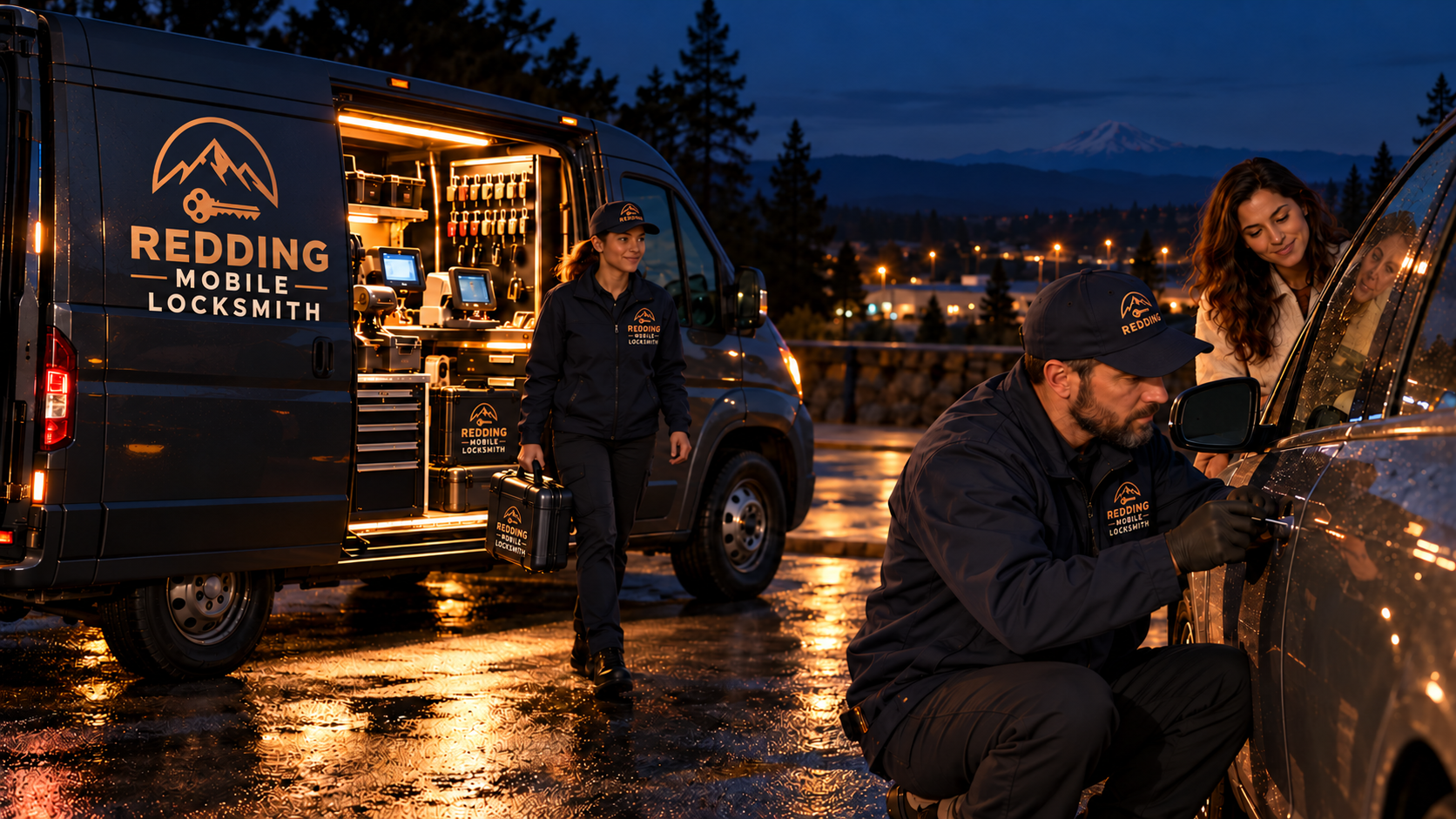
The service is mobile. A branded team in uniforms arrives in a branded service van that carries professional tools, key cutting and programming equipment, and common hardware. The work happens beside your vehicle, in your driveway, at the lot where you are stuck, or at the side of the road.
That matters most when the vehicle cannot be driven. Without a key, towing it to a shop is the usual alternative, and a tow is a bigger expense of effort and trouble. A mobile locksmith removes that step for most vehicles.
Our night work follows the same pattern. See after hours emergency service for the overall night process, and night car lockout if you are also locked out. Local pages show how it applies where you are, such as vehicle key replacement in Redding or vehicle key replacement in Yreka.
If the vehicle is parked somewhere that rules apply, such as a private lot, say so. The property owner may have steps for contractors.
Safety, weather and the long dark stretches
A lost key at night is a safety issue first. Move to a lit, visible spot. If you are on a rural road or a highway shoulder, stay with the vehicle only if it is safe, and use your hazard lights. If traffic is close, stand well away from the road.
Climate matters here. Valley summers are hot, and a parked vehicle without climate control gets uncomfortable in time. Mountain winters bring snow and cold in towns such as Mount Shasta, McCloud and Weed, and a long wait in a cold vehicle is a risk of its own. Tell the dispatcher about the weather where you are.
If a child or a pet is locked inside a vehicle, call emergency services first, before anyone else. Do not wait for a locksmith. Our guides on a child inside a locked car and a pet inside a locked vehicle explain why.
After the new key works
Once the key is tested and handed to you, a few follow up steps are worth doing. Put the spare somewhere safe. Write down where you keep it. If a key was lost, consider whether the vehicle should forget it, and whether any other locks, such as a house key on the same ring, need attention.
If your lost key was on a ring with a house key, the house now has a key in unknown hands. Our rekey locks page explains how to change the lock so the old key stops working.
If you would rather plan ahead than call at night, send a request through our contact page. A phone line is coming soon, and no number is published at this time. Describe the vehicle, the key type, and whether a spare exists, and we will work from there.
Common questions
Can you make a car key if I have lost every key?
Often yes. With no key to copy, the locksmith proves ownership, identifies the key code, cuts a blade, and programs a chip so the vehicle accepts it. The method depends on the make and model. Tell the dispatcher the year, make and model so the right equipment comes.
Is it simpler if I have a spare key?
Yes. A working spare gives the vehicle a key it already trusts, so a new key can be cut and added alongside it. The old key keeps working, and the visit is usually shorter. You still need to show you own the vehicle.
What proof of ownership will I need?
Plan on registration or title plus photo identification that matches. For a company vehicle or a rental, the owner may need to authorize the work. Requirements vary, so ask the owner or your insurer what they accept before the visit.
Will my old key still work after replacement?
It depends on the case. With a working spare, usually yes. After an all keys lost job, the vehicle often clears old key data and learns new keys as a set, so older keys may stop working. Ask the locksmith what will happen to any key you find later.
Do you replace smart keys and key fobs?
Many are handled by a mobile locksmith, depending on the vehicle. Smart keys need programming equipment and sometimes extra steps. Give the dispatcher the year, make and model, and say how the key starts the car, with a blade or a start button.
What if a child or pet is locked inside the vehicle?
Call emergency services first. Do not wait for a locksmith. Tell the emergency dispatcher your exact location and that someone is locked inside. After the emergency is handled, we can help with the lock and any replacement key.