
Home / Contact
Request service
Contact Redding Mobile Locksmith After Dark
The request form below is the way to reach us today. The call line is coming soon. Here is what to have ready, how to describe a lock or key problem, and what happens once your request is in.
Start with the request form
The request form on this page is the working way to reach Redding Mobile Locksmith right now. It sits at the request section of this page, and it is built for the middle of the night as much as the middle of the day. Short answers are fine. A clear location and a plain description matter more than polished wording.
Fill in what you can and leave the rest. If you are standing outside in the cold, you do not need to write a story. Two or three lines about where you are and what is wrong give the dispatcher enough to begin. Anything missing can be asked back to you once the request is read.
Expect a few plain questions after you send it. That is normal and it is how the dispatcher makes sure the right person with the right tools comes to the right place. Think of the form as the first half of a conversation, and keep your phone nearby so you can answer when the follow up arrives.
Use the form for any of the work we do: a locked car, a locked house, a lost or damaged key, a lock that has stopped working, or a planned job such as rekeying. The same form covers all of it, and you can tell us in the first line which one you are dealing with.
About the call line
We know many people would rather talk to a person. The phone number for the call line is not published yet. It is coming soon, and this page will be updated when it is ready. Until then, please do not hunt for a number on other sites and assume it belongs to us.
That is a real safety point. When someone is locked out at night, the first number that appears in a search is not always the right company. Lock out searches attract lookalike listings. If you did not get a number from this site, treat it with care, and ask any caller who they are and which company they represent.
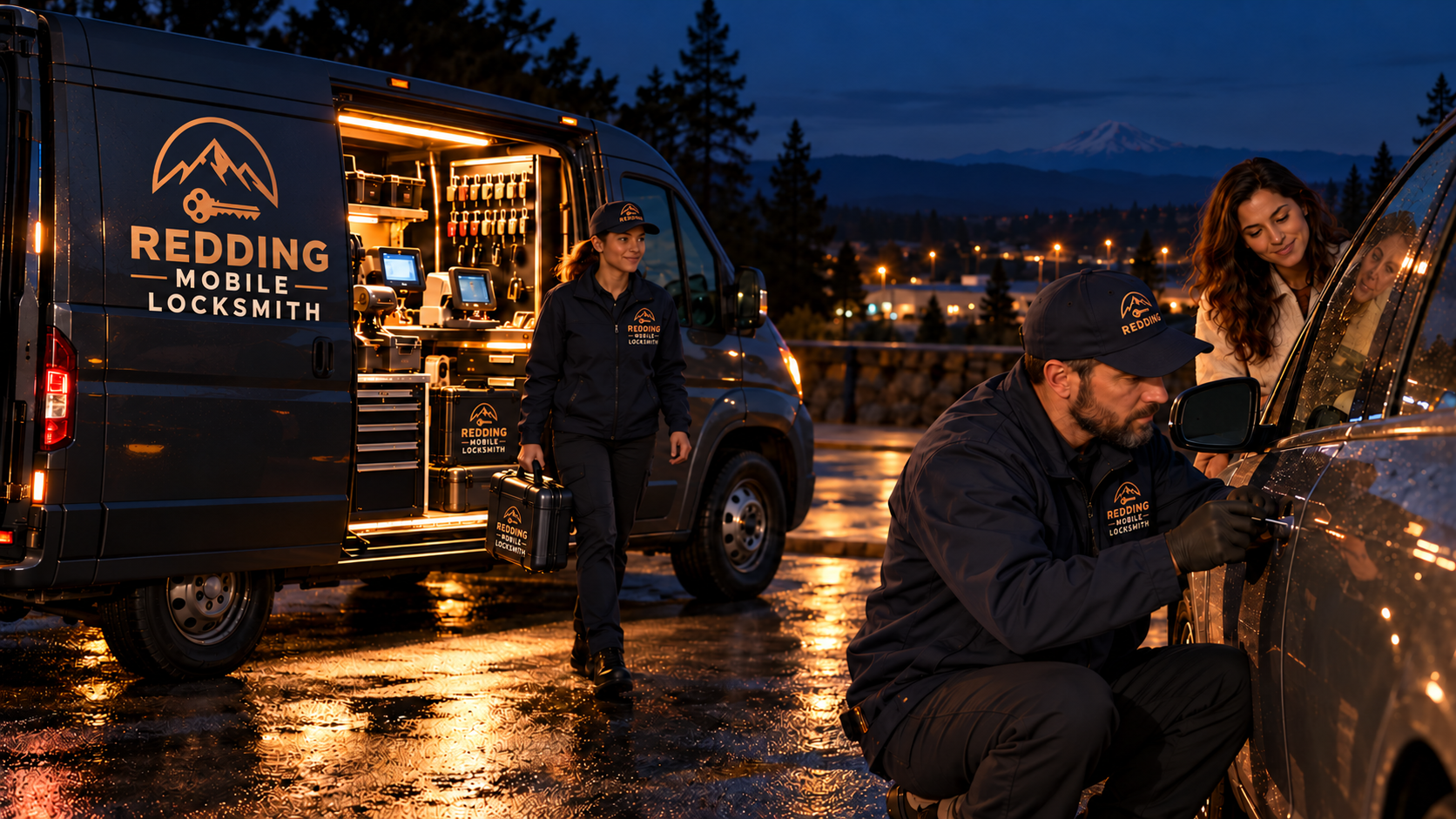
Email and street address are also not published. Everything starts with the request form. Nothing about that changes the work itself. The team is a branded crew in uniforms with a branded service van, and the van carries the tools, key cutting and programming equipment and common hardware the work calls for.
Give your location first
Location is the single most useful thing you can send. Name the community from our service list, such as Redding, Anderson, Shasta Lake, Mount Shasta or Yreka, and then describe the exact spot as you would to a friend picking you up. Say whether you are at a home, a business, a roadside, a lot or a trailhead.
Rural and mountain places need extra care. A long private road, a gate, a turnoff along Interstate 5 or a spot on Highway 299 or Highway 89 can all be confusing in the dark. Mention gate codes only if you are comfortable sharing them, and say what a driver will see first, such as a mailbox, a sign or a lit porch.
If your phone has a map pin, note the nearest highway and the direction you were traveling. If you are in a car, say which side of the road you are on. If you are at a building, say which door. These small details save a lot of back and forth when every minute outside feels long.
Describe the lock or key problem in plain words
You do not need the trade vocabulary. Say what happened and what you see. Keys are inside the car. The key turns but the door will not open. The key broke off in the lock. The deadbolt spins loose. The fob stopped working. Each of those points to a different cause, and a plain sentence is more useful than a guess at a technical name.
Tell us what you already tried, and be honest about it. If you pulled hard on a handle, forced a key, sprayed something into a lock or tried to pry a door, say so. That helps the locksmith plan the work and avoid surprises. Damage from forcing a lock is common, and nobody will judge you for it.
If the problem is new, say when it started. A lock that failed after a cold snap, a key that has been wearing for months and a lock that stopped after a break in attempt each tell a different story. A short timeline is often the most valuable line in the whole request.
- Say where the keys are, if you know.
- Say whether the door is closed, ajar or damaged.
- Say whether anyone or anything is inside.
- Say what you already tried.
- Say what you need: entry, a new key, a repair or a new lock.
Vehicle details to have ready
For a car, truck or van, have the make, model and year in front of you. Trim level and whether the vehicle uses a push button start or a turn key can matter too. If you can see the vehicle identification number through the windshield or on paperwork, keep it handy. It is a reliable way to confirm the right key.
Tell us how many working keys exist. A single remaining key and a lost key situation are not the same job, and the answer changes what equipment is needed. Say whether the key is a plain metal blade, a chipped key with a plastic head, a flip key or a smart fob.
Put the car in its safest state before you contact us. Move it out of traffic if it is running and you can do so. Take valuables with you. Stay near it only if you feel safe, and read our guide on preparing your vehicle information for the call for a fuller checklist.
Home and business details to have ready
For a house or apartment, say whether you own it, rent it or manage it. Tell us the type of door, such as a front door with a deadbolt, a patio slider or a side door to a garage. Say whether the lock is a key lock, a keypad or a smart lock, and whether it is the main entry or a back door.
Add anything that changes the picture: a dog in the yard, a baby asleep inside, a vehicle parked behind a gate, a lock that has been sticking for weeks. These details help the locksmith bring the right hardware and plan a calm approach. They also tell us whether the visit is a simple entry or a repair that needs parts.
For a business, say who is allowed to authorize work and whether you are the owner, a manager or an employee. Describe the door: glass storefront, metal back door, office suite or gate. If there is an alarm, say so, because forcing a door can trigger it and nobody wants a second emergency.
If a landlord, property manager or building owner has to approve the work, say that clearly. Rules about who may change or open a lock vary from place to place and from lease to lease. We will not tell you what your lease says. We will ask you to confirm you have the right to request the work.
What you may be asked to show
A locksmith opens a lock for a person who is entitled to be inside. That is why you may be asked to show identification, and why you may be asked to show that you own or lawfully use the vehicle or property. This is routine and it protects you as much as anyone else.
For a vehicle, ownership paperwork or registration with a matching name is a common request. For a home, something with your name and the address on it may do. For a business, a person with authority over the premises is needed. Read why a locksmith may ask for identification to see how this works.
Have the documents where you can reach them before you contact anyone. A driver's license in a wallet is useless if the wallet is locked in the vehicle. Think about a phone photo of registration, a lease or a utility bill kept in a safe place. Those copies are not always accepted, but they give the locksmith something to work with and they save a long wait.
If you cannot show proof right now, say so in the form and explain why. A wallet locked in a car is a common reason. The dispatcher can tell you what other options exist. Please do not try to talk around the question. A professional who skips it is not working in your interest.
Safety before you hit send
Your safety comes before any lock. If you are in danger, call emergency services. If a child or a pet is inside a locked vehicle, call emergency services first, before you contact any locksmith. A heat or cold emergency inside a car moves sooner than any visit can.
If you are alone at night in a quiet lot or on a dark road, stay in a lit place with other people if you can. Lock your phone screen so it is not an easy grab. Keep your remaining belongings with you. Tell someone you trust where you are. Our guide on a safety first plan for being locked out at night walks through this in order.
Keep the form short if your battery is low. A single line with your location and a plain note on the problem is better than a long message that never sends. Charge the phone as soon as you can, and keep it near you, because the next step may require you to answer a message or a call.
What happens after you send the request
The dispatcher reads your request and checks it against the communities we serve. If something is missing, such as which door or what vehicle, you will be asked. Then the work is matched to the right kind of visit, whether that is a lockout, a key made on site or a repair or installation.
When the team arrives, the person at the door should be in a uniform and the van should carry the company branding. You may ask who they are and to confirm the details of your request before any work begins. Our guide on confirming who is arriving at your door explains what to check.
Before work starts, the locksmith explains what will be done and what is needed from you. Only start when you understand it. If something does not feel right, you are allowed to say no and wait. A calm, clear process is part of what you are paying for.
Information that stays off the form
Keep sensitive details out of the request. Do not type card numbers, bank details, passwords, alarm codes or full identity numbers into the form. None of that is needed to start. If a payment is discussed later, it happens in person with the locksmith, once the work is understood and you have agreed to it.
The same goes for photos and long documents. A short written description does the job at this stage. If an image of a damaged lock or a key would help, the dispatcher will ask for it. Until then, a few clear words are safer and easier to read on a small screen in poor light.
If you are asked for something that feels wrong, such as a payment before anyone has seen the job, or a code that opens your property, stop and think. A legitimate request for service rarely needs more than your location, your contact detail, a description and later, proof that you are entitled to the work.
Finally, be careful with what you post publicly while you wait. A message that says you are stranded at a certain place with your keys locked in can be seen by people you did not mean to tell. Share your location with the dispatcher and with people you trust, and keep the rest quiet.
Planned jobs and non urgent questions
Not every request is an emergency. If you want a lock rekeyed after a move, a new deadbolt installed, a spare key cut or door hardware checked at a shop, say so in the form. Planned work can be arranged around your schedule and does not need to happen at night.
Read about rekeying and installing new locks first if you are unsure which one you need. Rekeying changes what key works in a lock you already have. Installing replaces the hardware. The choice depends on the condition of the door and what you want to change.
Business customers can use the same route for planned security work. Door closers that slam, strikes that no longer catch, panic bars that stick and cylinders that have been shared among too many people are all worth raising. See business door hardware and business security for how that work is approached.
Questions are welcome too. If you are not sure what kind of key your vehicle uses, or whether a lock can be repaired, ask. Mention your community and what you see, and let the dispatcher say what information would help. You do not need to commit to anything just by asking.
Common questions
Is there a phone number I can call right now?
Not yet. The call line is coming soon and this page will carry the number as soon as it is published. For now, use the request form on this page. Please be careful with numbers found elsewhere online, because lookalike listings often target people who are locked out at night.
What should I write in the first line of the form?
Write where you are and what is wrong. For example, name the community, say it is a car or a house, and state that the keys are locked inside or that a key broke. A short, specific first line lets the dispatcher understand the situation before reading the rest.
Do I need to know technical lock terms?
No. Plain words are better than guessed terms. Say that the key turns but the door will not open, or that the deadbolt feels loose. If you can, mention the type of door or the vehicle model, and let the locksmith work out the technical side when they see it.
Will I be asked to prove the car or home is mine?
Most likely, yes. A professional opens a lock only for someone entitled to be inside, so identification and some proof of ownership or lawful use are normal. If you cannot show proof, explain why in the form and the dispatcher will tell you what options exist.
What if a child or pet is locked in the car?
Call emergency services first, before anything else, and follow their instructions. Heat and cold can become dangerous before help can arrive, and emergency responders are the right first call. Once the situation is safe, you can send a request for the lock itself.
Can I use the form for work that is not an emergency?
Yes. The same form handles planned jobs such as rekeying after a move, installing a new deadbolt, cutting a spare key or checking door hardware. Say that it is not urgent and what you would like done, and the work can be arranged around your schedule.
Start here
Send the essential details.
The dispatch line is coming soon. Share the details here and we will take it from there.