
Home / Services
Services overview
Twelve locksmith services, and how to choose the right one
This page lays out every service Redding Mobile Locksmith offers, from a late night lockout to a full set of business door hardware, and gives you a simple way to decide which one fits your situation.
How the twelve services fit together
A locksmith does a few things well, and they all connect. Someone opens a door. Someone makes or programs a key. Someone fits, repairs or changes the lock. Twelve pages sound like a lot, but they are really three groups of work seen from different angles.
The first group is about getting in. The second is about keys, mostly for vehicles. The third is about the lock itself and the door around it. Business work sits across all three, because a shop or office has the same needs as a home, only with more doors and more people.
Each service has its own page with a specific lens. One walks through the first ten minutes of a lockout. One explains how to tell a key problem from a car problem. One takes you around a house and points at every lock. Pick the page that matches the question in your head.
The order of the pages matters less than the question behind them. A good habit is to read the page for your situation, then one neighbor page. Someone with a lost car key will benefit from vehicle key replacement and then transponder programming. Someone with a stuck deadbolt will benefit from broken lock repair and then new lock installation.
Services for when you are locked out
After hours emergency is the broadest page in this group. It describes the first ten minutes of any lockout: what to check, what to avoid and what to prepare. Read it first if you are not sure whether your problem is a car, a house or a business door.
Night car lockout narrows to vehicles, where keys sit on a seat or in an ignition, a door is locked behind you or a fob has stopped working. Night house lockout covers the same situation at a home, where the main questions are which door, which lock and who else holds a key.
The principle is the same in each: stay safe, stay visible and do not force anything. A professional opens the lock with the right tool and without leaving damage. A forced entry often costs more than the original problem.
In practice, most night calls begin with a person who is cold, tired and a little embarrassed. There is nothing to be embarrassed about. Keys get left in cars, doors close harder than expected and a jacket pocket is not a safe home for a fob. The point of the emergency pages is to turn the moment into a short list of actions.
- Locked out of a vehicle, with keys inside or out of reach.
- Locked out of a house, with a door that clicked shut behind you.
- Locked out of a building after the last person left.
- Locked out because a lock has jammed or a key has snapped.
Services for keys
Vehicle key replacement is for a lost, stolen or broken car key. It explains what the process looks like when no working key exists, and why it takes more than cutting metal. Transponder programming explains the small chip inside most modern keys and how it is introduced to the vehicle.
Vehicle locksmith is the wider view. It helps you decide whether the trouble you are having is actually a key problem. A car that cranks but will not start, a key that turns hard or a door that unlocks only sometimes can all point to the key, and the page explains how to tell.
If you only have one key, treat that as a problem to solve before it becomes an emergency. A spare made while you still have a working key is simpler than a key made from nothing. The guide on spare keys makes the case in plain terms.
A vehicle key has two jobs. It has to turn the mechanical parts, such as the door lock and the ignition, and it often has to prove itself to the vehicle's computer. A lost key therefore leaves two gaps to fill, one physical and one electronic. The key pages explain both, so the process makes sense before it begins.
Because both gaps matter, a key made at the roadside can still depend on facts about the vehicle: make, model, year and the type of key it uses. Have those facts ready, as the vehicle information guide describes, and the conversation stays short.
Services for locks and doors at home
Home locksmith is a walk around the house. It starts at the front door and moves through the back door, garage entry, side doors, sliding doors and windows, naming the lock or latch at each. It is useful whether you are buying, selling, renting or simply wondering what you have.
Rekeying changes the inside of a lock so that old keys no longer work, without replacing the lock itself. It makes sense after a move, after a breakup, after a lost key or any time you are not sure who holds a copy. Broken lock repair is for a lock that sticks, spins, jams or no longer latches.
Install new locks is for the time a lock is worn out or the door needs an upgrade. It covers what to look at when you choose a deadbolt, how the door and frame affect the result and what a good installation includes.
The house pages share a theme: a lock is only as strong as the door, the frame and the strike plate around it. A fine deadbolt in a weak frame does little. That is why the walk around the house includes the hinges, the screws and the gap between the door and the jamb, not only the cylinder in the middle.
Rental homes and shared spaces raise a few extra questions. Who owns the lock? Who is allowed to change it? Rules vary, so ask the owner or the property manager before any change, and tell the team what you learn.
Services for businesses
Business security looks at property access as a system. A building with several doors, several tenants and several schedules needs a plan: who has which key, what happens when someone leaves and how to keep a record. The page explains how to think about it before you buy any hardware.
Business door hardware gets into the mechanics. Closers, strikes, panic bars, exit devices and commercial locks all behave differently from the parts on a house door. The page explains what each part does and what to ask when one fails.
Many business calls start as emergencies and end as projects. A shop owner locked out at closing time wants the door open tonight. The better outcome is a plan so it does not happen again. We help with both parts.
Many businesses keep their keys the way a household does, in a drawer, with no list of who holds what. That works until it does not. A sound key plan names each key holder, each door and each date. It is not complicated, and it turns a mystery into a record.
The business pages also talk about schedules. A door that must be open to the public by day and secure by night needs hardware that supports both. A closer that is set too hard, or a strike that is slightly out of line, can make a good lock look broken.
A simple way to choose
Ask what is wrong right now. If you cannot get in, you want an emergency page. If you can get in but something is broken, you want a repair page. If everything works but you worry about who has keys, you want a rekey or business security page. If you need a key that does not exist yet, you want a key page.
Then ask where it is. A vehicle at a roadside, a house door or a shop front each send you to a different page. The location also shapes the safety advice, since a dark pullout carries different risks from a driveway.
If two pages seem to fit, read both. The pages are short enough to read in one sitting. When you are ready, use the request form and describe your situation in the same words you used to decide.
If you read the lists above and still feel unsure, take the quiet route: send the request, describe the symptoms in your own words and let the answer come back. A short exchange costs less than a wrong guess, and nobody here will tell you that your question was too small.
- Cannot get in: start with after hours emergency, night car lockout or night house lockout.
- Need a key: start with vehicle key replacement or transponder programming.
- Lock is broken: start with broken lock repair.
- Worried about copies: start with rekey locks or business security.
What the van carries
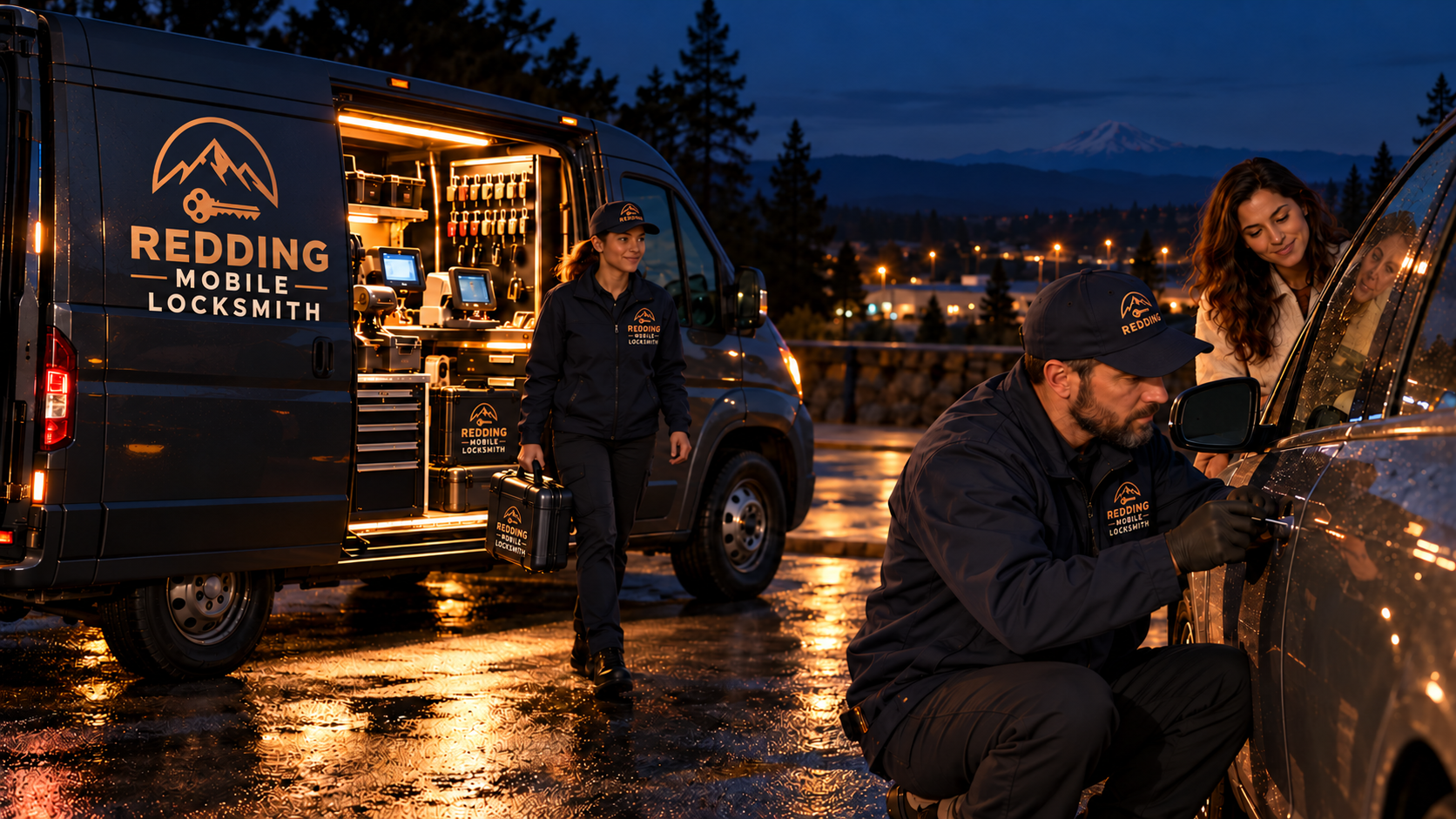
Mobile work depends on what is in the vehicle. The branded service van carries professional tools, key cutting and programming equipment, and common hardware. That means many jobs can be finished at your location without a second trip.
Some jobs still need a part that is not in the van. Unusual lock models, older hardware and specialty keys can take a second visit. When that is the case, you hear it before work begins, along with what the plan is.
The team arrives in uniform. You are welcome to check that what you see matches what you were told. The guide on confirming who is arriving at your door describes simple checks that take only a moment.
The van's equipment list is a practical matter, not a boast. A van that carries key cutting and programming equipment can make a key at your location. A van that carries common hardware can replace a broken latch on the spot. Both save a journey for you, which matters most when it is dark and cold.
Where the services apply
Every service is available across seventeen communities. In Shasta County those are Redding, Anderson, Shasta Lake, Cottonwood, Palo Cedro, Millville, Lakehead and Sims. In Siskiyou County they are Mount Shasta, Yreka, Dunsmuir, McCloud, Weed, Granada, Montague, Fort Jones and Etna.
The coverage page groups them by corridor and gives ZIP codes. Read it if you are unsure whether your address falls inside the area. Rural properties with long roads and gates are common, so a clear description of your location counts for a lot.
Seasons change the work. Summer heat in the valley raises the stakes on a locked vehicle. Snow and ice in the mountain towns affect locks, door seals and the way a van can reach you. Keep that in mind when you describe your problem.
Travelers deserve a note. Highways 5, 299, 44, 89, 97 and 3 bring people through the region who do not know the towns. If you are a visitor, name the highway and the nearest community when you describe where you are, and say what the surroundings look like. That is enough to start a plan.
Guides that go with each service
The after dark library has seventy guides that pair with the services above. Before a lockout call, the dispatcher checklist helps you describe your location. Before a key call, the proof of ownership guide helps you gather what you will need.
For vehicles, the transponder keys guide and the smart key guide explain the technology. For homes, the bedtime lock check gives you a nightly routine, and the guide on deadbolts and door frames shows what to look at.
Businesses can start with the guide to a commercial building lockout. It sets out who to contact, what to prepare and how to keep the property safe while you wait.
These links are meant as a starting shelf, not a maze. Pick one guide, read it through and use the links inside it to continue if you want more. Every guide ends with the same kind of questions, so you can compare answers if two guides seem to disagree.
Safety comes before service
A locksmith can open a door. A locksmith cannot rescue someone from a hot car or a dangerous situation. If a child or a pet is locked in a vehicle, or anyone inside a building is in trouble, call emergency services first and stay on the line. Everything else can wait.
Keep your own safety in mind while you wait for help. Stay in a lit, visible place. Keep your phone charged. Tell someone where you are. If you feel unsafe, move to a safer spot and update your request so the team knows where to find you.
Do not accept help from a stranger who offers to open your door with improvised tools. The risk of damage and the risk of an unwanted entry are both higher. Wait for a professional who can explain what they plan to do.
Even when the cause of a lockout is minor, such as a bag put down in the wrong place, the sequence of safety steps is the same. Stop, look around, protect yourself, make the call. Calm repetition is a skill, and the pages are written to help you practice it before you need it.
Making a request
The telephone line is coming soon. Until it is published, requests go through the form on the contact page. Tell us where you are, what is locked, what kind of lock or vehicle it is and how to reach you.
After you send it, stay near your phone and stay where you said you would be. If your situation changes, for example you find a spare key or a friend arrives with one, tell the team so no one makes a trip for nothing.
The about page explains how the service is organized and what has yet to be published. The contact page lists what to have ready.
Before you leave this page, it may help to decide which service you would call for first if something went wrong tomorrow night. Write the answer down. A plan that exists on paper is worth more than a plan you have to invent while standing in the cold.
Common questions
Which service should I pick if I am not sure?
Pick the one that describes what is wrong right now. If you cannot get in, choose a lockout service. If you can get in but a lock misbehaves, choose repair. If you only need to know who holds copies, choose rekeying. When in doubt, describe the situation on the request form and the right path will be named.
Do all twelve services work at night?
The service is a 24 hour operation. Emergency work is the most common thing at night, but key work and lock work can also be requested at any hour. Some jobs, such as hardware installation, are easier in daylight, and you will be told when waiting makes the result better.
Can one visit cover more than one service?
Often yes. A person who is locked out of a house may also want a rekey while the locksmith is there. A car owner may need a lockout opened and a spare key made. Say what you want on the request, and the plan can be set before the van arrives.
Do I need to know what lock or key I have?
Not exactly. A clear description is enough: front door deadbolt, back door knob, car make and year, push button start or key. If you can take a photo of the lock, even better. The team will identify the exact type on arrival and explain what it means for the job.
Is business work different from home work?
The locks may look similar, but the parts around them differ. Commercial doors use closers, strikes, exit devices and larger cylinders. More people also share a key plan. The business pages cover those differences, and the home pages stay focused on household needs.
What if my service is not on the list?
Describe it on the request form anyway. The twelve services cover the usual work, but locks come in many forms. The team will tell you plainly if something falls outside what the van can handle and will not guess about it.