
Home / Services / After Hours Emergency
Emergency service
After hours emergency locksmith: the first ten minutes of a lockout
The first ten minutes decide how the rest of a lockout goes. This page lays out what to check, what to avoid and what to prepare, in the order a composed dispatcher would give them to you.
Start with safety, not the lock
Before you think about the door, think about yourself. Where are you standing? Is there light? Are other people nearby? Is the ground safe, the road quiet, the weather tolerable? A lockout is not an injury, and nothing about it is worth taking a risk.
If you are in a dark lot or on a roadside, move toward light and toward other people if you can do so safely. Keep your vehicle in sight if it is yours. Switch on your phone flashlight so that anyone who stops can see you. Tell a friend or family member where you are, and keep that message simple.
If a child, a pet or any person is locked inside a vehicle or a building and may be in danger, stop reading and call emergency services. A locksmith is a good second call and the wrong first one. Everything else on this page can wait until that situation is settled.
Think about the small things too. Put on a coat if you have one, drink water if you have it and sit down if you are tired. A person who is cold and tense makes poor choices. The calmer you are, the clearer your request will be, and the easier it is for the team to help. Speak slowly when you describe your location, and repeat it once.
If you are with other people, give each a job. One person watches the road, one keeps the phone, one checks the spare key options. Shared tasks turn worry into action and keep everyone in a safe spot instead of wandering.
Check what you can check without tools
Most lockouts have one more door than you think. Walk around the vehicle and try every handle, including the trunk or tailgate. Try each door of the house, including the garage entry, the back door and any slider. A door that was left unlatched, a window that is not locked or a spare key under a mat can end the problem in one moment.
Look at the keys you have. Is the fob in your pocket, or are you assuming it is? Pat down your coat and bag slowly, in a light you can see by. Many night lockouts come from a key that sat in a different pocket than the one you checked in a hurry.
Think about who else might hold a key. A family member, a housemate, a neighbor, a landlord or a property manager can often help sooner than any service. Make that call while you wait, because a person nearby with a spare is the simplest answer there is.
Take a mental inventory of what is inside. Are the keys visible through a window? Is the engine running? Is a bag, a phone or a wallet in there? Those answers shape the plan. A running engine, for example, calls for a different set of precautions than a parked car, and the guide on keys locked inside a running car explains why.
If you left the keys in the house and are locked out of the car, or the other way round, the question changes to which of the two is easier to open. A locksmith can explain the options when you describe the setup.
- Try every door and the trunk or tailgate.
- Check each pocket and bag under a proper light.
- Think about who holds a spare and call them.
- Look for an open window only if reaching it is safe.
What to avoid in the first minutes
The urge to do something is strong, and it causes most of the damage in a lockout. Do not force a door, a window or a handle. Do not wedge tools into a gap. Do not break glass unless it is a real emergency and emergency services have told you to. A broken window costs more than almost any locksmith visit.
Do not use hot water on a frozen lock or on frozen glass. It refreezes and can crack the glass. Do not spray random lubricants into a lock cylinder, because some leave a film that gathers dirt and makes the lock stick again. And do not take advice from a stranger who offers to open it with improvised tools.
Do not leave the scene to look for a spare unless you are sure the vehicle or home is safe to leave. An unlocked door that you walked away from is also an invitation. If leaving is unavoidable, tell someone and lock what you can.
Beware of the helpful stranger. Someone who stops and offers to open your door with a wire or a wedge may mean well, but the result is often damage to weather seals, wiring or the lock itself. A modern car door contains cables, sensors and airbag wiring, and none of that likes a hook.
Equally, be wary of tempting shortcuts you find online. Methods that appear in videos are often tied to older vehicles and do not work on newer ones. Do not let a hopeful video persuade you to try something that could cost a window or a door panel.
What to prepare while you wait
Preparation turns waiting into progress. Write down your exact location, using a road name, a landmark and a direction of travel. The guide on what to tell the dispatcher has a full checklist, and it is worth a read: what to tell the dispatcher.
Gather what you know about the lock or vehicle. For a car, that means make, model, year and whether it has a push button start. For a door, it means the type of lock, whether a deadbolt is thrown and whether the door opens in or out. This vehicle information guide shows where to find the details.
Think about proof. A locksmith should confirm that you are entitled to enter before any work begins. A driver license with a matching address, a vehicle registration seen on your phone or a lease and a utility bill can all help. The proof of ownership guide sets out the usual items.
If you have a pen and paper, write the key facts down. If you only have a phone, use the notes app. Include the location, the vehicle or lock details, your name and the time you first noticed the problem. A written record is easy to read aloud and easy to correct.
Photograph the lock or the vehicle if you can do so safely. A clear picture of the door, the keyhole or the dash can answer questions that are hard to answer in words. Do not take photos of documents unless you are asked to share them, and never post them publicly.
Sending the request
The telephone line is coming soon and is not published yet. For now, use the request form on the contact page. Give your town, your location, what is locked and how to reach you. Add anything about the weather or the surroundings that the team should know.
Short, plain lines work well. For example: "Locked out of a pickup, key on the seat, push button start not involved, parked at a gravel pullout off a highway, phone battery low." Saying that your battery is low is useful, because a team can plan around it.
After you send it, stay near your phone and stay where you said you would be. If you move, update the request. If you find a key, say so. A short message saves a trip and keeps the line open for someone who needs it.
Good requests share three qualities. They are specific, because a vague location wastes time. They are honest, because a team that knows the weather and the risks can prepare. They are current, because a changed situation is worth a one line update. Treat the request like a short note to a friend who is coming to help.
If the form asks for something you do not know, say so rather than guessing. A guess that turns out wrong costs more than an honest gap. The team would rather hear that you do not know the year of the car than be told the wrong year.
What an emergency visit looks like
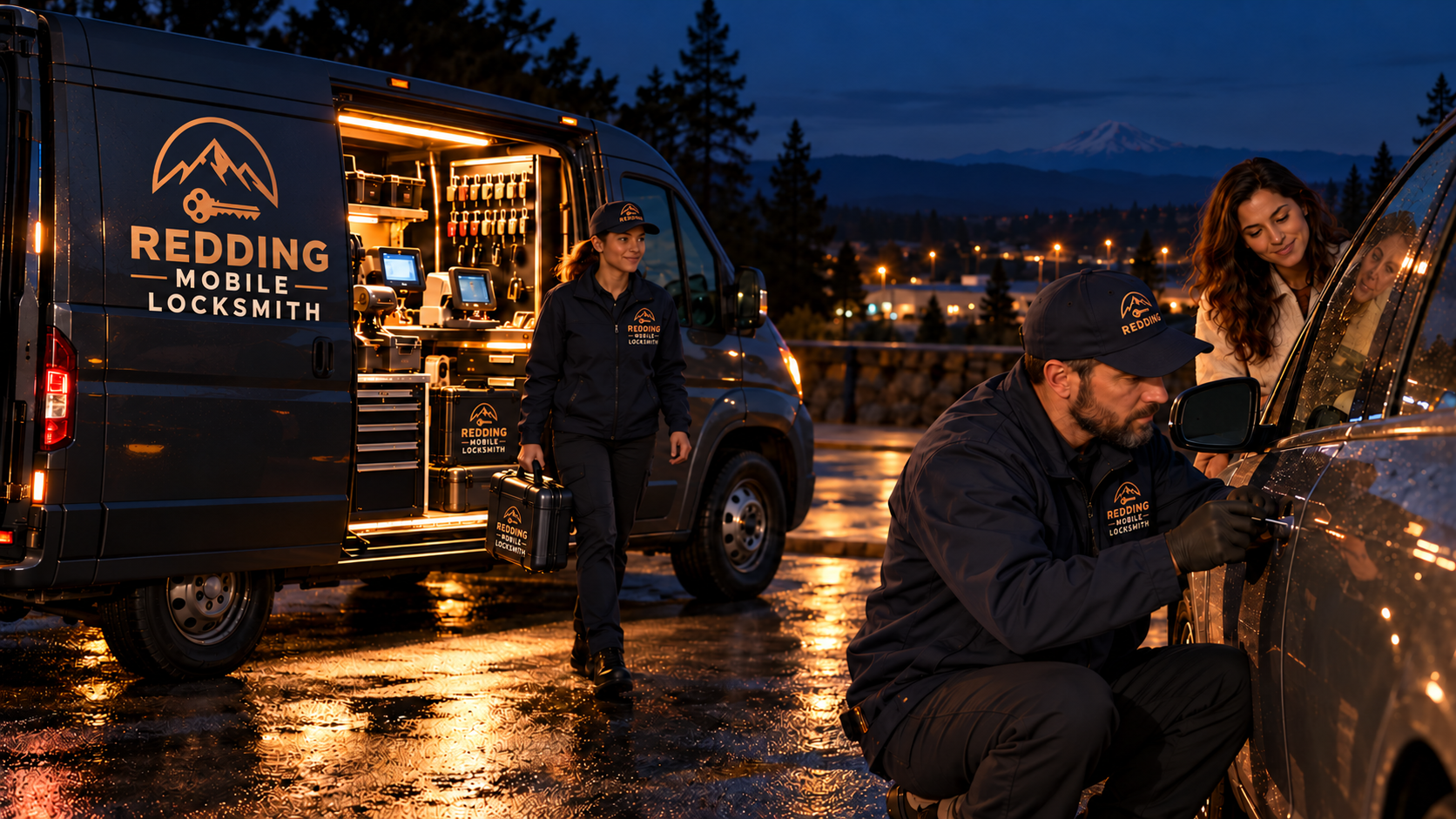
The team arrives in uniform in a branded service van. The van carries professional tools, key cutting and programming equipment and common hardware, so most problems can be handled on the spot. You can check the uniform and the vehicle against what you were told. The guide on confirming who is arriving lists the checks.
Before any work, the locksmith asks for proof that you are entitled to get in. This is for your protection as much as anyone else. A good locksmith explains what the job involves and what the plan is, and waits for your agreement. If the plan changes, you hear about it first.
The opening itself is usually unremarkable. A trained person uses the right tool for the lock, and the door opens without damage. If a lock has failed or a key has broken, the visit may continue with repair or replacement. You decide how far to go that night and what can wait for daylight.
Questions are welcome during the visit. Ask what the plan is, what will be done to the lock and what the options are for key replacement. If you do not understand a term, ask for it in plain words. A person who explains clearly is a person who respects you.
Keep your own belongings in view while the work goes on, and keep the area clear. If you are in a house, keep pets and children at a safe distance from the door. If you are in a lot, stay clear of the van's work area, and let the team do the work in peace.
Cars, houses and businesses are different problems
A vehicle lockout often involves a key on a seat or a fob that has stopped working. See night car lockout for the specifics, and vehicle locksmith if you suspect the key itself is the problem. A house lockout involves doors and latches, and night house lockout explains what to check at each one.
A business lockout is different again, because there may be an alarm, several doors and a manager who needs to know. Business security explains how to think about it, and the guide on commercial building lockouts after hours sets out who to call.
In every case the same first ten minutes apply. Safety, checks without tools, nothing forced, information gathered, request sent. Only the details of the lock change, and the details are for the professional to handle.
One more cross reference may help. If you suspect that the key itself is failing, the broken lock repair page explains the difference between a worn key and a worn lock. If the trouble is chiefly a missing key, vehicle key replacement and transponder programming describe what follows after the door is open.
Weather and place change the plan
In the valley around Redding, summer nights stay warm and a closed vehicle holds heat. In the mountain towns, a cold night can mean frozen locks and numb hands. The guides on summer heat and frozen door locks deal with each.
Rural spots add distance and darkness. Near Anderson and Shasta Lake the Interstate 5 corridor offers lights and traffic, but a side road a short way off can be very dark. The rural road guide explains how to mark your position.
Mountain terrain affects phone signal. If you have to climb to find coverage, do it carefully and tell someone where you are going. Do not leave your vehicle in an exposed spot without a reason, and do not let your phone drop to a low charge.
Winter calls in the mountain towns need the most care. A cold lock can feel stiff even when the key is right, and a person who forces it risks snapping the key. Warm the key gently in your hand rather than the lock with a flame or a lighter. Open flames near a vehicle are a hazard.
Summer calls in the valley need a different kind of care. Heat builds inside a closed vehicle and the metal of a door handle can be too hot to touch. Stay in shade, drink water and keep someone with you. If anyone feels unwell, call emergency services.
Local pages for emergency service
Each community has its own page on this service. Residents of Redding will find after hours emergency service in Redding, those in Anderson will find the Anderson page, and Shasta Lake has its own page.
Farther out, there are pages for Cottonwood, Palo Cedro and Lakehead, along with the mountain and valley towns of Siskiyou County. The coverage page lists all seventeen.
The local pages repeat the core advice but speak to what is distinct about each place: terrain, weather, housing and the sort of calls that come from there. If you are traveling, read the page for the town you are in.
A town page does not change the core steps. It adds local color, such as the highways that lead in and the housing most common there. If you live in one of these towns, it is worth bookmarking the page for later, so you can find it from a phone with weak signal.
Print the local page if you like and keep it with your vehicle papers. A paper copy does not need a signal, and it can be useful when you have to read a list with cold hands.
After the door is open
Once you are in, the night is not over. Ask yourself why the lockout happened. A worn key, a loose latch or a deadbolt that does not throw cleanly are all things the locksmith can look at while the van is there. A small repair now can prevent a second emergency.
Consider a spare. If you had one key and it has been lost, the sensible next step is to make two. The spare key guide explains how to store a copy safely, away from the vehicle and away from your pocket.
If you lost a key somewhere you cannot recover it, think about security. A lost key can open a lock for someone else. Rekeying changes the lock so the old key no longer works, and for vehicles the key system can often be told to forget a lost key.
Finally, treat the night as information. A lockout is a useful signal that your key plan has a gap. Fix the gap this week, not next year. Make the spare, store it well, tell the right person where it is and check that the doors and locks you rely on are in good shape.
A short visit in daylight, with a locksmith who has time to talk, is a sound way to turn a bad night into a better system. The home locksmith page shows what that visit can cover.
Common questions
What is the first thing I should do when locked out at night?
Make sure you are safe. Move to a lit, visible place, keep your phone charged and tell someone where you are. If a child or pet is locked inside, call emergency services first. Only after that should you check doors, pockets and spares, and then send a request.
Should I try to open the lock myself?
No. Forcing a door, window or handle usually causes damage that costs more than the original problem. Improvised tools can also scratch paint, bend a frame or break a lock. A trained locksmith uses the right tool for the lock and avoids damage, so wait for help.
What information do I need to give?
Give your location, what is locked, what kind of lock or vehicle it is and how to reach you. For a car, add make, model and year. For a door, add whether it is a deadbolt or knob lock. Mention weather, gates, long driveways or anything else that affects access.
Why will the locksmith ask for proof?
To make sure the person asking is entitled to enter. A locksmith who opens anything for anyone puts owners at risk. Have a license, registration, lease or a similar document ready. The request is a protection, not an accusation, and a calm answer makes the visit shorter.
Can the same visit include other work?
Often yes. If a lock is worn, a key is broken or you need a spare, say so. The van carries tools, key cutting and programming equipment and common hardware. The plan and the options will be explained before any work begins, and you decide how much to do that night.
What if I cannot say exactly where I am?
Describe what you can see: the highway, the direction you were going, the last town, a sign or a landmark. Avoid guessing a road name you are not sure about. The location checklist guide helps, and sharing a map pin from your phone, if it works, adds clarity.