
Home / After dark / Keys for motorcycles and ATVs
Night vehicle guide
Keys for motorcycles and ATVs when the problem hits at night
A motorcycle or ATV key is small, easy to lose, and often tied to a lock that does far more than start the engine. Here is how those keys work, what to gather before you call, and how to stay safe while you wait.
Why these keys deserve their own page
Most people think about car keys when a lock problem comes up. Motorcycles, quads and side by side utility vehicles get less attention, yet they are lost, locked away and damaged just as often. They also tend to be parked in places where a lockout is awkward: a gravel pull out, a farm gate, a campsite, a garage corner at the back of a property.
Their keys are small and light. They live in jacket pockets, tank bags, cup holders and glove boxes that are open to the weather. A single ride through brush or water can take a key off a ring without you noticing.
This guide is written for the person standing next to a machine they cannot start or open at night. It keeps to general principles, because key types vary by model and year. Nothing here replaces a conversation with the dispatcher about your exact machine.
What a motorcycle or ATV key actually does
A typical key on these machines does more than turn an ignition. On many models it also unlocks a seat, a storage box, a fuel cap, a steering lock or a side case. Some machines use one key for all of those. Others use two keys, one for the ignition and one for accessories.
The ignition is a small switch with a lock cylinder in front of it. When the correct key is inserted, the cylinder turns and the switch closes the circuits that run the machine. A steering lock may also release at the same time, which is why a key that will not turn often has something to do with the handlebars being locked in one position.
Some newer machines add a chip in the key head, similar to the transponder in a car key. The machine reads the chip when the key is turned on and refuses to run if the code does not match. If your key has a thick plastic head, a chip may be inside it. If your machine uses a keyless fob, the principle is closer to a push to start car.
Common night problems with these keys
Most night calls fall into a handful of patterns. A key falls out of a pocket on the trail and is not found. A key is snapped in the ignition because someone leaned on the handlebars. A seat or storage lock will not release and the key is inside. A worn ignition turns only if you wiggle the key.
Cold also plays a part. In the mountain towns of Siskiyou County and the higher ground above Lakehead, a cold night makes small mechanisms stiff, and a worn key that worked in summer can start to stick. In the valley around Redding, heat and dust cause a different kind of wear, where grit gets into the keyway.
Water is another quiet cause. A machine washed, left in the rain, or driven through a stream can leave moisture in the ignition. The key may feel gritty or refuse to turn until the lock dries. If you suspect this, do not force it. Let the lock rest, wipe the key blade clean with a dry cloth, and try gently once more. If it still resists, stop and call.
The first step is always the same. Work out which of these patterns you are in, because the solution is different for each one. A lost key calls for a new key. A broken key calls for extraction. A sticking ignition may call for lock repair rather than a new key.
- The key is lost and you have no spare.
- The key is broken and part of it is still in the lock.
- The key is inside a locked seat or storage compartment.
- The key turns but the machine does not start.
- The key will not turn at all.
Gather these details before you call
A calm call is a short call. Before you dial, collect the facts the dispatcher will want. Start with what the machine is: motorcycle, scooter, quad, side by side or utility vehicle. Then the make, the model, the model year and the engine size if you know it. If the machine has a title or registration paper, have it nearby, because a locksmith may ask you to show that the machine is yours.
Look for a key code stamped on the ignition, on a tag that came with the machine, or on a spare key. Do not worry if you cannot find one. A locksmith can often work from the lock itself, but a code on a tag can make the job more direct.
Think also about who will be at the machine when the locksmith arrives. If you are leaving the scene to find shelter, make sure someone with authority over the machine can meet the team and show the paperwork. A key cannot be made for a machine whose owner is not there, and a second trip is an avoidable delay.
Take a photograph of the ignition and any other lock you need, if the light allows. Note whether the machine has a chip key or a plain metal key, and whether it has a fob. Finally, tell the dispatcher exactly where the machine is, in plain landmarks, and whether you are on private land, a roadside or a campground.
Plain keys, chip keys and fobs
A plain metal key is the simplest case. It is cut to match the pattern of pins or wafers inside the lock cylinder. If the lock is in good shape, a new key can be cut from the lock itself or from a code, and nothing needs programming.
There is one more case worth naming: the key that looks fine but has worn. Years of use round off the cuts on a small key, and a copy of a worn key inherits the wear. If your key is tired, a locksmith may suggest cutting from the lock or from a code rather than copying the old blade. That gives you a sharper, more accurate key that turns more smoothly.
A chip key adds a second step. The metal blade turns the cylinder, but the chip must also be recognized by the machine. A new chip key has to be introduced to the machine so that it accepts the code. This is called programming, and it needs the right equipment. Whether a particular machine can be programmed on site depends on the model and the year, so ask rather than assume.
A fob on a motorcycle or quad is less common but exists. It works like a car fob. The machine looks for the fob nearby and allows the ignition to run. A failed battery in the fob can look like a lost key. Read the section below on batteries before you assume the worst.
When the key is broken off
A snapped key is common on small machines because the blade is thin and the leverage is high. If the broken piece is still sticking out of the lock, do not try to pull it with pliers. Pliers grip the soft brass and often shave it, which pushes debris deeper and makes extraction harder.
If part of the key is inside the lock, stop turning. Leave the handlebars alone. Do not squirt oil into the lock, because oil can attract dirt and make the pin movement unpredictable. Keep the piece you have. A locksmith can often use the broken half to help cut a replacement.
Extraction is done with thin tools that hook the key from the side. It takes patience, and it is cleanest when the lock is not forced first. If the lock is worn, the locksmith may recommend replacing the cylinder, and that decision belongs to you after hearing the options.
Staying safe while you wait after dark
A machine that will not start at night is a safety question as much as a lock question. Decide first where you are safest. If you are on a public road, move the machine off the travel lane if you can do so without hurting yourself. If you cannot move it, put on bright clothing and stay well clear of the lane.
On trails and farm tracks, the main risks are cold, dark and isolation. Tell someone where you are. Keep your phone charged by turning down the brightness and closing apps. If you carry a headlamp, use it, and keep both hands clear for balance.
Think about the ground under you before you settle in to wait. Loose gravel, wet grass and frozen ruts all move under a heavy machine. If the machine is leaning on its stand, do not lean on it to look at the ignition. A machine that tips in the dark can injure a leg and make a small problem much larger. Choose a stable spot, keep the stand on firm ground, and sit or stand where a fall would not trap you.
Avoid the temptation to hot wire or force the ignition. Pulling wiring apart in the dark can short components, set off a theft system or create a fire risk. Wait for the right help. If anyone in your group is hurt or in danger, call emergency services before anything to do with the key.
- Move out of traffic and stay visible.
- Tell a person you trust where you are.
- Keep your phone charge for the call that matters.
- Do not force the ignition or pull wiring apart.
- Call emergency services first if anyone is hurt.
How a mobile locksmith helps with these machines
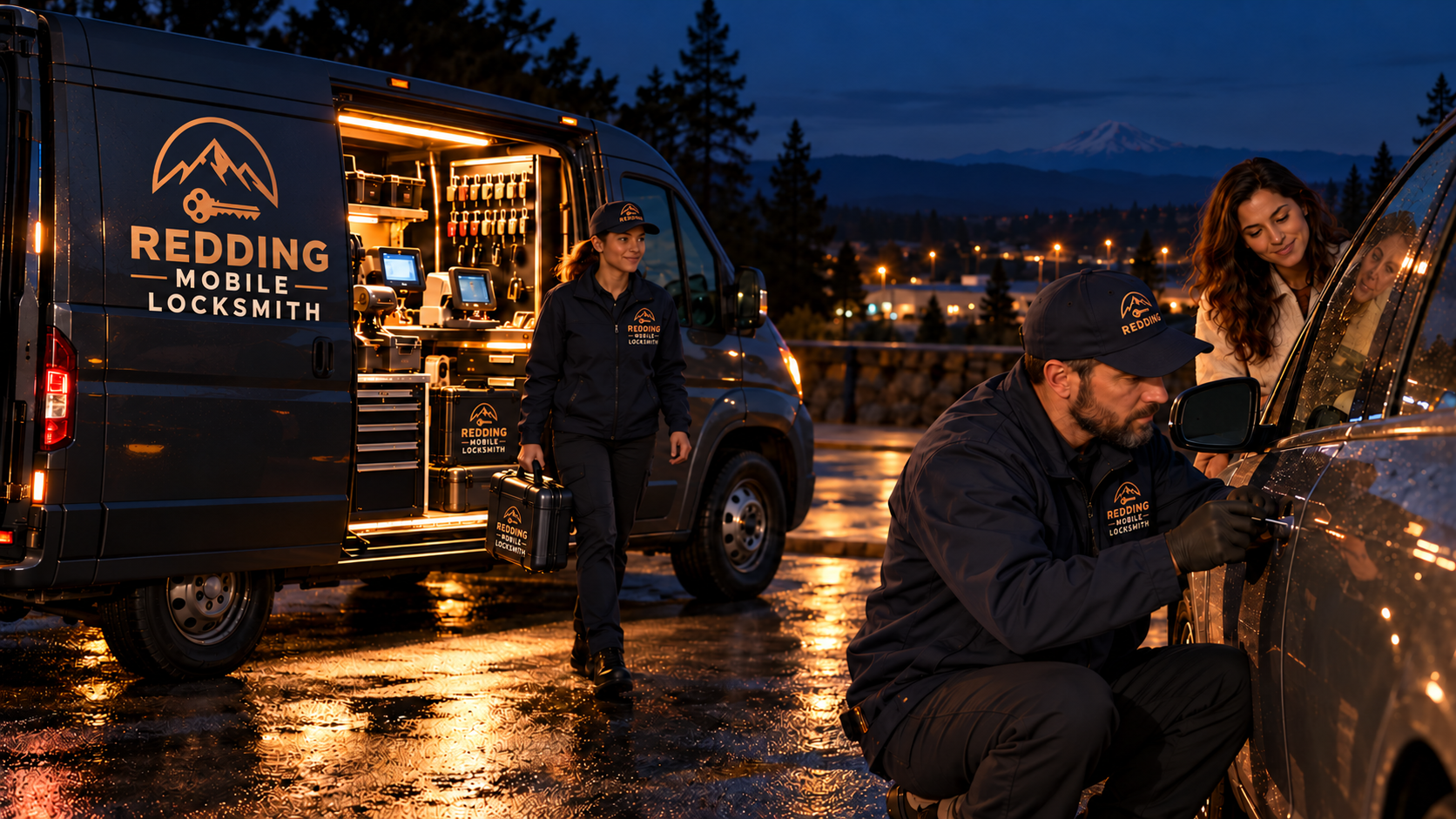
Redding Mobile Locksmith works from a branded service van that carries professional tools and key cutting and programming equipment, and the team serves communities across Shasta and Siskiyou counties. For a machine this size, a mobile visit can save you the trouble of moving it. The locksmith comes to the machine, looks at the lock, and explains what can be done on site.
That said, not every machine suits every approach. Some keys can be cut at the roadside. Some need a closer look in a workshop. Some need parts from the manufacturer. A good dispatcher will tell you honestly which of those applies once they know the model and the year.
Ask what the visit will cover before you agree to it. Ask who is arriving, what they will do, and how the price is set for your particular job. You can also use the request form to describe the machine in writing so that details are on record.
Ownership and identification
Making a new key for a machine is a security matter. A responsible locksmith will want to see that you own the machine or have the right to use it. This is not suspicion. It protects you, because it means nobody can walk up to your quad and have a key cut for it.
Have your photo identification ready, along with a registration, title or purchase paper. If the machine belongs to a business, a farm or a rental operator, have whatever shows your connection to it. Rules about proof can vary, so ask what the locksmith needs when you call. Our guide on proof of ownership for key replacement explains the idea in more detail, and the page on why a locksmith may ask for identification covers the reasons.
If you cannot show paperwork because it is stored inside the locked compartment, say so. There are often other ways to link you to the machine, and the dispatcher can explain what is acceptable.
Preventing the next night call
The strongest fix for a lost key is a spare made before you need it. Have an extra key cut while you still have a working original. Copying a working key is far simpler than starting from nothing, and it keeps your options open. Read why a spare key matters before you need it for the reasoning.
Keep one key somewhere safe and away from the machine. Do not hide it on the machine itself. Magnetic boxes under fenders are the first place anyone looks, and they fall off on rough ground.
Fit a loop or a lanyard so the key cannot slip loose on a ride. Check the key head for cracks now and then. A key that has begun to bend or chip is telling you it will fail soon. For related reading on wear, see worn key symptoms and key fob battery failure at night.
Where to go next
If your problem is a lost key, the service page on vehicle key replacement explains how replacement works in general. If the machine has a chip, read about transponder programming. For wider vehicle work, see the overview of vehicle locksmith services.
If you are locked out of a car or truck that you used to haul the machine, the guide to keys for work vans and the page on keys for pickup trucks on ranches may help. The vehicle information checklist works for any machine with an engine.
A word on what to expect from the visit itself. The locksmith will look at the ignition and any other lock involved, ask how the key was lost or broken, and check the paperwork. Then you will hear the options in plain words: cut a key, program a chip, extract a broken piece, repair a worn cylinder, or replace the cylinder. You decide which route to take. Nothing should start until you understand it and agree.
Whatever the problem, the steady approach works well. Stay safe, collect the details, describe the lock honestly, and let the dispatcher tell you what is possible.
Common questions
Can a locksmith make a key for a motorcycle or ATV without the original?
Often a replacement can be made from the lock itself or from a key code, depending on the machine. Some models also need a chip programmed. Because this varies by model and year, give the dispatcher the make, model and year and ask what is possible for your machine.
What should I never do when a motorcycle key breaks in the ignition?
Do not pull on the broken piece with pliers, do not spray oil into the lock, and do not keep turning the handlebars. Keep any piece you have. These steps protect the lock and give the locksmith the strongest chance of a clean extraction.
Is it safe to wait with the machine at night?
It depends on the place. Get clear of traffic, stay visible, tell someone where you are and keep your phone charged. If you feel unsafe or anyone is hurt, call emergency services first and deal with the key afterward.
What information should I have ready for the call?
Have the type of machine, make, model, year, where it is parked, what has gone wrong with the key and any registration or title paper. A photograph of the ignition helps. Also note whether the key has a plastic head or a fob.
Why might the locksmith ask me to prove ownership?
A new key opens and starts the machine, so a careful locksmith confirms that you have the right to it. Photo identification plus a title, registration or purchase paper is the usual answer. Ask what is accepted when you call.
Does Redding Mobile Locksmith come out to remote trailheads and farm tracks?
The team serves communities across Shasta and Siskiyou counties, and location matters for every job. Describe exactly where you are, what the ground is like and whether the gate is locked. The dispatcher can then tell you honestly what is practical.