
Home / After dark / Locked out at night, a safety first plan
Night lockout guide
Locked Out at Night: A Safety First Plan for Drivers
A vehicle lockout after dark is mostly a safety problem and only partly a lock problem. This plan puts people first, then visibility, then information, then the call.
Why a night lockout needs a plan
In daylight a lockout is an annoyance. At night, it changes character. You cannot see as far, other people cannot see you, temperatures drop and your phone battery may be lower than you would like. The same keys on the same seat can lead to a very different evening depending on where you are standing and who is with you.
A plan removes guesswork. When the moment comes, you do not need to decide everything from scratch. You follow steps in order: protect people, make yourself visible, check the simple fixes, collect your information and make a clear call. Each step is short, and each one makes the next easier.
This guide is written in the voice of a dispatcher who has taken many such calls. It is steady, practical and a little unglamorous. It focuses on vehicles, since that is where most night lockouts happen. It does not teach anyone to defeat a lock. It teaches you how to be safe and prepared while a trained professional does that part.
Keep the whole plan in your head as six short moves. People first. Visibility second. Simple fixes third. Information fourth. The call fifth. The arrival sixth. If you remember nothing else from this page, remember that order, because it keeps you from skipping to the lock when the real risk is the dark road or the cold.
Step one: count the people and the risks
Start by counting everyone who was in the vehicle. Make sure every person is outside and accounted for. If any person, especially a child, or any animal is still inside the locked vehicle, call emergency services at once and stay on the line. Do not wait for a locksmith. A closed vehicle can heat or chill into a danger in a short time, and trained responders are the right people for that situation.
If everyone is outside, check for injuries and cold. Do people have coats? Is anyone anxious or unwell? Is the group safe from traffic? Take a moment to settle the group, speak calmly and tell them what you are going to do. People copy the mood of the person in charge, so a steady voice helps.
Check the surroundings with a slow look. Are there other vehicles, lights or buildings nearby? Is the ground flat and clear? Is there a ditch, a drop or running water? A gravel pull off along a rural road looks very different in the dark than in the afternoon. Plan your waiting spot with those risks in mind.
If you are alone, add one more check. Tell a friend or relative where you are and what you are doing, even if you expect to be fine. A single message gives someone else a reason to notice if you go quiet, and it costs you a few seconds.
Step two: be visible and stay off the road
Move people away from the traffic lane. If you are on a road with no shoulder, stand well off the pavement, behind a barrier or guardrail if there is one. Never wait in the middle of a lane or on a curve where drivers cannot see you. If a vehicle stops to help, you can still say you are fine.
Use light. A phone flashlight held toward the road helps oncoming drivers see you. Bright clothing or a reflective item adds visibility. Do not rely on a dark jacket in a dark spot. If you have a hazard light that still works, leave it on. If the vehicle's battery is not an issue, the hazards help drivers notice the car.
On mountain roads and cold nights, add warmth to the plan. Put on every layer you have. Sit together, share body heat and shield children from wind. See mountain roads, cold nights and lockouts and rural road lockouts after dark for places where this matters most.
- Stand well off the traffic lane.
- Hold a phone light toward the road to be seen.
- Keep children close and between you and the vehicle.
- Put on every layer and share body heat if it is cold.
Step three: try the simple fixes without force
Walk around the vehicle and gently test every door, the hatch and the trunk. Drivers lock one door and forget about the others. Look for a window left open a crack. Check inside for a spare key, a valet key or a second set of keys visible on a seat. Think about whether a family member could bring another key.
If you have a key fob with a hidden mechanical key, find the release and the slot on the door handle. Many modern fobs carry an emergency blade, and some vehicles hide the keyhole under a small cap. Your owner's manual explains this for your model. Do this only if you are calm and in a safe place.
Stop there. Do not pry a door, jam a tool into the weatherstrip or force a window. Doors hide wiring, airbags and electronic modules. A forced entry may damage them, and the repair costs more than a service call. If a stranger offers to help with a trick, thank them and decline.
Be equally careful about advice from the internet. A video that shows a trick on one vehicle may not apply to yours, and a method that works on an old door can wreck a newer one. The calm choice is to wait for a trained technician who has the right tools and knows when not to use them.
Step four: collect your information
While you wait or walk to a spot with signal, gather what a dispatcher needs. First, the vehicle: year, make, model and trim. Key and lock systems change between model years and trim levels, so these four facts matter. If you know the color and plate, include them.
Next, the key: is it a plain metal key, a key with a chip, a key with buttons or a push to start fob? Is the spare available? Is the battery weak? Is anything broken? Third, your proof of ownership: registration, insurance or identification that matches the owner. If your papers are in the vehicle, explain, and ask what else the team can accept. Rules vary.
Finally, your location. Name the town, the road, the type of place and any marker such as a gate, a sign, a building or a mile marker if you can read one. If you are in a spot with weak signal, write the details down first. Our guides on what to tell the dispatcher: a location checklist and preparing your vehicle information for the call cover this in more depth.
A small written note on your phone can hold much of this in advance. Keep your vehicle details, the registration photo and a short description of your usual routes in one place. Then a stressful night becomes a matter of reading from the note instead of recalling facts under pressure.
Step five: make the call or send the request
Choose a safe spot to make the call. If your phone has weak signal, walk a short distance to where it improves, but do not leave children alone and do not wander far from the vehicle. If you are in a group, send one person while the rest stay together. Tell someone where you are going.
State the facts in order: the town, the problem, the vehicle details, the location and who is with you. Mention any hazard, such as cold, a dark road or someone who is unwell. The dispatcher will ask questions. Answer plainly. If you do not know something, say you do not know. Guessing causes confusion.
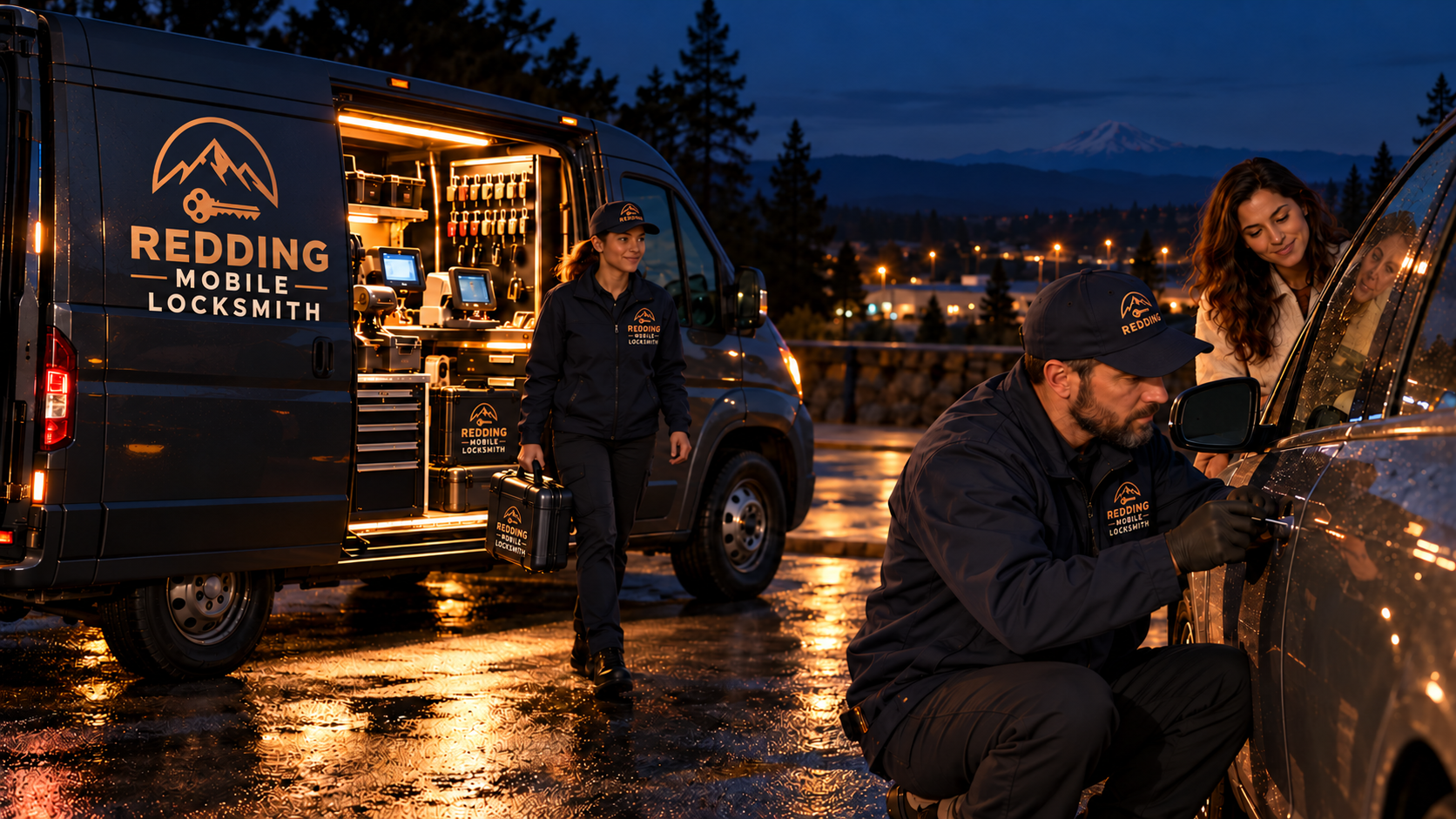
The phone line is coming soon, so use the request form on the contact page and include these details. Redding Mobile Locksmith runs as a 24 hour mobile service across Shasta County and Siskiyou County, with a branded service van that carries professional tools, key cutting and programming equipment and common hardware.
A call that is clear and short is a good call. You do not need to explain how the lockout happened or apologize for it. The team has heard every version, and what helps is the information, not the story. Save the story for later, when you are warm and the door is open.
Step six: wait safely and verify who arrives
While you wait, stay in a visible, safe spot. If a vehicle you do not know stops, you do not have to accept help, a ride or conversation. Stay with your group. Keep your phone charged and keep it in your hand. If your battery is low, dim the screen and save it for the call.
When the service van arrives, take a moment to confirm. The team wears uniforms and the van is branded. Ask for identification and for the name of the service. Read our page on confirming who is arriving for a calm list of what to check. A professional expects these questions and answers them without fuss.
Expect the technician to ask for proof that the vehicle is yours. This is a standard step, and a good sign. It protects you, because a locksmith who opens a vehicle for anyone is a danger to every owner. Our page on why a locksmith may ask for identification explains the reasoning.
If the technician asks something you cannot answer, such as a proof document that is locked in the vehicle, do not argue. Offer what you do have and ask what else works. Patience on both sides is the surest way through, and it keeps the process honest.
What the technician does at the vehicle
The technician looks at the vehicle, confirms the lock type and explains what they plan to do. They select tools made for that vehicle and work carefully around the door, the seals, the wiring and the airbags. The aim is to open the vehicle without damage and leave it exactly as they found it, only unlocked.
We do not publish methods, because the same detail would help a thief. What you can expect is a clear, calm process: identity check, inspection, explanation, careful entry and a test of the doors and keys afterward. If the lockout comes from a lost key, a broken key or a failing fob, the team can talk through replacement and programming on the spot.
After the door opens, check the vehicle. Lock and unlock with the key and the fob. Confirm the interior lights and alarm behave normally. Make sure nothing is damaged. If you notice anything odd, say so before the technician leaves. Small problems are far easier to sort out while the van is still beside you.
Ask for a short summary of what was done, and keep it. If anything was repaired or replaced, note what and when. If the lockout showed that a key is worn or a fob is failing, ask about a spare or a replacement so you are not facing the same plan next month.
Special cases that change the plan
Some situations need a different first step. If a child or pet is inside, call emergency services first. If your vehicle is running with the keys inside, the problem has a time element, since the engine is still burning fuel. Read keys locked inside a running car for what that adds.
If the cause is a dead battery, a frozen lock or a weak fob, the fix differs. See key fob battery failure at night, frozen car door locks on winter nights and a dead car battery and door locks. If a key snapped in the lock or the ignition, say so, and keep the pieces.
If you are in a lonely spot, such as a trailhead or lakeside lot, read trailhead lockouts and lakeside parking lockouts. If you are in a busy lot, see waiting for help in a parking lot.
Prevent the next night lockout
The strongest prevention is habit. Touch your pocket before you close a door. Keep a spare key with someone you trust, not hidden on the vehicle. Replace fob batteries before winter. Learn where your hidden mechanical key is and how to release it. Charge your phone before a night drive.
Think about the places you park. If you often stop at a lake, a trailhead or a late shift job, leave a spare in a safe place at home and tell someone your plan. For a family vehicle, decide who carries the keys. See why a spare key matters before you need it.
When you want to talk, our night car lockout service page and vehicle locksmith overview explain what we do, and our Etna coverage shows how we serve the Scott Valley area. A plan on paper does most of the work, and calm does the rest.
Share this page with the people you drive with. A teenager new to driving, a partner who rides along on long trips and a relative who borrows your vehicle should all know the six moves. Five minutes of conversation at home can save an hour of confusion on a dark road. Print it or save it to your phone so it is there when the signal is weak.
Common questions
What is the very first thing to do in a night vehicle lockout?
Make sure every person and animal is accounted for. If a child or pet is inside the locked vehicle, call emergency services right away. If everyone is outside and safe, move away from traffic, stay warm and visible, and then try the doors gently.
How do I stay safe on a dark rural road?
Stand well off the road, behind a barrier if you can, and keep your group together. Use a phone light, wear bright clothing and keep children close. Do not wait in a traffic lane. Share warmth if it is cold and keep your phone charged.
What information should I have for the dispatcher?
The vehicle year, make, model and trim, the type of key, your exact location, who is with you and any hazard such as cold or darkness. Also have proof of ownership ready. Clear facts in order shorten the call and help the team prepare.
How do I know the person who arrives is the right one?
The team wears uniforms and drives a branded service van. Ask for identification and the name of the service, and compare it with the request you made. A professional expects the question and answers it without fuss. If anything feels wrong, say so.
Should I try to open the car myself?
Try only the simple, gentle things, such as testing every door and looking for a spare. Do not pry, force a window or use tools on the weatherstrip. Doors hide wiring and airbags, and damage costs more than a service call.
Can the technician replace or program a key at the vehicle?
The service van carries key cutting and programming equipment, so many key jobs can be handled on site. What is possible depends on the vehicle and its system. Have the year, make, model and trim ready and ask what your vehicle requires.