
Home / After dark / A store owner locked out at closing time
Storefront guide
A Store Owner Locked Out at Closing Time: A Calm Walk Through the Night
Imagine the last customer leaves, the lights go down and the front door swings shut with the keys on the counter. This guide follows that moment step by step and shows how an owner can handle it calmly.
The scene: the door closes and the keys stay inside
Picture a small shop in a town along Interstate 5. The owner has counted the register, turned off the sign and walked out to the sidewalk with a deposit bag. The door swings shut behind them. The keys are on the back counter, next to the till.
It is a quiet moment, and it feels louder than it is. Nothing has been taken. Nobody is hurt. Yet the owner is outside a locked store, at night, holding the day's money. That combination is why this situation needs a plan.
This guide treats the scene as a hypothetical illustration. It does not describe any real customer. It uses the example to show the order of steps that a calm owner can follow, whether the shop sells hardware, coffee, clothes or something else.
The first step is not about the door at all. It is about the person standing outside it.
Notice how small the trigger is. A door that closes by itself is not a failure of character. It is a feature of the door. The cure is a habit, and a habit is easy to build once the owner has felt this particular night once.
Step one: protect yourself and what you are carrying
An owner at closing is sometimes a target. People watch shops at night, and a person leaving with a bag is easy to notice. Do not stand still in a dark doorway. Move to a lit spot where passers by can see you.
If you are carrying a deposit, think about where it goes. Keep it close to your body and out of sight. If you feel unsafe, step into a lit, open business or call someone you trust. A short call to a family member or a neighbor changes the situation immediately.
If anyone approaches in a way that feels wrong, call emergency services. Do not try to solve the lockout and a safety problem at the same time. The door can wait. Your safety cannot.
Once you are in a safe spot, take a breath. A lockout at closing is almost always solvable, and the next steps are simple.
Keep your phone in your hand, not buried in a bag. A phone you can reach is a lifeline, and one you cannot find is a second problem. Check that the battery is not low before you step out the door each night.
- Move away from the dark doorway to a lit spot.
- Hold the deposit close and out of sight.
- Call someone you trust and tell them where you are.
- Call emergency services if anyone makes you feel unsafe.
- Do not wait alone in an empty lot.
Step two: check the simple ways back in
Before calling anyone, think about the options you already have. Is there a rear door that locks differently? Is there a second set of keys at home or with a partner? Does a manager or an employee live nearby and carry a key?
Many owners keep a spare in a safe place for exactly this night. If the spare is in a drawer at home, the trip may be the easiest answer. If the spare is in a lock box at the shop, remember the code. If the spare is with a family member, one call may end the problem.
Check the door gently. Is it locked, or just pulled shut? Some storefront doors have a latch that only engages when the key turns, and some lock automatically. A short, careful test tells you which kind you have. Do not force the door, and do not pry at the frame.
If an alarm is installed, think about what opening the door will do. The alarm company may need a call. A code may need to be entered within a short window. Ready answers prevent a second problem from piling onto the first.
Step three: choose who to call and in what order
Decide the order of calls. If the shop is rented, the landlord may have a key or a rule about who opens the door. If the building belongs to someone else, a property manager may help. If you own the building, a locksmith is the usual next call.
Be ready with facts. State the address in plain words, the type of door and whether there is an alarm. Say whether the door is glass, metal or wood. Say whether you are the owner or a tenant. Say whether anyone is inside.
Our guide on what to tell the dispatcher gives a checklist for the call. If you want the broader building view, a commercial building lockout after hours covers authority, alarms and hardware.
Keep notes. Write the time you were locked out, the time of each call and the name of each person you spoke with. These small facts help later, if anyone asks what happened.
What the technician will ask a shop owner
A responsible locksmith confirms that the person asking has the right to enter. Expect questions. Are you the owner or a tenant? What is the name of the business? Can you show photo identification? Is there a lease, a license on the wall, a bill or an invoice with your name?
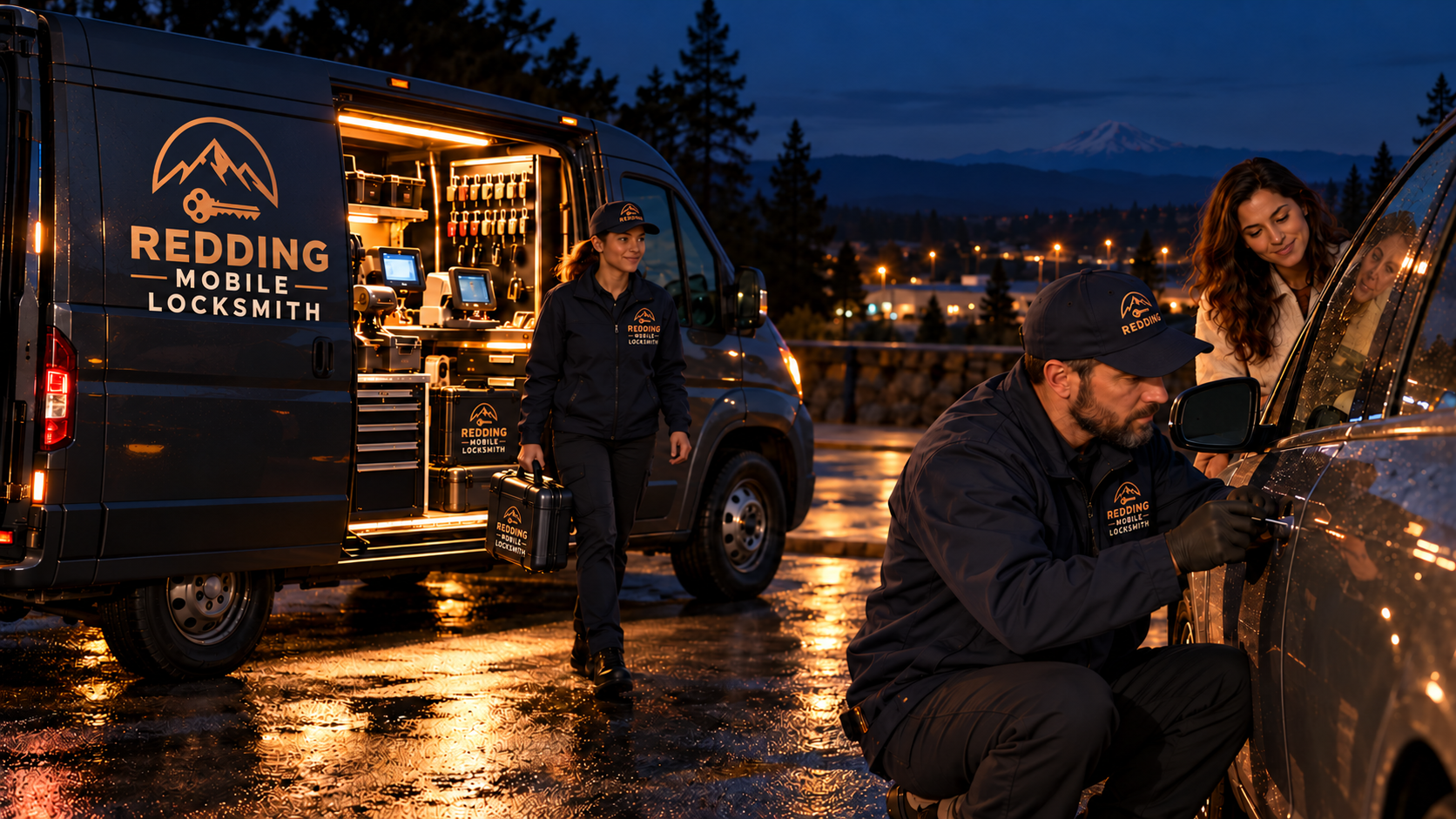
You may feel the questions are unnecessary at your own shop. They protect you. The same service could otherwise help someone who wants to break into your store. Ask the technician to show identification too, and note the branded van and uniform.
Our guides on why a locksmith may ask for identification and confirming who is arriving explain both sides of the check.
If you rent, the lease may name who controls the door. If so, tell the technician honestly. They may ask to contact the landlord or property manager before starting, which is a normal part of the work.
If you rent the space, find out in daylight who controls the exterior doors. A lease may say that only the landlord may change locks, and an after hours lockout is a poor moment to learn that for the first time.
- Photo identification in your name.
- A lease, a business document or a bill that shows you run the shop.
- The business name and address in plain words.
- The names of anyone else with authority over the door.
- Alarm details, if the building has one.
Understanding the storefront door
Storefronts often have glass doors set in metal frames. These doors usually have a narrow stile, a lock near the bottom or the middle and a closer overhead. The glass makes the door look fragile, and the hardware makes it stronger than it looks.
A glass door can be opened without breaking anything. A professional works the lock or the latch with tools designed for the job. Breaking the glass is almost never the right answer. It ruins the door, exposes the shop and often costs far more than a visit.
Wooden and metal doors are different again. Some have a deadbolt and a latch. Some have a single lock. Some have a panic bar on the inside and a key lock on the outside. The technician will look at yours and decide on the safest method.
Our business door hardware page describes closers, strikes and panic hardware, and the business security page shows how a shop can think about doors and key control.
Your shop may hold items that matter more than cash, such as customer orders, tools or records. Mention them when you describe the problem, so the technician understands why you want the door opened with care and not force.
- Glass storefront doors can be opened without breaking the glass.
- Never pry at the frame or the stile yourself.
- Tell the technician about any alarm or card reader.
- Ask the technician to test the lock before leaving.
- Open and close the door yourself to confirm it works.
Money, stock and what to do while you wait
While you wait, the main concern is the deposit and your own safety. Keep the money with you. Do not leave it in a car parked in the dark. If you can, wait inside a nearby open business, with your phone and the dispatcher's details at hand.
The shop itself is a second concern. If the door is locked and the alarm is quiet, the stock is probably safe. Watch the front from a distance if you can. Do not stand directly in front of the glass where you are visible and alone.
If you notice anything strange, such as a light that was off and is now on, a door that was closed and is now ajar or a stranger lingering, call the proper authorities. Do not go in to check. Wait outside, in the light.
If it is cold, put on a coat and find shelter. Our guide on waiting for help in a parking lot describes simple habits that make waiting safer, and late shift workers and lockouts covers working at night.
Take photos of the door and frame once the visit ends, if you wish. A short record of the condition of the lock, with the date, answers questions later and costs nothing.
- Keep the deposit on you, close and out of sight.
- Wait in a lit area, not in front of the glass.
- Keep your phone in hand with the battery checked.
- Call the proper authorities if anything looks wrong.
- Never go in to check on a possible intruder.
After the door opens: check, test and secure
When the technician opens the door, step in with them. Look at the lock, the latch and the frame. Ask whether anything was damaged. Close the door and open it yourself. Make sure it locks and unlocks smoothly before the technician leaves.
Turn the alarm off, if needed, and then set it again. Check the register area, the back door and any windows. Make sure nothing has changed. This takes a few minutes and gives you peace of mind for the night.
Ask about the lock. If it is worn or sticky, the technician may suggest repair or replacement. Our broken lock repair page describes the signs. If a key was lost, ask about rekeying, which changes the lock so the old key no longer works.
Make a spare right away. A duplicate stored at home, with a trusted person or in a secure box, saves the next night.
Rehearse the routine with a new hire on their first closing night. Walking through it once, door by door, teaches more than a page of instructions and gives the new person confidence.
A closing routine that prevents the next lockout
The strongest fix is a habit. Build a short closing routine and follow it every night. Many owners find that one simple step prevents most lockouts: keys go in the pocket before the door closes, every time, without exception.
Put the routine in order. Count the register. Lock the back. Set the alarm. Check your pockets for keys, phone and deposit. Step out. Pull the door. Test the handle. The order does not matter as much as doing it the same way each night.
Share the routine with your staff. Anyone who closes the shop should follow it. A laminated card by the back door is enough. Add a note about where the spare lives and who to call if something goes wrong.
Our restaurant closing time key problems guide shows a similar routine for another kind of business, and why a spare key matters explains the spare.
- Keys in the pocket before the door closes.
- Phone and deposit checked before you step out.
- Alarm set and the back door locked.
- A spare stored at home or with a trusted person.
- A card by the door with the steps and the contact.
Small town shops, rural highways and winter nights
Shops in Redding, Anderson and the mountain towns face different nights. A busy street in the valley may still have people around at closing. A small town on Highway 89 or Highway 97 may be silent by six. Winter adds cold, and cold hands make everything harder.
Match your plan to your town. In a quiet town, choose a place to wait that is lit and visible. In a busy one, stay clear of crowds that do not know you. Keep a flashlight in your bag and a warm layer in the car.
Our guide on mountain roads, cold nights and lockouts covers the cold. The pages for Weed, McCloud and Cottonwood describe smaller communities where help can be farther away.
No matter the town, the same rule holds. Light and company are safer than distance from the door.
Getting help from the After Hours team
The After Hours team at Redding Mobile Locksmith works as a 24 hour mobile service across Shasta County and Siskiyou County. The branded van carries professional tools, key cutting equipment and common hardware, so many storefront jobs can be finished at the door. The phone line is coming soon.
Use the request form on the contact page. Say that you are a store owner locked out at closing. Give your location in plain words, the type of door, whether there is an alarm and whether you are the owner or a tenant. Add a reliable contact.
The after hours emergency page explains how night requests are handled, and the guides section holds related topics.
Common questions
What should I do first if I am locked out of my shop at closing?
Make sure you are safe. Move to a lit place with other people and keep any deposit close and out of sight. Call someone you trust if you feel uneasy. Once you are safe, check for a spare key or a second entrance before calling for professional help.
Will a locksmith need proof the shop is mine?
Yes. Expect to show photo identification and something that connects you to the business, such as a lease, a bill or a business document. If you rent, the technician may contact the landlord. These checks protect your store from anyone else who might ask.
Can a glass storefront door be opened without breaking it?
Yes. A professional uses tools made to operate the lock or latch, so the glass stays intact. Breaking the glass exposes the shop and costs far more than a visit. Do not force the door yourself, since that can bend the latch or damage the frame.
What if the alarm goes off when the door opens?
Know the code and the alarm company call back details before work begins. Tell the technician an alarm is fitted, so they can plan. Have your code ready as the door opens, so you can silence the system at once and confirm everything is in order.
Should I rekey after a lockout?
Only if there is a reason, such as a lost key or a former employee with a copy. Rekeying changes the inside of the lock so old keys stop working. It is usually simpler than replacing the lock. If the cause was only a door closing behind you, it is not needed.
How do I stop this from happening again?
Build a closing routine and follow it every night. Keys in the pocket before the door closes, a spare stored at home or with a trusted person, and a card by the door with steps and contacts. Share the routine with anyone who closes the shop.