
Home / After dark / Fleet vehicle night lockouts
Fleet guide
Fleet Vehicle Night Lockouts: A Calm Plan for Managers and Drivers
When a work vehicle is locked at night, a driver is stuck outside and a job is waiting. A written plan turns that moment from a scramble into a short list of steps anyone on the team can follow.
Why fleet lockouts are a management problem
Picture a delivery van parked behind a loading area after the last stop of a long shift. The driver closes the door, and the keys are on the seat. The shift ends, the office is shut and the next driver starts at dawn. One locked door has just become a scheduling problem.
For a private car, a lockout is a personal inconvenience. For a fleet, it affects customers, schedules, drivers and sometimes cargo. A single missed key handoff can cascade through the next morning's routes. This is why the response should be planned in advance, not invented on the spot.
Fleets also have more people involved. A driver, a dispatcher, a manager and sometimes an owner or a lender all have a stake. Without a plan, each of them guesses what the others expect. With a plan, everyone knows who decides, who calls and who stays with the vehicle.
This guide is written for managers and owners, and it is short enough to share with drivers. Every vehicle type in a fleet is different, so use it as a frame to build your own page.
Treat the plan as a living page. Update it when you add a vehicle, change a shift or lose a key. A plan that sits in a drawer for a year is out of date by the next emergency.
Who is allowed to authorize the work
The first question at the scene is who may say yes. A driver may not own the vehicle. A technician will ask for proof that the vehicle belongs to the business and that the person requesting work has the right to ask. If that proof is not ready, the job stalls.
Decide in advance who the authorizing person is. It might be the owner, a fleet manager or a named supervisor. Give the driver that name and a way to reach them. Put the information on a card in the vehicle, or in a phone note the driver can open.
Also decide what the authorizing person can do remotely. Can they send a registration photo? Can they confirm the vehicle by plate? Can they approve the work by message? A technician needs a clear and checkable answer, and so does the driver.
Our guide on proof of ownership for key replacement explains the kinds of documents that satisfy a technician, and why a locksmith may ask for identification explains the reasoning behind the questions.
Make sure drivers know they will not be blamed for asking. A driver who fears punishment may try to force a door or wait too long before calling. A calm culture produces earlier calls and smaller problems.
- Name the person who can authorize lockout work, and a backup.
- Give drivers a way to reach that person at night.
- Keep registration and company documents in a place the manager can reach.
- Record the plate and identification number of every vehicle.
- Decide in advance how approval is given and recorded.
The driver's first steps at the vehicle
The driver's first job is safety. A lot behind a building, a rural turnout or a roadside shoulder can be dark and isolated. The driver should move to a lit area with other people, tell the dispatcher where they are and wait there, not beside the vehicle in an empty lot.
If the engine is running, say so. If there is cargo, say what kind in general terms. If there are passengers, animals or children inside, call emergency services first. Do not wait for a locksmith in any of those cases.
Then check the simple things. Are all doors locked? Is there a lock box, a spare key or a hide a key system the company authorizes? Does the driver have a second fob? Many fleet issues end at this point because a prepared team has a spare in reach.
If none of that works, call the dispatcher with the plan below. Our guide on a safety first plan for locked out nights lists steps that fit any driver.
Teach the sequence by repetition. A short briefing at the start of a shift, once or twice a season, is enough. Drivers who have heard the steps will follow them in the dark.
What the dispatcher should collect
A dispatcher is the single point of contact. Their job is to gather the facts in a fixed order. This protects the driver from repeating themselves and gives the technician the details needed to bring the right equipment.
First, location. A plain description is better than a name. Say what kind of road, which side of a building, what is nearby and how to recognize the spot. Our guide on what to tell the dispatcher gives a checklist.
Second, vehicle. Year, make, model, trim, color and plate. A work van, a pickup and a box truck all have different locks and keys. Key types vary by model and year, so never assume. Third, status. Is the engine on? Are keys inside? Is anyone inside? Is cargo exposed?
Fourth, authority. Who is requesting, and who has approved the work? Fifth, a contact. A reliable phone number for the driver and for the manager. Write the answers in a single message that can be forwarded.
Ask the dispatcher to keep a script by the phone. Reading from a short script means no detail is skipped at 2 a.m., when everyone is tired and the questions feel obvious.
Key control for a fleet: the quiet fix
Most fleet lockouts come from weak key control. Keys are shared between shifts, left on seats, handed off in parking lots and copied without records. A modest system fixes most of this.
Keep a log. Each vehicle has a named key set and a place where the set lives. When a driver takes a key, they sign it out. When they return it, they sign it in. At the end of every shift, someone counts the keys. Paper works. A shared sheet works. What matters is that it is used.
Keep spares in one secure place away from the vehicles. Limit access. A lock box in the office, with a short list of who may open it, is better than spares spread across glove boxes.
Also decide what happens with a lost key. Our guide on a lost key and vehicle security explains how reprogramming removes a missing key from a vehicle's memory, which is the standard answer for a business that wants to be sure.
If your fleet uses keys of mixed ages, mention that in the log. An older vehicle with a plain metal key is a different job from a newer model with a chip, and the log helps a technician plan from the first message.
Smart keys, transponders and fleet vehicles
Modern work vehicles often use transponder keys or smart fobs. These keys protect the vehicle against casual theft, and they also add cost and complexity when one is lost. A fleet with a dozen vans may have a dozen different key types.
Know which vehicles use which key. Keep a simple table: vehicle, year, make, model, trim, key type and how many keys exist. This takes an afternoon to build and saves hours in an emergency. It also helps a technician plan before arriving.
Do not guess about key styles. A technician will check the vehicle. Our guides on transponder keys explained for night emergencies and keys for work vans explain the general differences.
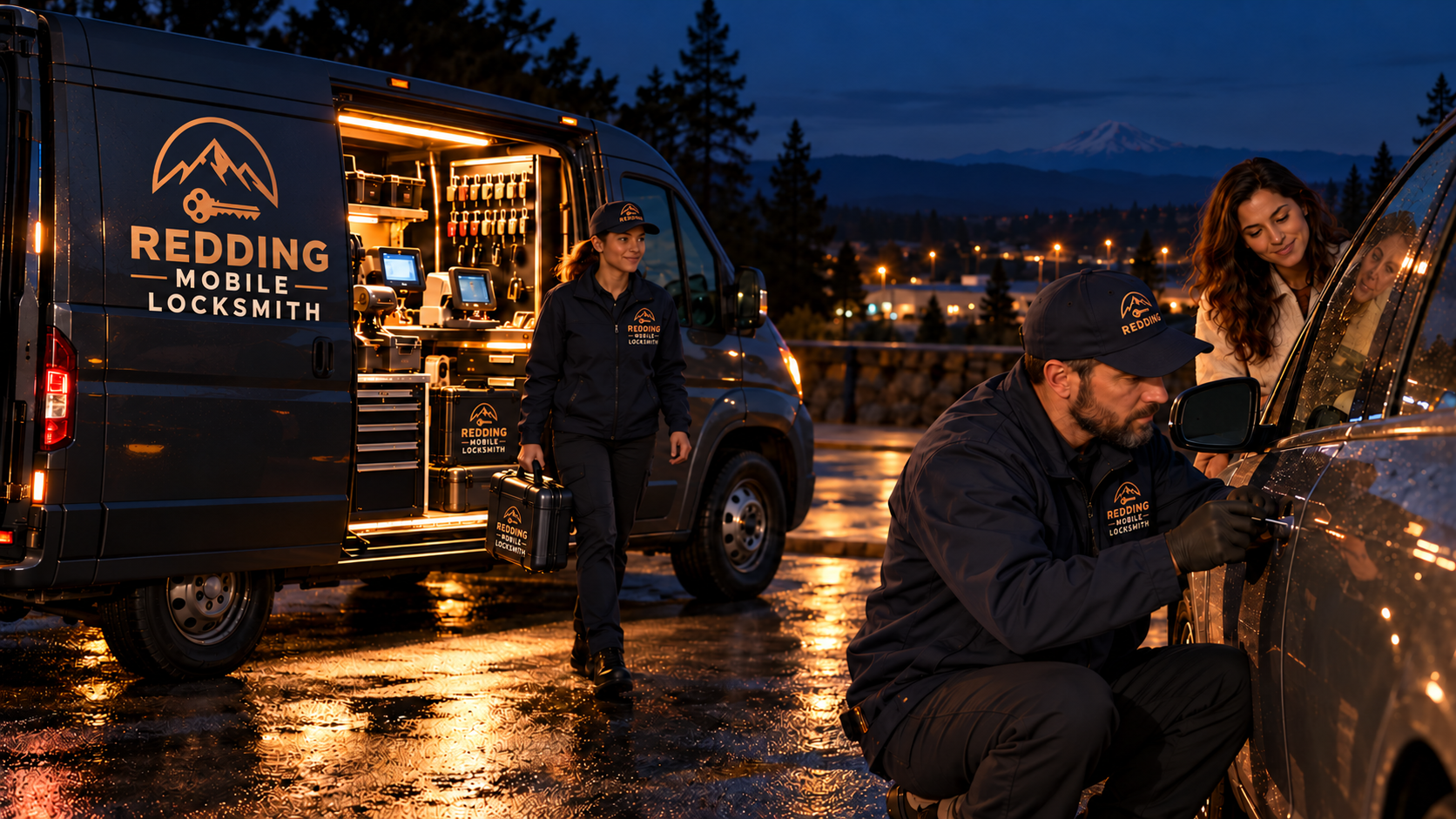
The branded service van from Redding Mobile Locksmith carries key cutting and programming equipment, so many work vehicle keys can be made at the vehicle. The transponder programming page describes how.
After any attempt at forced entry by a driver, tell the technician at once. Hidden damage to a lock or a wire changes how the work is done, and honest information makes the job safer.
- The cargo area may carry its own separate lock.
- A bulkhead door between cab and cargo may need its own key.
- An alarm or an immobilizer may be fitted.
- Doors may carry side airbags and wiring that must be left alone.
- A walk around the vehicle with the driver confirms nothing was harmed.
Opening a work vehicle without damage
A work vehicle earns money by being on the road. Damage to a door, a seal or a window takes it out of service. A professional opens the vehicle with tools made for the job and does not force anything.
Work vehicles can have special features. A cargo area may have a separate lock. A cab may have an alarm or an immobilizer. A bulkhead door may need its own key. Tell the dispatcher about any of these so the technician can plan.
Insist on a calm process. Ask the technician to explain the method in general terms before work starts. Ask the technician to inspect the vehicle with the driver afterward. A short walk around the van, with a photo, protects both sides.
Our night car lockout service and vehicle locksmith page describe the approach in more detail.
Drivers should also know when to stop waiting. If conditions turn bad, the right answer may be to move to shelter and rejoin the vehicle later with the technician.
- Stand in a lit area with other people nearby.
- Keep the phone charged and share your location with the dispatcher.
- Do not leave exposed cargo unattended in an empty lot.
- Carry water in summer and warm layers in winter.
- Move to shelter if conditions turn unsafe.
Waiting safely: drivers, cargo and weather
While the team waits, the driver's safety comes first. A driver in a dark lot should stand in a lit area, keep a phone charged and let the dispatcher know of any change. If someone approaches and the driver feels uneasy, they should move toward people and call for help.
Cargo is the second concern. If the vehicle holds goods that are valuable or sensitive, the dispatcher decides whether another team member should stay at the scene. Do not leave a driver alone with an exposed load in a quiet lot.
Weather is the third. In the valley, summer heat is severe, and a driver should have water and shade. In the mountain towns, a night in winter can be dangerously cold. Our guides on summer heat and vehicle lockout safety and mountain roads, cold nights and lockouts cover each season.
Read waiting for help in a parking lot and late shift workers and lockouts to see how simple habits keep drivers safe.
Consider a monthly check. Pick one vehicle and test its spare key, its lock box entry and its documents. A five minute check each month finds problems before they reach the roadside.
Records, invoices and learning from each event
After every event, write a short note. It should say when the lockout happened, where, which vehicle, what caused it and what was done. Keep the technician's invoice with the note. Over a few months, patterns appear.
Patterns point to fixes. If lockouts happen at one site, the site may need a lock box. If they happen at shift change, the handoff may need a log. If they happen with one vehicle, the key or the door lock may be worn. Our guide on worn key symptoms helps spot the last case.
Share the note with the team. A short message that says what happened and what changed keeps the lessons alive. Avoid blame. The aim is a better system, not a punishment.
Keep the records in one place and keep them private. They contain plates, locations and names, and they belong to the business, not the public.
If your yard has cameras or lights, mention them when you describe the location. A well lit, visible site is a better place to wait and a better place to work.
- The date, time and place of the event.
- The vehicle year, make, model, trim and plate.
- The cause, in one plain sentence.
- What was done, who did it and what the invoice states.
- One change you will make because of this event.
A fleet with commercial buildings and gates
Many fleets operate from a yard with gates, an office and a storage building. A night lockout may involve the building as well as the vehicle. A driver who cannot enter the office cannot return the keys, and a locked gate can trap a vehicle inside.
Keep a separate plan for the building. Our guides on a commercial building lockout after hours and locked out of an office after hours describe it. Hardware matters as well, and the business door hardware page explains closers, strikes and panic hardware in plain words.
If your yard has a key safe or an electronic access system, make sure at least two people can reach it. A single keyholder is a single point of failure, just like a single working vehicle key.
The business security page describes how a business can look over its locks, doors and key control with a professional.
Sending a fleet request
Redding Mobile Locksmith is a 24 hour mobile service for Shasta County and Siskiyou County. The branded van carries professional tools, key cutting and programming equipment. The phone line is coming soon, so start with the request form on the contact page.
In the request, state that it is a company vehicle. Include the vehicle year, make, model and trim, the plate, the exact location in plain words, the name of the authorizing person and a reliable contact. Say whether cargo or people are inside.
The after hours emergency page describes how night requests are handled. For fleets in larger towns, see Redding and Anderson.
Common questions
Who should call for help when a fleet vehicle is locked at night?
The driver should move to a safe, lit place and contact the dispatcher, who calls on behalf of the business. The dispatcher gives the location, vehicle details and the name of the person authorizing the work. This keeps the call clear and ensures a technician can verify the request.
What proof does a locksmith need for a company vehicle?
Expect to show photo identification, and proof the vehicle belongs to the business, such as registration or title paperwork. The technician will also want to know who authorized the work. Have these documents ready in advance, in a place a manager can reach at night.
Can a fleet keep spare keys in a lock box?
Many fleets do, with a short list of people who may open it. A lock box in a secure office is usually safer than spares scattered in vehicles. Whatever you choose, keep a log so you know who took which key and when it came back.
How does a fleet protect itself from a lost key?
Keep a key log, count keys at the end of every shift and limit copies. If a key goes missing, ask about reprogramming. On many models, a technician can clear the stored keys and add only the ones you hold, so the missing one cannot start the vehicle.
What if the driver is alone with valuable cargo?
Decide in advance. The dispatcher can ask another team member to join the driver, or ask the driver to wait in a lit, public place where the vehicle is still in view. Do not leave a driver alone with an exposed load in an empty lot at night.
Can the same technician make keys and open the vehicle?
On many models, yes. The service van carries cutting and programming equipment, so a technician can often open the vehicle and make a key during the same visit. Tell the dispatcher the vehicle year, make, model and trim so the right equipment is on board.