
Home / After dark / Mountain roads, cold nights and lockouts
Cold night guide
Mountain roads, cold nights and lockouts: what to do first
Cold changes every part of a lockout. Batteries weaken, locks stiffen, hands go numb and waiting stops being a minor annoyance. This guide puts your body first and the key problem second, in clear order.
Why cold turns a small problem into a serious one
On a mild evening, a lockout is a nuisance. You wait, you pace, you check your phone. On a mountain road in winter the same lockout is a different event, because the clock is running on your body as well as your schedule. In the higher country of Siskiyou County, around Mount Shasta, Dunsmuir, McCloud and Weed, nights bring snow and hard cold. Even in the foothills of Shasta County, a winter night after a clear day can drop low enough to matter.
Cold also changes how vehicles and keys behave. Phone batteries drain sooner. Key fob batteries weaken and sometimes stop sending a signal. Door seals freeze to the frame. Lock cylinders can stiffen when moisture inside them turns to ice. Gloves make it hard to hold a small key, and fingers lose feeling long before you notice.
For all those reasons, the first rule of a cold weather lockout is that safety comes ahead of the vehicle. If you are not dressed for the temperature, if you feel unwell, or if you are in a spot where the cold will soon become dangerous, the right call may be emergency services rather than a locksmith. A locksmith opens locks. Emergency responders handle people in trouble.
This guide is written to be read in a calm moment, ideally before you need it. If you are reading it on a roadside right now, read the next section first and the rest later.
The first steps when you are cold and locked out
Stop, breathe and look around. Make sure you are away from moving traffic, on firm ground and not standing in a drift or on an icy slope. If you are on a grade, check that your vehicle is not rolling and that you are not downhill of it. A vehicle that is parked on ice can shift when doors are touched.
Check your phone. Note the battery level and whether you have signal. If the battery is low, tuck the phone inside your jacket against your body. Warmth restores some of the charge you would otherwise lose. Keep the screen dim and close apps you do not need.
Then count your layers. Zip your jacket, pull up your hood, put on gloves and a hat if you have them. If those items are inside the locked vehicle, think about where you can get out of the wind. A rock face, a guardrail or the lee side of the vehicle gives some shelter. Do not sit on the ground or on snow, because the cold seeps through steadily. Keep moving gently to stay warm without sweating, since damp clothing makes the cold worse.
Try every door once, including the rear doors and the tailgate or hatch. Do not pour hot water on a frozen door or window. Hot water can crack glass and refreeze. Our guide on frozen car door locks on winter nights explains what ice does and what to avoid.
When to call emergency services first
There are a few situations where a locksmith is the wrong first call. If a child, an infant or a pet is inside the locked vehicle, call emergency services before anything else and follow what the operator says. Do not wait for a key. Do not hunt for a technician first. The same applies if anyone with you feels dizzy, confused, unusually sleepy, numb or very weak in the cold.
If your vehicle is on the road in a spot where other drivers could hit it, or if you are on a stretch of Interstate 5, Highway 89 or another route with snow and limited shoulder, safety from traffic matters more than the lock. Call emergency services if you cannot get to a safe spot. Do not stand in the travel lane to wave down help.
If you are far from any building, the temperature is falling and your phone has little battery, make the call early. It is easier to cancel help than to wait too long to ask for it.
This guide is not medical advice and does not replace the instructions of an emergency operator. It exists to help you sort one problem from another. Once everyone is safe, the key problem becomes a calm one that can be solved with a plan. The child inside a locked car guide explains the order of calls for a vehicle with a person inside.
Describing a mountain location clearly
Mountain roads are hard to describe because they bend, climb and look alike in the dark. A dispatcher cannot send a technician to the road with the big trees. Take a minute to build a clear description before you call or fill out a request.
Start with the highway or road name and your direction of travel. Highway 89 toward McCloud, Highway 97 toward Weed, Highway 3 toward Etna, Interstate 5 near Dunsmuir, Highway 299 toward Lakehead and Highway 44 east of Redding are all examples of how a traveler might begin. Then give the nearest fixed reference you can see or read: a junction, a bridge, a mile marker, a gate, a large sign, a pullout with a trash bin, a turnoff to a trailhead.
Add which side of the road you are on, and whether the spot is a pullout, a driveway or a shoulder. Snow banks can hide pullouts, and a technician needs to know where to stop. If the road is snow covered, say so, because a mobile technician may need to plan for conditions and approach carefully.
The full list of details worth preparing is in our location checklist for dispatchers. Read it once and keep a copy of the key points in your phone notes.
Winter lockouts and the keys themselves
Cold is hard on keys. Metal keys can seem to stick in a frozen lock because tiny amounts of moisture freeze inside the cylinder. Plastic key heads become brittle, and a stressed key can snap in a lock. If a key does not turn, stop. Forcing it risks a break, and a broken key is a bigger problem than a stuck one. See a key broken off in a door lock for what to do if it happens.
Remote keys and fobs can fail in cold weather. The small battery inside may weaken when it is cold and recover when it warms. If your fob does not unlock the doors, try holding it close to the door handle, then try the physical key blade if your fob includes one. Many fobs hide a mechanical key inside. For push to start vehicles, the details vary by model and year, and you should look at your owner's manual in a calm moment before you need it.
Our page on key fob battery failure at night walks through what a weak fob does and does not mean. It is also a reminder that a dead battery can look like a lost or broken key when it is neither.
Locks can also freeze at the door handle or the trunk, and ice can build around door seals. The guide on ice and snow around door handles explains why pulling harder on a frozen handle can break parts and what is safer to try.
What to have ready for the technician
Whether you are using a request form or speaking with a dispatcher, the same details help. Have the year, make, model and trim ready. Key systems vary by model and year, so a close guess is not enough. Note the color, because at night in snow, a technician is scanning for a parked vehicle.
Say what type of key you use: a plain metal key, a key with a plastic head, a remote with buttons, or a push to start fob. Say whether the keys are inside the vehicle, lost somewhere else or broken. Say whether the engine is running. If it is, mention the fuel level if you know it.
Tell the dispatcher about the conditions. Is the road snow covered? Is there ice? Is the pullout plowed? Are there steep grades? Any detail that affects how a technician approaches your location is useful. Also say how many people are with you and whether anyone is cold or unwell, because that changes priorities.
Have identification ready. A technician will usually ask you to show that you are entitled to enter the vehicle, and a driver license is the simplest proof. If the registration is inside the car, that is fine, since other details can help establish who you are. More on this is in why a locksmith may ask for identification.
Waiting in the cold without taking risks
Waiting is where cold weather lockouts go wrong. People decide to sit it out in the open, or they walk off in the dark to find signal, or they try to open the vehicle and make things worse. A plan for the wait is as important as the call for help.
If you have a safe, sheltered place close by, such as a lit porch of someone you know, go there. If you are in a group, stay together. If you are alone and the only option is your own spot, stay beside the vehicle on the side away from traffic, where responders can see you and your phone can reach a signal.
Keep your body temperature steady. Add layers, tuck your hands under your arms, and shift your weight now and then. Avoid anything that makes you sweat, because damp clothing chills you. Do not drink alcohol to feel warmer. It may feel like warmth but it makes cold harder to judge.
Keep your phone ready and dim. Use the flashlight in short bursts. Tell the dispatcher if the weather turns worse or if you start to feel unwell. A good dispatcher wants to hear that. It is not a bother, and it may change the response.
Confirming who is arriving
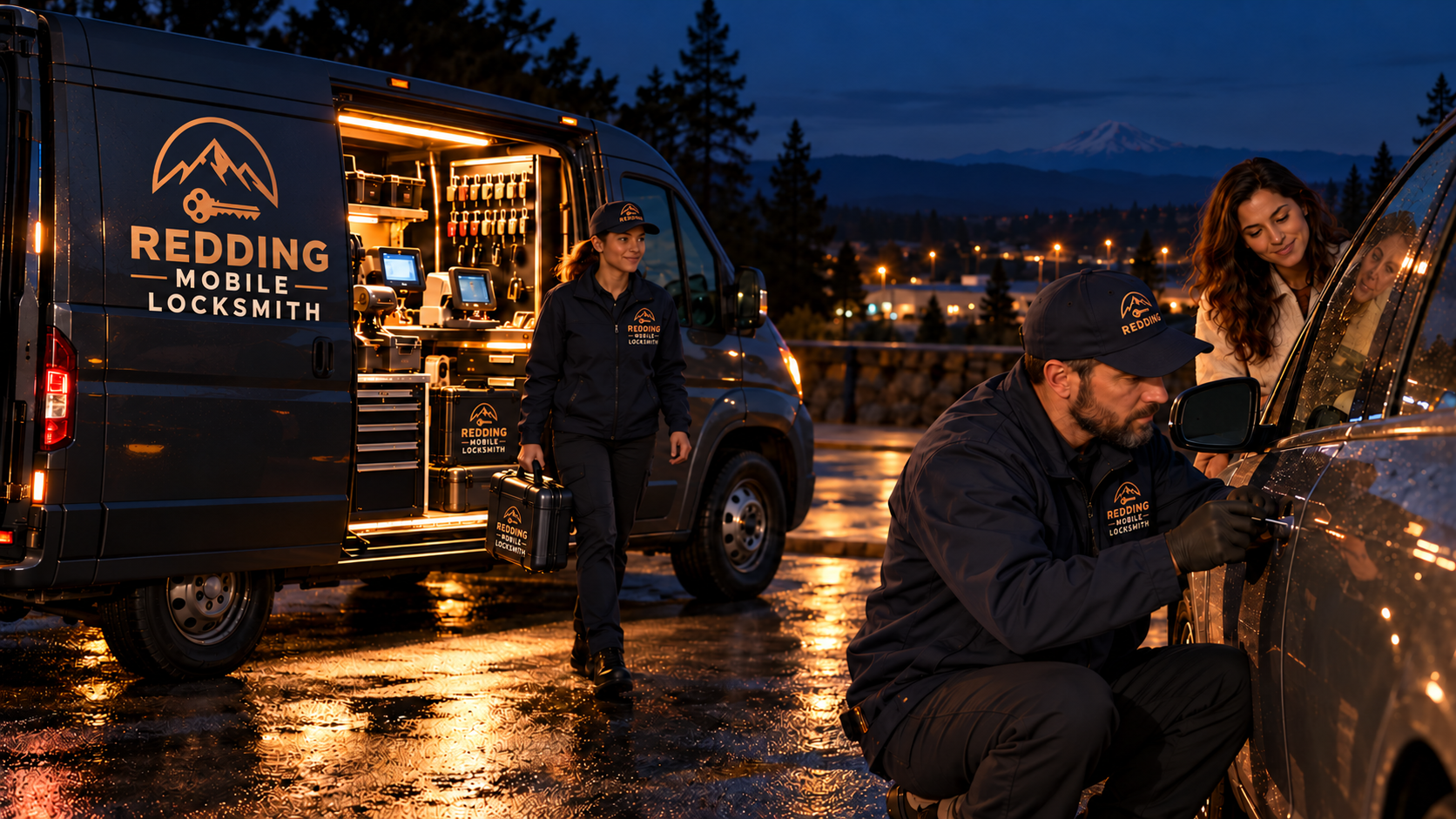
In remote places at night, you should know who is coming before they get there. Ask the dispatcher what the arriving technician will look like and how they will identify themselves. A branded service van and a uniformed team are part of how Redding Mobile Locksmith operates, so you can reasonably expect a technician to look the part and to explain who they are.
When the van arrives, let the technician approach you. Stay near your vehicle and keep your phone ready. Ask for identification if you want to check. Confirm that the name and details match what you were told. If something feels wrong, you can decline the service and call someone else, or contact emergency services if you feel unsafe.
Our guide to confirming who is arriving at your door covers the same habits in a home setting, and they translate well to a roadside.
Once the technician begins work, stay close but out of the way. Cold hands and busy tools do not mix. When the door is open, grab your keys, phone and gloves, and test the key before the technician leaves.
After the door opens: warming up and moving on
Once you are in the vehicle, take a moment before driving. Check that the keys you have are the ones that work. Start the engine and let the heater begin to work. Warm your hands, then check the mirrors and the windows for frost. Do not drive off with iced windows. A few clear breaths and a methodical scrape are worth the time.
Test the lock and unlock buttons on your fob. Try the key in the door as well. If the key sticks, feels rough or catches, it may be worn. A worn key is a common cause of repeated problems, and the worn key symptoms guide explains what to look for. If you only have one key, think about getting a spare cut soon, with a vehicle key replacement, rather than waiting for the next cold night.
If anything about the lock or ignition feels wrong after the technician leaves, tell them before they go. It is easier to address while they are on site.
Drive carefully on the way home. Snow and ice on mountain roads call for patience, longer gaps and gentle steering. The lockout is over, and the goal now is simply to arrive.
Cold weather habits that prevent lockouts
Winter lockouts often come from small, understandable habits. You step out to scrape the windshield and leave the engine running. You open a gate and the door swings shut. You wear gloves, and the keys slip from your grip. You warm the car and leave the fob on the seat. A few habits prevent most of this.
Keep a spare key with a trusted person or in a secure place at home. Make a rule that you take the keys out with you every time, even for a minute. Keep the fob in a pocket that zips, not a loose coat pocket. Replace the fob battery before winter, not after it fails. Check that your key is not worn, and consider a spare if it is.
Keep a winter kit in the vehicle, not in a locked trunk. Warm layers, gloves, a hat and a way to charge your phone are the basics. Keep the vehicle details in your phone notes so you can read them out when your hands are numb.
Our guide to why a spare key matters before you need it goes deeper on planning ahead. If you travel between Dunsmuir, Mount Shasta and McCloud for work or errands, a small bit of preparation is worth a great deal on a cold night.
Common questions
Should I call a locksmith or emergency services first on a cold night?
If a child, a pet or any person is in danger, or someone feels unwell from the cold, call emergency services first. If everyone is safe and you are sheltered, a locksmith request is appropriate. When in doubt, choose the emergency call. A key problem can wait, but a person in the cold should not.
Can I use hot water on a frozen car door?
It is not a good idea. Hot water can crack cold glass and may refreeze, leaving the door worse. Gentle methods, such as clearing loose snow and ice with a soft tool, are safer. If a lock or door is frozen shut and you are locked out, a professional can advise on options without causing damage.
Why does my key fob stop working in the cold?
The small battery inside a fob can weaken in low temperatures, and the signal may become too faint to reach the vehicle. Holding the fob near the door handle can help. Many fobs contain a hidden mechanical key. A new battery usually solves the problem, so replace it before winter.
What should I say about my location on a mountain road?
Give the road or highway name, your direction of travel and one fixed landmark such as a junction, bridge or gate. Say which side of the road you are on and whether it is a pullout or shoulder. Mention snow or ice on the surface, since this affects how a technician approaches.
How can I stay warm while waiting?
Add every layer you have, stay out of the wind and avoid sitting on snow or bare ground. Keep your phone close to your body so the battery lasts. Move gently without sweating. If you feel unwell, confused or numb, contact emergency services right away rather than waiting.
Can I request a locksmith without a phone call?
Yes. The company's phone line is marked as coming soon, so the request form on the contact page is the way to send your details. Use it when you have a steady signal. For any danger to a person, call emergency services first and handle the key problem afterward.