
Home / After dark / Keys for Nissan vehicles
Nissan key guide
Nissan keys at night: lost, locked in or not starting
A Nissan that will not start at night can mean three different things: the key is gone, the key is locked inside, or the key is present and not working. This guide helps you tell them apart and act calmly.
Which problem do you actually have?
The first job is a simple sorting exercise. A Nissan key problem at night almost always falls into one of three groups, and each group has its own solution. Naming the right one saves the dispatcher many questions and gets the correct equipment into the van.
A fourth case, covered below, is a stolen key. Group one: the key is lost. You cannot find it anywhere and you cannot get into the vehicle. Group two: the key is locked inside. You can see it through the window, or you know exactly where it is. Group three: you hold the key, yet the vehicle does not respond. The doors do not unlock, or the engine will not run.
Notice that a fourth possibility exists: a key that is stolen. If you think someone took the key, treat it differently. Do not go back to the vehicle alone, and consider calling the police. A new key can be made later, and the stolen one can often be removed from the vehicle's memory. Our guide on stolen keys: steps to protect your vehicle covers it. Take a slow minute and decide which group describes your night. Say it out loud if that helps. People who sort the problem first tend to give clear descriptions, and clear descriptions lead to fewer wrong turns. The sections below deal with each group in turn.
If the key is lost
When a Nissan key is truly gone, a replacement has to be made. The process has two halves. First, a locksmith cuts a blade if the key has one. Second, the key is matched to the vehicle's computer so the engine will start. Without the second half, a perfectly cut blade only opens the door.
Nissan has used several kinds of keys across its range of cars, crossovers, pickups and vans. Some are plain metal keys with a chip. Some have remote buttons. Some are smart keys used with a push button. Which one you own depends on the year, the model and the trim. We do not claim a key type for a particular year, because it is safer to confirm from the vehicle itself.
Be ready for a few more questions. The technician may ask whether the vehicle has been repaired recently, whether a previous key was made by someone other than the dealer, and whether the alarm sounds when you open the door. These details help the technician choose the right approach. Collect the year, make, model and trim. Add the vehicle identification number if you can see it through the windshield. Then think about proof of ownership, covered below. For the service in full, see vehicle key replacement.
If the key is locked inside
This is the most fixable of the three. Nothing needs to be made. The vehicle needs to be opened safely so you can reach the key you already own. A technician does this with tools made for the purpose, taking care of paint, weather seals and door electronics.
Resist the urge to help. People with a coat hanger, a wedge or a screwdriver cause expensive damage far more often than they open the door. Modern doors have wiring, airbag sensors and delicate latches inside, and a wrong push can break any of them.
Imagine a driver who steps out to open a gate, closes the door out of habit, and hears the locks click with the key in the cup holder. The sinking feeling is familiar to many people, and it says nothing about carelessness. A lockout is one of the most common reasons anyone calls a locksmith. Check one thing before you call: is the engine running? A vehicle left running with the key inside is a different situation, with its own risks, discussed in our guide on keys locked inside a running car. For the usual lockout, see night car lockout. And if a child or an animal is inside, call emergency services before anyone else.
If you have the key and the vehicle will not respond
This is the group that surprises people. You have the key. The doors do not unlock with the button, or the engine will not start. The cause is often a small battery, not the key itself.
Start with the fob battery. A remote or smart key uses a small coin battery, and cold weather makes a weak one worse. Use the hidden blade, if your vehicle has one, to open the driver door by hand. Then follow your owner's manual for starting with a weak fob, which for many vehicles means holding it against a marked spot.
If the dashboard is dim, the starter only clicks, or the lights flicker, suspect the vehicle battery instead. That is a different job from key work, and a locksmith may not be the right call. Our guide on a dead car battery and door locks explains how to tell. If the doors work and the engine cranks but will not run, the vehicle may not recognize the key, which brings us back to programming.
Describing a Nissan key to a dispatcher
The words you choose matter. Here is a short guide to describing what you see.
Be honest about what you are unsure of. If you cannot say whether the vehicle is a particular trim, say so. If you do not know whether the key has a chip, say so. Guessing leads to the wrong tool in the van. You do not need the correct names. Plain words are fine. A technician would rather hear 'a thick plastic head with three buttons' than an incorrect guess at the key type.
If you have a photo of the key on your phone, mention it. If you have the old key, bring every piece. Even a broken key can help a locksmith, because the chip inside may still be readable.
- Say whether the key has a metal blade that you can see.
- Say whether the head has buttons, and how many.
- Say whether you start the engine with a key or a button.
- Say whether the key was made by a dealer or by someone else.
- Say whether you have any other key, even one that does not work.
Proof of ownership and why it matters
A locksmith will ask for your photo identification and for proof that the Nissan is yours, such as the registration or the title. This is true for any vehicle, and it should be. A technician who will make a key for the first person who claims ownership is a danger to every vehicle owner in the county.
Many drivers keep the registration in the glove box. That works until the keys are locked inside or the vehicle is not accessible. A photo on your phone is a sensible backup. If the Nissan belongs to a business or a family member, you may need a letter or another document, and the rules can vary.
If you rent or lease, the situation has its own wrinkles, since the paperwork may be held by the company. Ask when you make contact. Our guide on why a locksmith may ask for identification gives more background, and proof of ownership for key replacement lists what is commonly accepted.
Night conditions across the north state
Where you are changes how the night feels. In and around Redding, parking lots and shopping areas stay lit and busy for part of the evening, then empty out. In the foothills and along the river canyons, a pull off can be dark and quiet within minutes. In the mountain communities, winter nights can bring snow and ice.
Interstate 5 carries a lot of Nissan commuters and travelers. A lockout at a rest stop is a different experience from a lockout in your own driveway. Weather matters as well. Summer heat in the valley makes a locked vehicle uncomfortable once the sun has been on it, and winter cold in the mountain towns makes a long wait on foot risky. Plan your waiting spot with the temperature in mind. Tell the dispatcher where you are, what is near you, and whether other people are around. If you feel uneasy, say so.
Picture a driver pulling into a small lot in Dunsmuir after a late drive and finding the key missing from a jacket. The lot is dark, the temperature is falling, and the nearest open place is a short walk away. The right move is to get to light and warmth first, and then make the call. No key is worth sitting in a dark lot for.
Things to leave alone while you wait
The wait can feel long, and the urge to do something is strong. A few actions are better left undone.
Instead, stay near the vehicle in a visible place, keep your phone charged, and wait for the plan to be confirmed. Calm waiting is a skill, and it protects you.
If the wait is long, let someone you trust know where you are. A short message with the location and the plan is enough. Check in again when the technician arrives and when the work is done.
- Do not keep pressing the start button or turning a failing key. Repeated attempts can drain the battery.
- Do not pull on the door handle with force. Handles and linkages crack.
- Do not break a window. Replacement glass costs far more than any key service.
- Do not follow directions from a stranger who offers to help in a dark lot.
- Do not leave a pet or a child inside while you search for a key.
What happens when the technician arrives
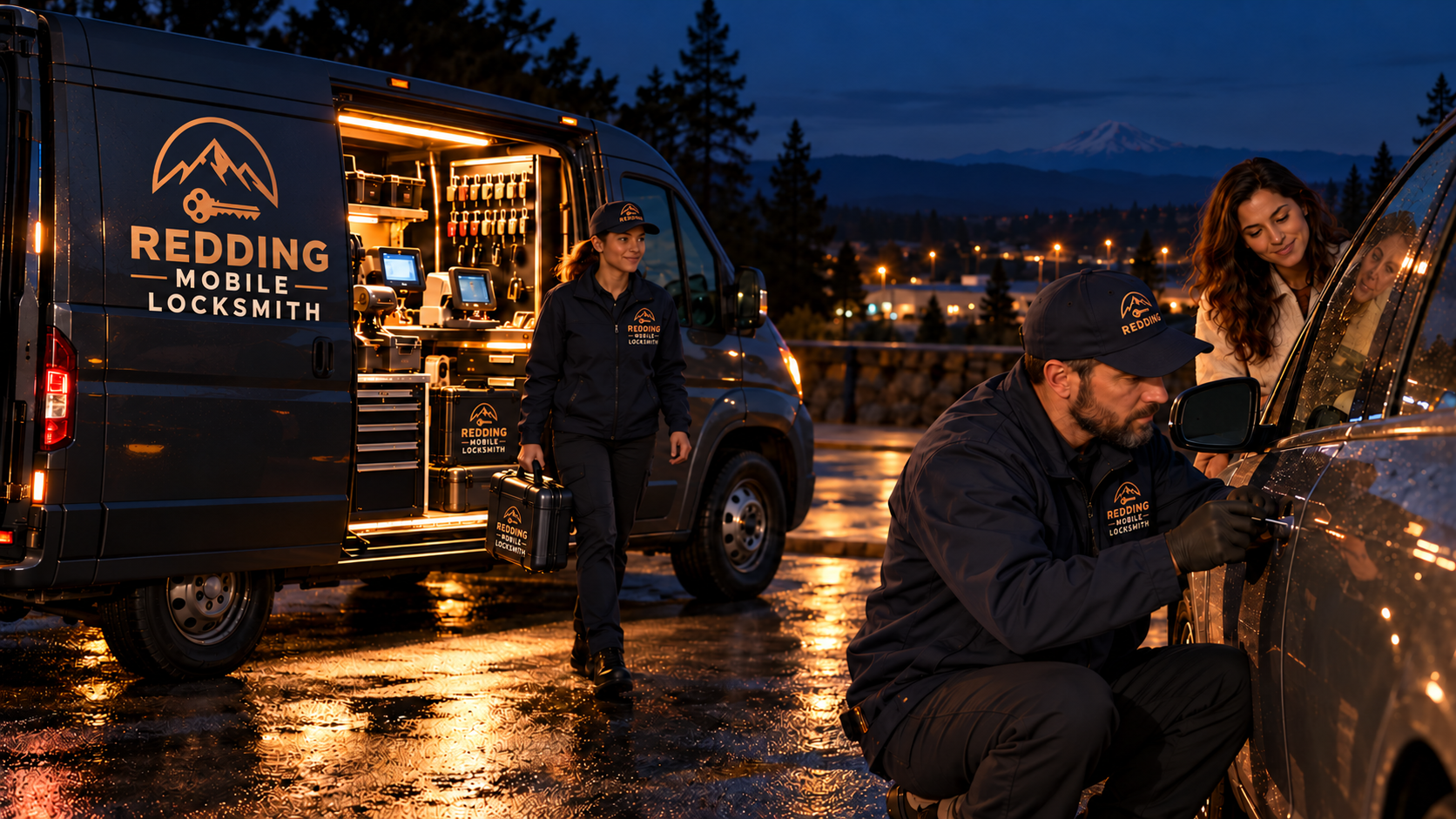
A branded service van arrives, and a technician in uniform introduces the job. You should see the company name on the van and on the uniform. Ask for identification if you want it. Ask what will happen, in what order, and how long it may take. A professional answers plainly.
The technician will check your identification and the vehicle paperwork. Then the vehicle is examined, the key type is confirmed, and the plan is explained. A blade is cut if there is one. The chip or smart key is programmed. The doors, the ignition and the remote are tested.
If something is more complicated than expected, the technician should say so before continuing. Some vehicles need additional steps. Some jobs cannot be completed at the roadside and need a different setup. Ask the technician to show you each key working before you sign off. Lock and unlock all doors, start the engine and switch it off twice, and press every remote button. If the vehicle has a hatch or a sliding door, test those too. A calm explanation is part of the service. For programming itself, our page on transponder programming gives the detail.
Keeping the next night easy
When the problem is solved, spend a few minutes on prevention. Make a spare while you still have a working key, or while the technician is present. Store it somewhere safe and apart from the vehicle. A drawer at home is better than a hiding place on the vehicle itself.
Think of the spare as insurance that costs little compared with a night call out. A copy made now is a calm errand in daylight, with time to ask questions and test the result. A key made under pressure works just as well, but the person holding it is tired and cold. Replace a fob battery before it dies. Pick a date you will remember, such as the change to daylight saving time, and make it a habit. Many drivers change the coin cell once it starts to feel slow. Keep a spare battery in a drawer, not in the glove box. If your key head is cracking, treat it as a warning and get a copy made.
Finally, share the plan. If more than one person drives the Nissan, agree where the spare key lives and who calls for help. Our guides on why a spare key matters before you need it and key fob battery failure at night are good places to start.
Getting help from Redding Mobile Locksmith
Redding Mobile Locksmith is a 24 hour mobile locksmith in Redding, California. We serve Shasta County and Siskiyou County, from Redding, Anderson and Shasta Lake in the south to Yreka, Montague and Fort Jones in the north. Our uniformed teams drive a branded service van with key cutting and programming equipment.
The phone line is coming soon. For now, use the request form on our contact page. Say which of the three groups you are in, give the year, make, model and trim of your Nissan, describe the key, and tell us where you are standing.
To learn about the full range of automotive work, visit vehicle locksmith. Whether the cause is a lost key, a locked in key or a battery, the approach is the same: sort the problem, gather the details, and ask clearly. Stay in a safe place while you wait, keep your identification at hand, and let the process run in order.
Common questions
What is the first thing to do if my Nissan key is missing at night?
Move to a safe, lit place, and search pockets, bags and the ground once more. Then stop searching and gather your identification, registration or title, and the year, make, model and trim. Describe the key and ask for help. Safety comes before the vehicle.
Can a locksmith make a Nissan key if I have no spare?
Usually yes, once ownership is confirmed. The key is created from vehicle information and programmed so the computer accepts it. Steps vary by vehicle, and the technician will tell you plainly what your Nissan needs and whether the work can be done where it is parked.
My Nissan will not start but I have the key. Is the key bad?
Not always. A weak fob battery or a weak vehicle battery causes many of these cases. Try holding the fob where your manual says, and look for a dim dashboard. If the engine cranks but will not run, the vehicle may not recognize the key, which a locksmith can examine.
Is it safe to try opening the door myself?
It is not recommended. Door panels hold wiring, sensors and latches that break easily, and the repair may cost more than the lockout call. A technician uses proper tools and protects the paint and seals. If a child or animal is inside, call emergency services first.
Do I need to bring anything to the visit?
Have your photo identification and your registration or title ready. Bring every key you own, even worn or broken ones, because they can help. Know the year, make, model and trim of the vehicle. If the Nissan belongs to a business or relative, ask what extra paperwork may be needed.
How can I avoid another night like this?
Make a spare and store it away from the vehicle. Replace the fob battery before it fails, and treat cracks or sticking in the key as warnings. Agree with other drivers about who holds which key. These small steps turn a night emergency into a minor errand.