
Home / After dark / Stolen keys, steps to protect your vehicle
Stolen keys guide
Stolen Keys: Steps to Protect Your Vehicle, in Order
Stolen keys are not the same as lost keys. Someone chose to take them, and that changes what you do first. This guide gives the steps in order, with safety placed ahead of the vehicle.
Stolen is different from lost
A lost key is an accident. A stolen key is a decision that someone else made. They may know which vehicle the key fits. They may know where you live. They may already be watching for the right moment.
That is why the first rule is simple. Do not go looking for the thief, and do not go looking for your car alone in the dark. Your safety is worth more than any vehicle or any bag. Everything else on this page comes after that rule.
If you are not sure whether the key was stolen or lost, treat it as stolen until you learn otherwise. The extra steps cost little, and they close doors that a lost key leaves open. If you are certain the key is only missing, our guide on a lost key and vehicle security fits better.
Keep your tone with yourself steady. Fear makes people hurry, and hurrying makes people skip steps. Read the list once, then act on one item at a time. The order below was chosen so that each step makes the next one safer.
Step one: get safe
Move to a lit place with other people. A store entrance, a staffed counter or a public building will do. If someone is nearby and you feel unsafe, call emergency services. Do not wait to be certain.
If a bag or purse was taken, other things went with it. Cards, identification, a phone and a house key may be gone. Take a moment to count what is missing. A written list helps you think clearly and helps anyone you call later.
Do not confront anyone and do not follow anyone. Nobody should risk injury to recover a key or a car. A thief who is surprised can become dangerous, and a vehicle can always be secured afterward.
- Move to a lit area with other people.
- Call emergency services if you feel unsafe or saw the theft.
- Count what else was taken, including cards, identification and your phone.
- Write the time and place of the theft while you remember them.
- Do not follow or confront anyone.
Step two: find out where your vehicle is
Know whether the thief can reach your vehicle. If the car is parked where you left it, and you are far away, you have time to think. If the car is in the same lot as the theft, the risk is higher and nearer.
If you can see the vehicle from a safe place and it is untouched, leave it for the moment. Do not walk to it alone if the person who took the key may be near. Ask a staff member or a friend to stay with you.
If the vehicle is gone, call emergency services and report it as taken. Give the year, make, model, color and plate. Do not try to search for it yourself. A report is a useful record whatever happens next.
Rural roads and trailheads make this harder, because the nearest help may be far away. Our guide on rural road lockouts after dark explains how to plan around that distance.
If you cannot tell whether the vehicle is still where you left it, ask a staff member, a security guard or a friend to look for you. Describe the vehicle clearly and tell them not to touch it. Keep a short written description with you so you do not rely on memory while stressed.
Step three: think about the rest of the ring
A car key rarely travels alone. It often sits on a ring with a house key, a gate key, a mailbox key or a work key. If a thief has all of them, your vehicle is not the only thing at risk.
Look at the ring in your memory. Which locks do those keys open? Where do you live compared with where the vehicle was parked? Did the ring have a tag or a fob that names a business or a street?
For each lock the keys fit, decide whether it needs attention tonight or later. A front door usually comes first. A storage shed can wait. Our page on rekeying explains how a lock can be changed so that old keys no longer fit, and our night house lockout page explains what to do if you cannot get home safely.
Write the ring down on paper while it is fresh. List each key and the lock it opens. This list will guide the whole conversation with a technician later, and it will stop you from forgetting a gate or a side door at the end of a long night.
- List each key on the ring and the lock it opens.
- Mark which locks are at your home, which are at work and which are elsewhere.
- Decide which lock needs attention first, usually the front door.
- Note any tag on the ring that names a business or a street.
- Keep the list on paper, since your phone may be gone.
Step four: secure the vehicle itself
If the vehicle is still yours to reach, it needs a plan. The plan depends on the vehicle. A transponder key or a smart fob can be removed from the vehicle's memory on many models, so the stolen one no longer starts the engine. An older key with no chip cannot be erased, and the lock itself may need to be changed.
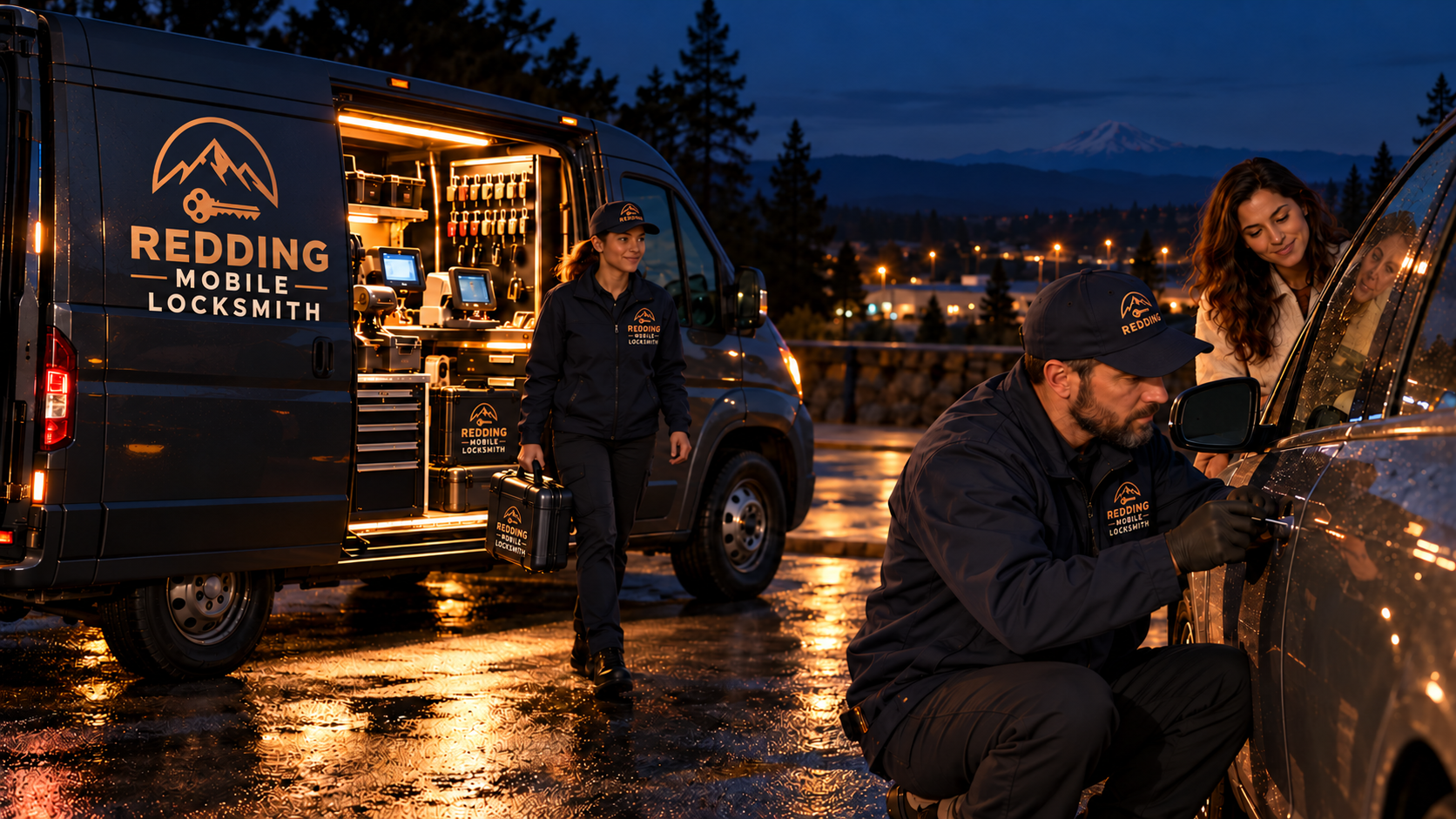
This work needs professional tools. A technician connects to the car, clears the key list where the model allows it, and adds new keys. The branded van from Redding Mobile Locksmith carries cutting and programming equipment for this kind of job, so work can often happen where the vehicle is parked.
Until that work is done, treat the vehicle as open. Do not leave anything valuable inside and do not let the vehicle sit where it was parked longer than needed. Our page on vehicle key replacement describes what the work involves.
Ask whether the vehicle has a second, hidden way in. Some vehicles have a mechanical key hidden inside a fob, and thieves who hold the fob may hold that blade as well. A technician can tell you how your model handles this, and whether a lock cylinder needs attention.
Step five: tell the right people
Make a short list of who needs to know. That usually includes local authorities, if the theft happened or if the vehicle is missing. It may include your insurer. It may include the owner of the vehicle if it is not yours, such as an employer or a family member.
Keep the call short and factual. Say what was taken, when and where. Give a case number to anyone who asks for it later, and write it down. Ask the insurer what documents they want from a locksmith, if any are needed.
Rules vary by place and by policy, so ask questions rather than assume. If a bank card was taken, contact the bank. If a phone was taken, contact your carrier. These are outside what a locksmith does, but they belong on the same list.
Keep every document you receive. A short folder, paper or digital, with the report number, the insurer contact and the locksmith invoice makes later questions simple. Do not post details of the theft on public pages while the matter is open.
- Local authorities, if the theft happened or the vehicle is missing.
- Your insurer, to ask what paperwork they want.
- The owner of the vehicle, if it is not yours.
- Your bank or phone carrier, if a card or phone was taken.
- Family members who use the same vehicle or the same keys.
What to prepare before the locksmith arrives
Preparation protects you. A technician will ask who you are and whether the vehicle is yours. That is not rudeness. The same service could otherwise help the thief, who may hold a copy of your registration too.
Gather your photo identification and proof of ownership. If your identification was in the stolen bag, say so at the start, and ask what else would help. Our guide on proof of ownership for key replacement lists options and explains the reasoning.
Write the vehicle details on paper in large letters: year, make, model, trim and the identification number if you know it. Key types vary by model and year, and those four facts decide what equipment is needed.
If a family member has a registration or a spare key, ask them to help. A second set of eyes at night is useful.
If the technician must verify ownership through the vehicle itself, such as matching the identification number to your paperwork, give them the time they need. It may feel slow at night. It is also the reason the process can be trusted by everyone involved.
- Photo identification, or a clear explanation of why you do not have it.
- Registration, title or other proof that the vehicle is yours.
- The year, make, model and trim of the vehicle.
- Any spare keys you still own.
- A safe, lit place to meet the technician.
Why you should expect to be asked for identification
A technician who asks for proof is doing the job correctly. A locksmith who asks nothing before making a key for a car is a risk to every owner in the county.
You can reduce friction by being ready. Hold your identification so it can be seen. Let the technician check the plate or the identification number against your paperwork. Stay calm if the check takes a few extra minutes.
Your side of the check matters as well. Ask the technician for identification and note the branded van and uniform. Our page on why a locksmith may ask for identification and our guide on confirming who is arriving explain what each side should expect.
Remember that you may be asked for the same proof more than once. A technician checks at the start, and a manager or a dispatcher may check as well. Keep the documents in one place so you can show them without searching your pockets again in the cold.
Night time, rural roads and mountain towns
Distance and darkness change how risky a theft feels. In Redding and Anderson, a lit lot is rarely far away. In the mountain towns of Siskiyou County, help may be farther off, and cold weather turns a long wait into a safety problem.
If you are on a road such as Interstate 5 or Highway 299 and the thief has gone, find a lit exit or pull out where other people can see you. Keep your phone charged if you can. If the phone was taken, ask someone nearby to help you contact emergency services.
In snow or deep cold, keep a warm layer ready. Our guide on mountain roads, cold nights and lockouts covers waiting safely in low temperatures, and waiting for help in a parking lot covers urban parking areas.
Light matters more than distance. A well lit entrance with one other person nearby is safer than a quiet spot close to your car. Choose a meeting place that anyone could find from a plain description, then tell the dispatcher exactly why you chose it.
Longer term: reduce the chance it happens again
Once the night is over, look at habits. Keep car keys apart from house keys when you can. Do not label keys with an address. Keep a spare in a safe place that is not the vehicle itself.
Many people also benefit from a plain routine for bags and pockets in public places. Use a zipped inside pocket. Keep your bag in view. Take keys out of a coat pocket before you hang the coat on a chair.
A spare key matters here too. With a spare in hand, the stolen key can be removed from the vehicle's memory without leaving you stuck. Our guide on why a spare key matters before you need it explains the reasoning. For your home, the home locksmith service page covers lock upgrades.
Consider a short family conversation too. If several people share the vehicle, everyone should know that a key was stolen and which keys no longer work. Our guide on managing keys for a shared family vehicle explains how to keep a household in step.
- Keep car keys and house keys on separate rings when you can.
- Never attach an address or a business name to a key.
- Store a spare somewhere safe that is not the vehicle.
- Use a zipped inside pocket for keys in crowded places.
- Check your pockets and bag before you leave any building.
Starting a stolen key request
Redding Mobile Locksmith is a 24 hour mobile service for Shasta County and Siskiyou County. The phone line is coming soon. To begin, use the request form on the contact page. Say that the key was stolen, where you are and where the vehicle is.
A stolen key is a priority detail. Mention it plainly so the request is treated with the right care. Add the vehicle details and note whether you can meet the technician in a safe, lit place.
Our after hours emergency page explains how night requests are handled in general terms. The guides section collects every related topic.
Have patience with the process. A calm request with accurate details tends to produce a calm and accurate response. Keep your phone in reach, stay in a safe place and let the technician confirm each step before work begins.
Common questions
What should I do first if my car keys were stolen?
Get to a safe, lit place with other people and call emergency services if you feel unsafe or saw the theft. Do not follow or confront anyone. After you are safe, work out where your vehicle is and which other locks the keys fit. Securing the car comes after your own safety.
Can a stolen key be stopped from starting my vehicle?
On many vehicles, yes. A technician can clear the stored key list and add only the keys you hold, so the stolen one no longer starts the engine. Some models behave differently, and older keys with no chip cannot be erased. Ask about your exact year, make, model and trim.
Should I tell the authorities even if nothing else happened?
Rules vary by place, so ask. A short report with the time, place and a description of what was taken is useful for your own records and for your insurer. If the vehicle is missing, treat that as an emergency and report it right away.
What if my house key was on the same ring?
Treat your home as exposed. Do not go to the house alone if you feel unsafe. Decide whether the locks should be changed so old keys no longer fit. The rekeying service handles that, and it can be done without replacing the hardware on the door.
Will the locksmith ask for proof the car is mine?
Yes. Expect to show photo identification and proof of ownership such as registration. This protects you, because the same service could otherwise help a thief. If your identification was stolen too, say so on the first call and ask what other proof would work.
Is it safe to wait next to my vehicle?
Only if the thief is clearly gone and the area is lit and busy. If you feel uneasy, wait inside a business or in a public space and meet the technician there. Cold or isolated locations raise the risk, so choose people and light over closeness to the car.