
Home / After dark / Keys for Honda and Acura vehicles
Honda and Acura keys
Honda and Acura keys: a calm plan for the night
Honda and Acura vehicles share a corporate family, so people often assume their keys work the same way. They may not. Here is how to sort out your key, stay safe, and get a working replacement in the dark.
Two names, one set of questions
Honda and Acura are separate brands. Acura sits on the premium side, and its vehicles often come with more features around the key. The question you face is the same for both: which kind of key do you have, and what does the vehicle need to accept a new one?
No general rule answers that. A key system can change from one model year to the next, and trim levels inside one model can differ as well. We do not name key types for particular years, because the safe approach is to look at the exact vehicle in front of the technician.
That is why the first thing a good dispatcher asks is for the year, make, model and trim. Have those four items ready and the rest of the call becomes much easier. Why the trim? Because two versions of the same model can leave the factory with different keys, different start systems and different security hardware. The trim often decides which one you own. If you are unsure of the trim, a badge on the rear, the registration or the vehicle identification number can settle it.
Read your own vehicle first
You already hold most of the answers. Look at how you start the engine. If you turn a key in a slot beside the steering wheel, your vehicle uses a key with a blade. If you press a button while the key stays in a pocket or bag, your vehicle uses a smart key.
Next, look at the key itself. A blade with a thick plastic head often means a chip is inside. A key with lock and unlock buttons built into the head is a remote head key. A flat fob with a small emergency blade tucked inside is a smart key.
Write down what you see. If the key is lost, describe it from memory with whatever detail you recall. Then tell the dispatcher whether the vehicle has a power sliding door, a trunk release, or a remote start feature, since those can be tied to the buttons on the key. Our guide on preparing your vehicle information for the call gives a longer checklist.
The key you hold and the key the vehicle knows
Most Honda and Acura keys from the transponder era onward carry a small chip. When you turn the key or bring the fob near the start button, the vehicle's computer asks the chip for a code. If the code matches, the engine may run. If it does not, the engine may crank and stop, or refuse to turn over at all.
This is the part many people do not expect. A key that is cut perfectly can still fail, because the vehicle has not learned it. A locksmith must program the chip or register the smart key. In the field, that means connecting equipment from the van to the vehicle and teaching it the new key.
The technician also checks that the programming took hold on every key, not only the new one, because programming sometimes needs all keys present. Bring every key you own to the visit, including worn ones. A good locksmith explains that process before starting. For a plain description of how the chip works, read transponder keys explained for night emergencies. The service page for transponder programming shows how the work fits together.
Acura and the extra features
Acura vehicles often include more convenience features tied to the key: memory seats, mirror positions, remote start and keyless entry on several doors. When a replacement key is made, some of those settings may need to be set again. A driver who expects the seat to return to a favorite position may be surprised when the new key does not do that on its own.
Picture an owner who gets the new key and finds that the remote start no longer responds. Nothing is broken. The remote start feature was never taught to the new key, or the vehicle needs a separate step to link it. A short conversation at the start of the visit prevents that surprise. Ask the technician which features will work with the new key and which may need a separate step. Some are stored in the vehicle and respond to whichever key is present. Others are tied to the key itself. The answer depends on the model and the year, so the technician should look rather than guess.
If you drive an Acura and a family member shares it, the memory settings can matter more than you think. Two drivers, two keys, and different seat positions are a normal setup. Mention it when you make contact so the visit covers it.
First steps when the key is gone at night
Go in this order. Calm checklists beat clever ideas.
When you have those pieces, reach out. If the situation involves a child or an animal locked inside the vehicle, call emergency services first and do not wait. Our guide on locked out at night: a safety first plan expands on this order of action.
Some people ask whether they should wait for daylight. If you are in a safe, lit place with shelter, waiting is a reasonable choice, and the request form is open at any hour. If you are somewhere exposed, cold, hot or isolated, do not wait. Move to safety and ask for help now. The decision belongs to you, and either one is fine as long as you are not putting yourself at risk. Remember that a key problem is rarely an emergency of the body. It is an emergency of inconvenience, and inconvenience can wait ten minutes while you make a safe place for yourself.
- Move to a place with light and, if possible, other people. Tell someone where you are.
- Check pockets, bags, the ground and the cargo area one more time, then stop searching.
- Look at the weather and your phone battery. Put on warm clothing or find shade as needed.
- Gather your photo identification and your registration or title.
- Write down the year, make, model and trim, plus a description of the key.
Valet keys, borrowed keys and shared keys
Some Honda and Acura vehicles come with a valet style key or a spare that was handed to a family member. Those keys can create confusion. A key given to a valet attendant may still be at a business. A spare lent to a relative may be in another town. Before you call a locksmith, make one phone call to the person who might have it.
Picture a driver who leaves a vehicle with a valet at an evening event. At closing time the attendant has gone, and the key is not where it should be. The first step is to contact the business, not to order a new key. Our guide to keys left at a business or with a valet covers that case.
If the key was truly lost and others may have access to the vehicle, tell the locksmith. They can often remove old keys from the vehicle's memory so only the new ones start the engine. That step is worth asking about any time a key might have fallen into the wrong hands.
When the key is inside and the doors are locked
A lockout has a different cause and a different solution. You have the key. It is just out of reach. On a Honda or Acura, this happens often with smart keys: the fob stays in a bag on the back seat, the doors lock themselves, and the start button no longer works because the fob is out of range.
Do not try to pry the door or push a tool into the window. Door panels hold wiring and side impact parts, and a bad attempt can break them. A trained technician opens the door with proper tools, protects the paint and the weather seal, and checks that everything still works afterward.
For lockout work, our page on night car lockout describes how it goes. Remember that for a child or a pet inside, the answer is always to call emergency services first. The guides on a child inside a locked car and keys locked inside a running car are worth reading before you ever need them.
Commuters, Interstate 5 and the long evening
Many people in the north state commute along Interstate 5, between Redding, Anderson and Shasta Lake. A commute creates its own patterns. Keys travel in work bags, gym bags and jacket pockets. Vehicles sit in parking lots for hours. A key can slip out of a pocket at a gas stop and be gone by the time you notice.
In summer, the valley stays warm well after dark. A lockout in a hot vehicle is uncomfortable, and for anyone with a medical need it can become urgent. Plan to wait in shade or in an air conditioned building, and carry water. In winter, the foothills and mountain towns can be icy, and a wait outside in the cold is unpleasant and can be unsafe.
Rural stretches add another factor: signal. Parts of the foothills and the river canyons have weak phone coverage, and a call can drop without warning. Share your location early, repeat it, and say what you will do if the call ends. Tell the dispatcher about the conditions. A technician who knows you are outside in the cold or in a lot with few lights can plan the visit around that. You may also be asked to stay on the line or move to a better place. Take that request seriously.
Worn keys and the signs of trouble
Most key emergencies do not arrive without warning. A Honda or Acura key that has been used for years can show wear. The ignition may need a wiggle. The buttons on the remote may work only on the third press. The plastic head may have cracked, exposing the chip. Each of these says the key is nearing the end.
A smart key wears in a different way. The battery weakens, the buttons stop responding, and the range shrinks until the vehicle no longer notices the key when you sit down. It may feel like a mystery, but it is usually a battery, and a fresh coin cell may solve it. If it does not, the fob itself may be failing. When a worn key finally fails, it tends to do so at the worst moment. Cold weather, a wet pocket or one more drop onto the pavement can finish it. A blade worn smooth also wears the ignition cylinder, so a bad key can create a repair that a new key would have avoided.
Our guide on worn key symptoms explains what to look for. If you notice any of them, get a new key made while you still have a working one to copy from. It is simpler, calmer and usually kinder to your schedule.
After the visit: test everything
When the technician finishes, do not accept a nod and a handshake as proof. Test the work yourself. Unlock and lock every door with each key. Start the engine, turn it off, and start it again. Try each button on the remote. Check that the trunk opens. If the vehicle has a push button, press it with your foot on the brake and confirm the dashboard behaves normally.
Keep the receipt or written note the technician gives you, and photograph the new key next to the old one if you still have it, so you can describe it later. Ask how many keys the vehicle now knows and whether the lost key has been removed. Ask what to do if the new key fails later. A technician who answers calmly is one you can trust.
Then think about the spare. A second key made during the same visit is simpler than a new call later. Keep it in a safe place away from the vehicle, and read adding a spare or replacing every key if you are choosing between the two.
How to ask Redding Mobile Locksmith for help
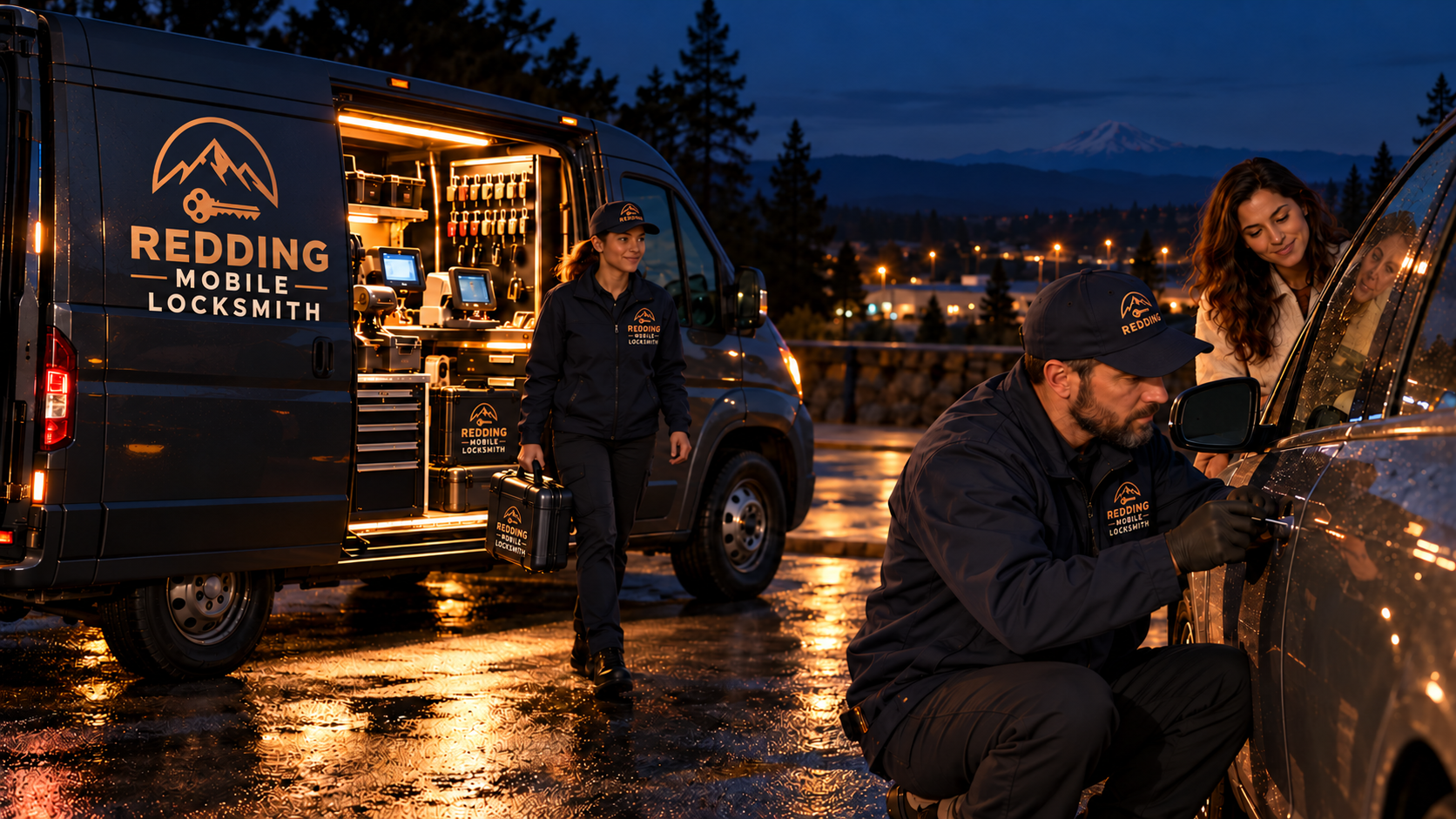
Redding Mobile Locksmith is a 24 hour mobile locksmith based in Redding, California, serving Shasta County and Siskiyou County. Our teams wear uniforms and arrive in a branded service van carrying key cutting and programming equipment. For the full range of work, see our vehicle locksmith and vehicle key replacement pages.
The phone line is coming soon. Until then, use the request form on the contact page. Give your location, the year, make, model and trim of the Honda or Acura, the kind of key you lost, and whether you have a spare. Say if you are outside and how the lighting looks.
Please be patient with the questions. Each one is there to protect you, the vehicle and the technician. We keep the process plain: confirm who you are, confirm the vehicle is yours, explain the plan, do the work and test it with you. That is all a night key problem should require.
Common questions
Are Honda and Acura keys the same?
Not necessarily. The brands share a corporate family, yet key systems vary by model, year and trim. Do not assume a key from one vehicle suits another. Give the dispatcher the year, make, model and trim, and describe how your vehicle starts, so the right equipment arrives in the van.
Can a locksmith program a new Honda or Acura key without the old one?
Usually a locksmith can, once ownership is confirmed. The key is created from vehicle information and then programmed so the computer accepts it. The steps depend on the system, and the technician will explain them and tell you plainly whether the job can be completed where the vehicle sits.
Why does my new key open the door but not start the engine?
The chip inside has not been taught to the vehicle. Cutting the blade only solves the lock. The computer must also learn the chip or smart key. This is why a key bought elsewhere and simply cut often fails, and why programming is part of any proper replacement.
Will my Acura seat and mirror memory work with a new key?
It depends on the model and year. Some settings are stored in the vehicle, and others are tied to the key. Ask the technician before the work is done, and mention any shared drivers. They can tell you which settings to expect and which may need to be set again.
What should I do if my smart key is locked inside?
Do not force the door. Stay in a safe, lit place and request lockout help. A technician opens the door with proper tools and checks the vehicle afterward. If a child or animal is inside, call emergency services first and stay with the vehicle until help arrives.
Should I replace every key after losing one?
Consider it if the lost key could be in the wrong hands. A locksmith can often remove the lost key from the vehicle's memory so only the new ones start the engine. If the key is simply misplaced at home, a spare may be enough. Ask the technician which fits your case.