
Home / After dark / Trailhead lockouts
Trailhead guide
Trailhead lockouts: what to do when the hike ends badly
The hike went well, the light is gone, and the keys are not where you thought they were. A trailhead lockout is its own kind of problem, with no address, little signal and a long day behind you.
Why trailhead lockouts happen so often
Picture a day hiker finishing a long loop as the light fades. Legs are tired, the pack is heavy, and the parking area is empty except for a vehicle or two. This is exactly the moment when small mistakes show up. The keys stayed in a jacket that is now in the vehicle. The fob dropped out of a pocket somewhere along the trail. The remote battery died after hours of cold. Or the door was shut with the keys on the seat when you changed boots.
Trailheads create lockouts for reasons that have little to do with carelessness. People swap clothes in the lot. They hand keys to a friend who locks the vehicle. They leave the fob in a pack and then change which pack they carry. Water crossings, scrambles and rain can damage a fob or wash a key out of a pocket. A key that was fine in the morning can be missing by the afternoon.
The setting makes it worse. Many trailheads in Shasta County and Siskiyou County sit at the end of a long gravel or paved road, with no lit buildings, no foot traffic and often weak phone signal. Around the mountain country near Mount Shasta, Lakehead and the lake basins, the terrain blocks reception in pockets.
This guide treats the trailhead lockout as a planning problem. The earlier you think about it, the calmer the evening is. Our overall safety first plan for night lockouts applies, and this page adds the details that are specific to a remote lot.
Check yourself and your group first
Before you worry about the vehicle, check people. Count everyone in your group and confirm that each person is accounted for, present and not hurt. After a long hike, fatigue, dehydration and cold are common. If anyone feels unwell, confused or in pain, call emergency services. That is outside what a locksmith handles, and this guide cannot give medical advice.
Next, think about light and warmth. Put on every layer in your pack. A headlamp or phone light helps, but save the battery. Drink water if you have it, eat something if you have food, and sit on your pack rather than on cold ground. If the group includes children or an older person, make their comfort the first priority.
Check whether anyone has an animal with them. A dog that was in the vehicle during the hike is a different matter than a dog on a leash beside you. If a pet is locked inside the vehicle, call emergency services first and follow their direction. The same goes for a child. The guides on a pet inside a locked vehicle and on a child in a locked car explain the order of calls.
Once everyone is calm, safe and warm enough, you can address the key.
Search for the key before you give up on it
A little methodical searching can solve the problem in many cases. Stop and empty your pockets and your pack onto the ground in a lit spot. Check every zipper pocket, the lid of the pack, the hip belt pockets and the pockets of any jacket you wore at any point. Check boots, since keys sometimes drop into a boot cuff or a gaiter.
Think back through the hike. Where did you last use the key or the fob? Did you stop to take a photo, change layers or tie a shoe? Did you hand your pack to someone? Often a key is in a friend's pack because they carried a bag of shared gear. Ask the group before you assume it is gone.
Walk around the vehicle with a light and look underneath and around the tires. Keys sometimes fall from a pocket as you step out of the vehicle and drop into the gravel. Look inside the vehicle through the windows, shading the glass with your hand. You might see the key on the seat, in the cupholder or in the ignition.
If you find that the key really is inside the vehicle, you are dealing with a lockout. If it is simply gone, you may be dealing with a lost key, which involves a different kind of job, including vehicle key replacement and key programming.
Lockout, lost key or dead fob: knowing the difference
It helps to name your problem exactly. A lockout means the key exists and is inside. A lost key means it is gone and you cannot get into the vehicle or start it. A dead fob means you have the fob but it does not respond. Each leads to a different next step.
With a lockout, the technician's task is to open the door without damaging it. No new key is required. With a lost key, the vehicle may need a new key cut and programmed to the vehicle's system, and that depends on year, make, model and trim. A technician arriving in a service van with key cutting and programming equipment can often handle this on site, but a complex system may need more time or a visit to another location.
With a dead fob, you may still have a mechanical key blade hidden in the fob. Check the fob case for a small release button. If the blade is there, try the door lock, which often sits under a small cap on the handle. A dead fob battery is usually a simple fix, and some vehicles can start by holding the fob against a marked spot in the cabin, though the method varies by model and year. Look at key fob battery failure at night for more.
Tell the dispatcher which of the three you have. It tells them what to bring.
Describing a trailhead location
This is the hardest part of any trailhead call. A trailhead often has a name that is well known locally and a different one on maps, and many parking areas have no address at all. A dispatcher may not know the name you use. Describe the place in a way that works for someone who has never been there.
Begin with the road you drove in on. Say the highway you turned from, the direction of the turn and roughly how far in you drove, in terms of landmarks rather than distance: a bridge, a cattle guard, a gate, a fork. Then describe the parking area. Is it gravel or paved? Is there a restroom building? A signboard? A fenced trailhead register? A creek beside it?
Tell the dispatcher whether the road in is paved, graded gravel or rough dirt, and whether it is passable for an ordinary van. In winter, mention snow or ice. In summer, mention dust or washboard. This helps a technician judge the approach.
If your phone shows a map location, read the coordinates or the nearest road names aloud. If you can send a location by text, do so, but give a spoken description as backup. The location checklist for dispatchers gives a longer list.
Signal, battery and a plan for poor coverage
Reception at trailheads is unreliable. You may find that one spot in the lot has a bar of signal and the rest has none. Before you stand in the dark waving a phone, check whether a short walk back along the access road improves it. Only do this if the road is safe and you are not leaving someone behind.
Save battery. Turn on low power mode, dim the screen, close apps and keep the phone warm in an inner pocket. Cold drains phone batteries sharply after a long day outdoors. Carrying a small power bank on a hike is a sensible habit, and you should keep it in your pack rather than in the vehicle.
If you have no signal at all, decide whether to wait for another visitor, walk to a place with coverage or flag down a passing vehicle. Leave a note on the dash or windshield if you leave, or tell someone in your group where you are going. Do not split a group at night without a clear reason.
When you do reach signal, send a clear request. The company's phone line is marked as coming soon, so the form on the contact page is the way to submit details. If there is any danger, contact emergency services instead.
Preparing for the technician
Once you have a way to reach help, prepare the details a technician needs. Have the year, make, model and trim of the vehicle ready. Key systems vary by model and year, so guessing is not enough. Say what kind of key you use: a plain metal key, a key with a plastic head, a remote with buttons, or a push to start fob.
Tell them whether the key is inside, lost or broken, and whether the engine is running. Mention whether the vehicle has an alarm. Mention whether anyone has a spare and can reach you. If a friend or family member can bring a spare key to the trailhead, that may be the simplest answer, and you should tell the dispatcher so you do not request service you do not need.
Keep your identification where you can reach it. A professional will usually ask you to show that you are entitled to the vehicle. If your wallet is inside the vehicle, another form of proof might work, such as a photo on your phone or a family member vouching by phone. Rules vary, so ask the dispatcher what is accepted. See why a locksmith may ask for identification.
Prepare your own expectations too. A trailhead may take a while to reach, and the technician may need to find the right turn in the dark. Your clear description matters more than anything else.
Staying safe while you wait
A trailhead at night is quiet, but it is not empty. Wildlife moves through parking areas after dark, and the sounds can be startling. Keep your group together, keep food sealed in your pack and keep your voice calm. Do not wander into brush or down trails with a dim light.
Choose your waiting spot with care. Stay where you can see the road in, and where headlights from an arriving van will reach you. Avoid sitting directly in the lane of the access road. If other vehicles pass, stay visible, but you do not need to approach drivers you do not know.
Keep warm. Cold air settles in canyons and creek bottoms at night, and a trailhead near a stream can feel colder than the valley floor. Use your layers, keep insulated from the ground and share warm drinks if you have them. Do not run the engine of a locked vehicle if you can't get in. Do not try to build a fire on dry ground without knowing local fire rules, as summer fire danger in the north state is real.
Let someone know where you are. A text to a family member with your location and the vehicle details is wise. If your group has a planned return time, tell them about the delay so they do not worry.
When the technician arrives
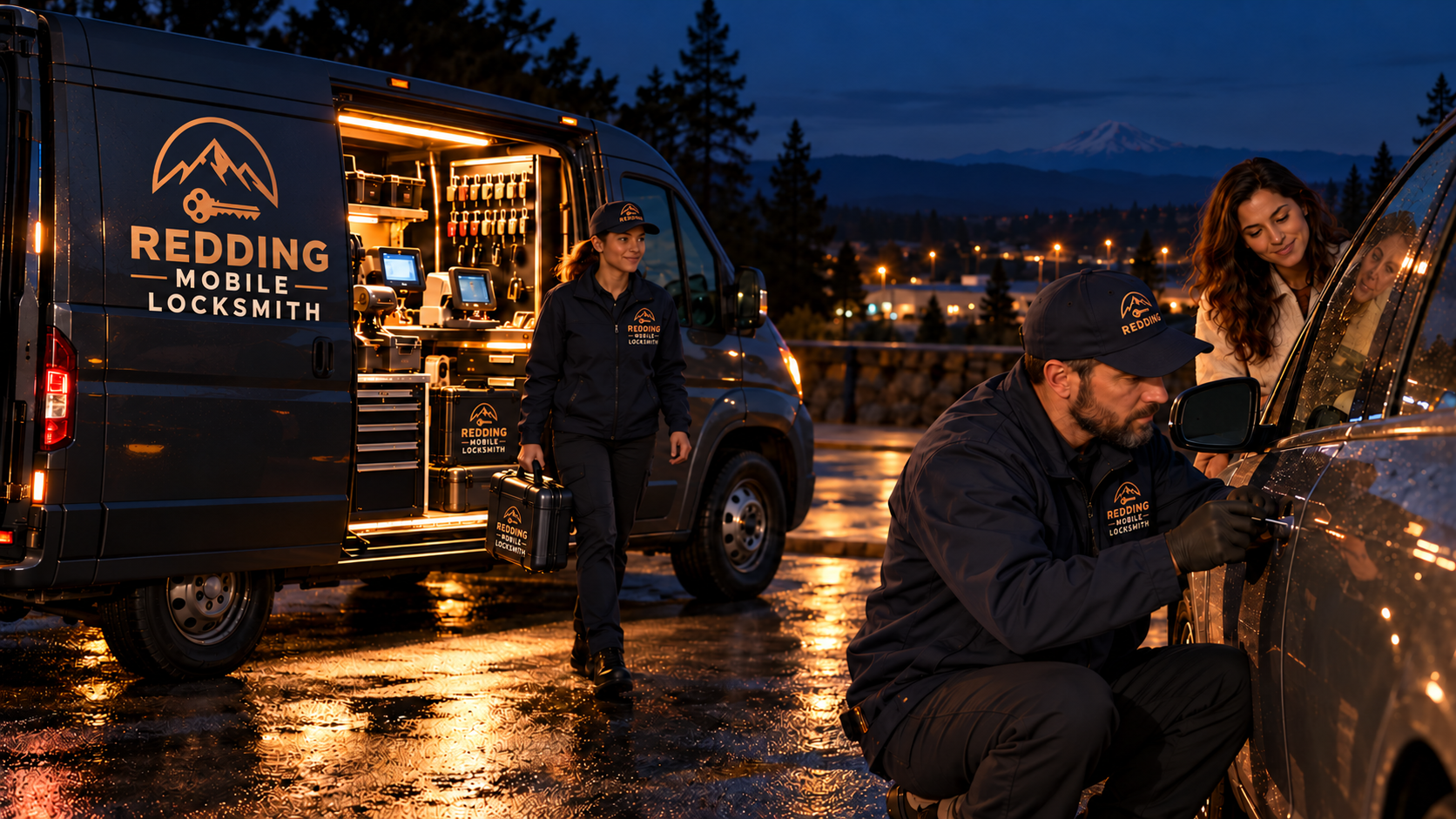
At a remote trailhead, a professional arrival should be calm and clear. The technician should introduce themselves and confirm your name and the vehicle. They will usually ask for proof that you are entitled to the vehicle before starting. This protects you and the vehicle.
Let the technician look over the situation. They may ask a few questions about the key and the lock. They will use professional tools and aim to avoid damage. You do not need to supervise closely. Stand where you can see but not in the way.
After the door is open, collect your things, then test the key. Press the buttons on the fob. Start the engine if the key allows. If the key was lost and a new one was made, check every function: lock, unlock, trunk, panic and start. If something does not work, mention it before the technician leaves.
Take a moment before leaving the lot. Check that the trailhead is clear of gear, that everyone is in the vehicle and that the headlights and windows are clear. Drive out slowly on the access road, since gravel at night hides ruts and animals.
Habits that prevent a trailhead lockout
The surest fix for a trailhead lockout is a small routine before the hike. Choose one place for the key and always use it. A zipped pocket on the pack or a lanyard clip works well. Do not leave the key in a jacket you may take off. If you drive with a group, designate one person to hold the key for the day.
Leave a spare key with someone who can reach you, or in a secure place at home. Do not hide a key on the vehicle, since that is the first place a thief checks. Consider a simple spare key that opens the door only, if your vehicle allows it, and ask a professional about options such as a spare or replacement key.
Replace your fob battery on a regular schedule, and before a big trip. Keep a power bank and the vehicle information in your pack. Tell someone your route and return time.
If you hike often around the Redding area, Redding's local night car lockout page explains how coverage works there, and the night car lockout service page describes the work itself.
Common questions
What if I have no phone signal at the trailhead?
Save your battery, check whether a short, safe walk along the access road brings a signal, and stay with your group. Do not split up at night without a reason. If someone is unwell or in danger, flag a passing vehicle or move to a place where you can call emergency services.
What is the difference between a lockout and a lost key?
A lockout means the key is inside the vehicle and the technician opens the door. A lost key means the key is gone, and the vehicle may need a new key made and programmed. Tell the dispatcher which applies so the right equipment and time are planned.
How do I describe a trailhead with no address?
Give the highway you turned from, the direction, the nearest landmarks along the access road, and what the parking area looks like. Mention the road surface and any gates. If your phone shows a location, read the nearest road names aloud. Clear landmarks help more than distances.
Can a dead key fob be the reason I cannot get in?
Yes. A weak battery can stop a fob from working, especially after hours in the cold. Many fobs hide a small mechanical key blade. If you find it, try the door lock. A new battery often solves the issue. Mention to the dispatcher that the fob is dead rather than lost.
Should I call for a locksmith if a pet is in the vehicle?
No, call emergency services first. A pet or a child inside a locked vehicle is an emergency, and an operator can direct the response. A locksmith is for a key problem, not for a living being in danger. Once everyone is safe, the key issue can be handled calmly.
What should I bring on a hike to avoid being locked out?
Carry the key in a zipped pocket on your body, not in the vehicle. Leave a spare with someone you trust. Bring a power bank, a headlamp and warm layers, and write down your vehicle year, make, model and trim in your phone notes. Tell someone your route and return time.