
Home / Anderson / Night House Lockout in Anderson
Anderson, 96007
Locked Out of Your Anderson Home After Dark
Night changes a lockout. The street is quiet, the porch is dim, and the plan has to be simple. This page walks Anderson households through the steps, the proof a locksmith may ask for, and how to stay safe while you wait.
Start with the quiet minute
Stop moving for a moment. Most night lockouts get worse because someone rushes. A person yanks on a window, climbs a fence or breaks a pane, and a ten minute problem becomes a repair bill and an injury risk. Take a breath and stand somewhere with light.
Picture an angler who spent the evening along a river bank south of Redding and drives home to Anderson at dusk. The truck is parked, the porch is dark, and the house key is gone from the pocket. It may be on the river bank, in the truck bed, or in a jacket on the back seat. That person has a real decision to make, and the first move is not to force anything.
Look at the situation as three questions. Is anyone inside who needs help right now? Is anyone outside who is cold, hurt or unsafe? Is the door actually locked, or only stuck? Answer those in order. If a child or a person who cannot manage alone is inside, call emergency services first and let the locksmith come second.
Then settle on a plan you can describe in one sentence. For example: I am staying by the truck under the light until the technician arrives. A plan that short keeps you from wandering and keeps whoever you call from worrying. It also gives you something steady to say when the dispatcher asks where you are.
Check the easy things before you call
Walk the outside of the house at a calm pace. Try the other doors you own, including the side door, the garage entry door and any door to a patio. Many people lock the front and forget that the back was never latched. Do not climb onto roofs or reach through broken glass.
Check the pockets, the bag and the vehicle one more time. Check the truck bed, the cup holder and the glove box. A key that fell between a seat and a console is common after a day outdoors. If you carry a spare with a neighbor or family member, that call can end the problem without a locksmith at all.
Think about who else has access. A roommate, a spouse, an adult child or a landlord may be a short call away. If someone is on the way with a key, a locksmith may not be needed. If nobody can arrive, you have your answer, and you can call without guilt.
- Try every exterior door you are allowed to use.
- Check pockets, bags, vehicle seats and the truck bed for the missing key.
- Call anyone who holds a spare, such as family or a landlord.
- Look for a lockbox or smart lock code you may have set up and forgotten.
- Stay out of windows, roofs and fences.
A lockout and a failed lock are not the same
A simple lockout means the lock works, but you have no key. A failed lock means something inside has broken. The difference matters because it changes the tools and the time. A working lock can often be opened without damage by a trained person using the right method.
Tell the dispatcher what you notice. Did the key turn halfway and stop? Does the handle spin without moving the latch? Is the deadbolt thrown, or only the knob lock? These details help the technician decide what to put in the van before leaving. A van that carries professional tools and common hardware is useful, but a clear description makes it more useful.
If the lock is damaged, the work does not end at opening the door. You may need a repair or a new cylinder before you can secure the home for the night. Ask about that early so the visit does not stall at the doorstep. A good dispatcher will explain what a failed lock means for the evening.
What proof of residence means
Any responsible locksmith wants to know that the person asking for the door to be opened lives there or has the right to enter. That is not rudeness. It protects you, because the same method that opens your door for you would open it for anyone. Expect the question.
Proof is usually simple. A driver license with the address, a piece of mail, a lease, a utility bill or a photo on a phone that shows the person at the property can all help. A renter may be asked about the landlord. An owner may be asked about the name on the mortgage or tax bill. Rules and policies vary, so ask the dispatcher what the technician will want to see.
If your wallet is locked inside, do not panic. Think about what you can still show. A phone with account details, a text thread with a landlord, or a neighbor who knows you can all support the request. Say plainly what you have. A technician can decide what is reasonable once they see the situation.
What to tell the dispatcher
Give the street and the nearest cross street, and say whether you are at the front, the side or the rear of the home. Anderson has older homes, newer homes and rural parcels, and a long driveway or a gate can hide a house number. Mention any gate code, dog or dark stretch of road that the technician should expect.
Name the door and the lock. A front door with a deadbolt is a different job from a sliding patio door or a garage entry. Say if it is a knob, a lever, a deadbolt or a smart lock with a keypad. Say whether the key went in and turned, or never entered the keyway.
Share your own situation. Tell them if you are cold, if there is a baby or a pet inside, or if you are alone. You can also tell them how you want to be contacted while you wait. The request form on the contact page is also an option when you are able to type a message.
Waiting safely in a small city
Anderson sits on the valley floor along Interstate 5, so the night can be warm in summer and sharply cold in winter. Plan for the weather. If you have a jacket in the truck, put it on. If the night is cold, sit in the vehicle with the doors locked instead of pacing the yard.
Choose a spot with light and a view of the street. A neighbor's porch, a lit entrance or your own vehicle parked under a light all work. Keep your phone charged and keep it in your hand. Tell one person where you are and what you are waiting for.
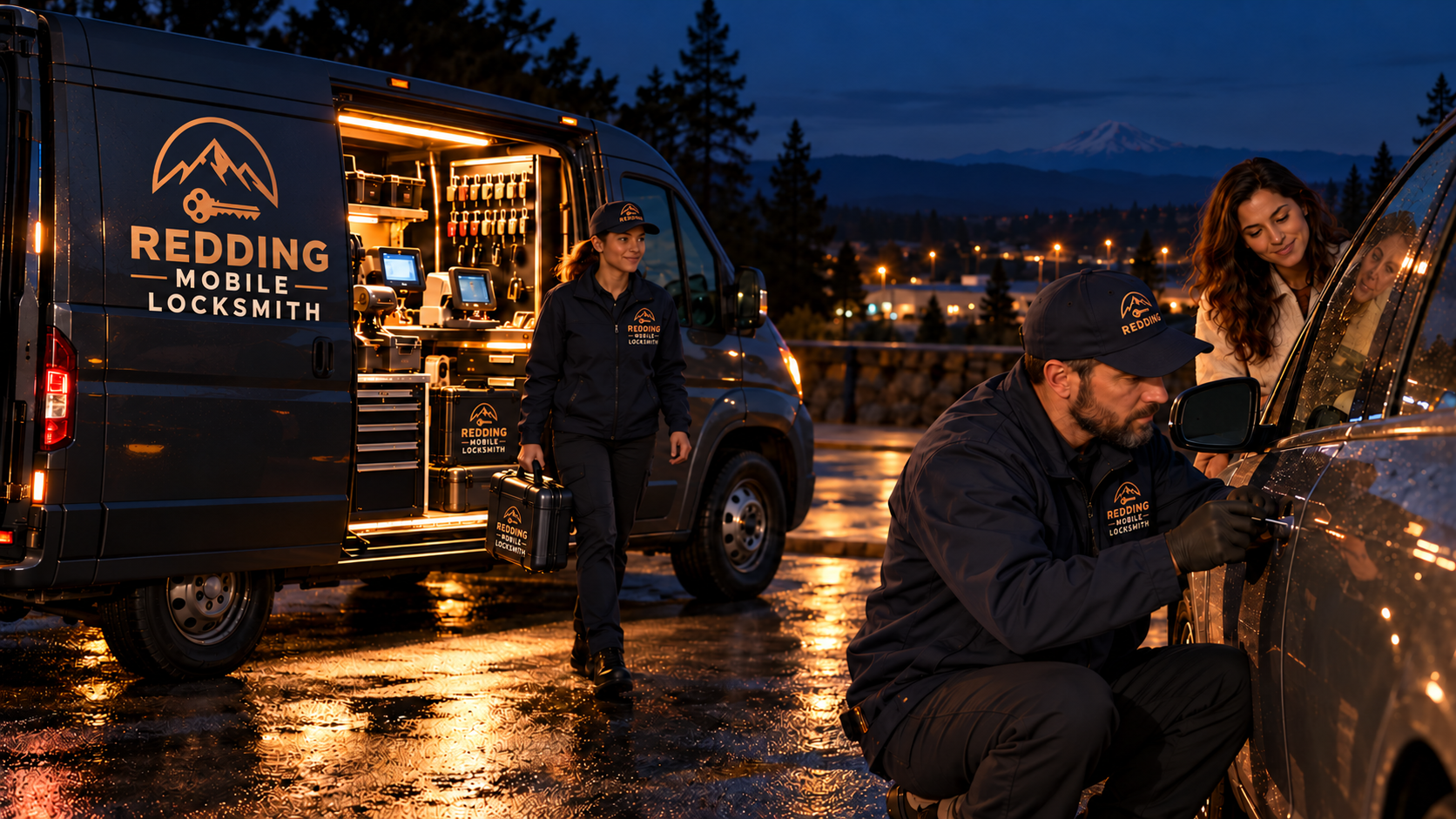
When someone arrives, wait for the introduction. A branded team in uniforms and a branded service van is what you should expect. Ask the person to confirm the company name and what they are there to do before you point at the door. Our guide on confirming who is arriving at your door lays out the steps.
What a professional does at the door
The technician looks at the door first. They check the frame, the strike plate, the type of lock and any damage. They decide which method suits the lock and the door. The goal is to open it with as little harm as possible, and then to make sure it locks again.
Once the door is open, the work is not finished. A good technician checks that the key you still have turns, that the latch catches and that the strike lines up. If a key is lost for good, they will talk through whether a new key, a new cylinder or a full rekey makes sense. You decide, and you can say no.
This page does not describe how doors are opened, and that is deliberate. The specific methods are the trade of a professional. What you need to know is that a trained person can usually open a working lock without breaking it, and that forcing it yourself usually costs more.
Expect a calm, plain conversation. The technician should say what they found, what the options are and what each one involves before any work begins. They should tell you when something is outside their scope or needs a second visit. If a door is warped by years of summer heat and winter damp, say so on the call, because a sticking door changes how a lock behaves. Questions are welcome, and a steady answer is the sign of a professional.
After you are back inside
Lock the door and take a quiet look around. Make sure nothing is out of place and nothing was disturbed. If you notice signs that someone was in the home, step out and call emergency services. A lockout is a key problem, not a crime scene, but be honest about what you see.
Think about the lost key. If it fell on a river bank, a trail or a parking area, it may be found by a stranger. A key with no tag does not tell anyone which door it opens, but the risk is real if your address is on the ring. In that case, rekeying the locks is a sensible next step and can be done at the home.
Make a spare plan. Give a copy to one person you trust. Think about a small lockbox in a hidden place, or a keypad deadbolt on the back door. The right time to build a plan is a calm afternoon, not a dark porch. Our page on night house lockouts covers the options in more detail.
Do one last thing before you sleep. Walk through the house and test the door you used, the back door and the garage entry. Pull each handle after locking it. This takes under a minute and gives you a calm last picture of the night. If anything feels loose, worn or sticky, write it down and have it looked at in daylight.
Renters, owners and shared homes
A renter should know who holds authority over the door. Some landlords want to be called first, and some leases say what you may and may not change. Rules vary, so check yours when you can. If the landlord cannot be reached and you are locked out, a locksmith can still help you get in, but you may be asked to show you live there.
An owner has fewer steps but the same need for proof. Keep a recent piece of mail or a bill in a spot you can reach. Many people photograph their license and a lease and keep it in a phone album. That small habit turns a long doorstep conversation into a short one.
Shared homes need a simple rule: everyone tells everyone when a key is lost. Roommates often assume the other person has a spare. A lost key in a shared home means the whole household has a security question. For help deciding what to do next, read about home locksmith services on this site.
Rural parcels and long driveways
Not every Anderson home sits on a lit street with a visible number. Some parcels are set back from the road behind a gate, a cattle guard or a stretch of gravel. After dark those details disappear. A technician who cannot find the entrance loses time, and so do you.
Help them by describing the landmarks you can see from where you stand. Say what color the mailbox is, whether the driveway slopes up or down, and where the gate sits relative to the road. If a porch light works, turn it on before you are locked out of reach of the switch. If it does not, stand near the road with your phone light and wave once a vehicle slows.
Dogs deserve a word. A loose dog on a rural parcel can be friendly to you and wary of a stranger in uniform. Say so on the call, and move the animal to a safe spot if you can reach it. The technician should never have to guess about an animal before stepping out of the van.
Preparing for the next night
Put a short checklist near the door inside the house. Include the name of the company you plan to call, the address in the format the dispatcher needs and a note about the gate or driveway. When stress is high, a written line is more reliable than memory.
Think about where the family keeps keys. A hook by the door, a dish on a shelf and a lanyard on the truck visor are all common spots. The point is that every key has one home. Most lockouts come from a key left in the wrong place after a long day.
Finally, learn the late night lockout steps before you need them. If you also use the truck for river and trail trips, read trailhead lockouts so you know what to do when the problem starts away from home. If a business is also on your list, see business security in Anderson.
Common questions
What should I do first if I am locked out of my Anderson home at night?
Stay calm and stay in a lit place. Check that no one inside needs help, then try other doors you are allowed to use and look through your pockets and vehicle. If a child or person who cannot cope is inside, call emergency services first. Otherwise contact the dispatcher with your location and the type of lock.
Why will a locksmith ask me to prove I live here?
A method that opens your door for you would open it for anyone, so a responsible technician wants some reason to believe you belong there. A license, mail, a lease or a bill can help. Policies vary, so ask the dispatcher ahead of the visit what the technician will want to see.
Can you open the door without damaging it?
A working lock can often be opened without damage by a trained person with the right tools. The result depends on the lock, the door and its condition. A failed or broken lock may need repair. The technician will tell you what they see before work starts.
What if my wallet and ID are locked in the house?
Say so plainly. Show what you can, such as a phone with account details, a message from a landlord or a neighbor who knows you. The technician will decide what is reasonable once they see the situation. You may not have to produce a card at all.
Should I rekey after I lose a key near the river?
If the lost key may be found by someone and your address could be linked to it, rekeying is a sensible step. It changes the pins so the old key no longer works. You can ask the technician about it at the door or request it later through the contact page.
Where do I find your phone number?
The phone line is coming soon. For now, use the request form on the contact page to tell us where you are and what happened. Include the street, the type of door and any details that help a technician prepare.