
Home / Cottonwood / After Hours Emergency in Cottonwood
After hours, Cottonwood
After Hours Emergency Help in Cottonwood: What the Call Sounds Like
When the lock fails in the middle of the night, the first step is a calm conversation. Here is how an around the clock dispatch call goes in Cottonwood and what the technician needs from you.
Start with safety, then the lock
Before anything else, check that you are safe. If someone is in danger, if there is a fire, a medical problem or a break in under way, call emergency services first. A locksmith is not a substitute for them, and no door is worth a delay.
If you are safe and the problem is a lock, take a breath. Most after hours calls are stressful but ordinary: a key left inside, a key snapped off, a deadbolt that will not turn. The voice on the line has heard each of them many times and will lead you through the next step in plain words.
Stand somewhere you can see your surroundings and keep your phone charged. If you are outdoors on a dark rural road or a long driveway, turn on your hazard lights or a flashlight so the technician can find you. A calm start makes everything after it easier.
The rest of this page walks through what comes next, in the order it usually happens.
If you are not sure whether a situation counts as an emergency, treat the doubt as your answer. A person outside in the cold, a vehicle on a dark road with no light or a home that cannot be secured for the night all justify asking for help. Describe what is happening and let the dispatcher help you decide.
Cottonwood and why night calls here are different
Cottonwood is a rural community south of Anderson in Shasta County, close to Interstate 5. Around it lie acreage, ranch properties, farm and shop buildings, long driveways and gates. A lockout here often means more than a front door: a gate, a barn, a work truck or a shop building may be involved.
Distance and darkness shape the call. There are fewer street lights, fewer neighbors within earshot and more places where a vehicle can sit without anyone passing. That is why describing your location precisely matters so much more than it does in a town center.
It also means the technician needs to know how to reach you. A gate may be locked, a driveway may be long and unlit, and a house may be set far back. Tell the dispatcher about each of these before the van heads your way.
For the wider area, see the Cottonwood coverage page, and for the broad service see after hours emergency locksmith service.
Weather plays a part as well. Hot dry summers make a waiting car uncomfortable, and cold winter nights make a long wait outdoors unpleasant. Mention the conditions on the call, because they affect how urgent your situation is and what you should do while you wait.
Picture the volunteer with the only key
Imagine a volunteer at a community club or small church near Cottonwood. They hold the only key to the hall, and they are locked out just before an evening gathering that others are traveling to attend. The volunteer is not the owner and is not sure what they are allowed to do.
This is an illustration, not a story about a real customer. It matters because many after hours calls are not about someone's own home. They are about a space someone looks after on behalf of others, and that raises a second question beside how to open the door.
That question is authority. The technician will want to know that you have the right to ask for the work. If you are a volunteer, say so, and have the name of the person responsible ready, such as a board member or the property owner. A short call to that person can settle the matter in a moment.
Once authority is clear, the job is much the same as any lockout. The difference is that the volunteer should also ask about a second key, since a single key held by one person is a weak point for any group.
Whoever holds the only key to a shared space should think about a second one. Ask the board or owner to authorize a spare and keep it with a different trusted person. A group depends on access, and a single key held by one volunteer is a weak point waiting to cause a late night.
What the dispatch conversation covers
A good dispatcher asks short questions in a steady order. They want to know who you are, where you are, what is locked, whether anyone is inside and whether you are safe. They will not hurry you, and you can say the same thing twice if you need to.
Expect questions about the lock itself. Is it a house door, a gate, a shop or a vehicle? Is a key broken off? Is the lock jammed or simply locked? Does the door have a deadbolt, a keypad or a smart lock? Short answers help the technician bring the right tools.
Answer what you are asked, then stop and listen. The dispatcher is building a picture, and extra detail is welcome, but the order of questions is there for a reason. If you do not know an answer, say so. A confident I do not know is more useful than a guess.
- Your name and the number you can answer during the call during the call.
- The exact place you are standing and how to get in, including gates.
- What is locked, and whether anyone, including a child or pet, is inside.
- What you tried and whether any key is broken or missing.
- Whether you can prove you have the right to open it.
Describing a rural location well
Do not assume a dispatcher can picture your place from an address alone. Describe how you reach it: the road, the turn, the color of the gate, the kind of mailbox, the nearest recognizable landmark that is still visible in the dark. Use words a stranger can follow.
Mention anything that could slow a van or confuse a driver. A cattle guard, a dirt stretch, a locked gate, a driveway that forks and a house number that is hard to read at night are all worth stating. If the way is unmarked, offer to turn on an outside light or wave a flashlight at the road.
Share your position in plain terms as well. Say whether you are at the house, the barn, the gate or the road. If you are in a vehicle, say which side of the road and which way it faces.
For a longer checklist of what to say, read what to tell the dispatcher: a location checklist.
If your phone signal is weak, say so at the start and give your location first, in case the call drops. Rural stretches near the river bottoms and hills can lose signal, and a short clear message sent early is worth more than a long one cut off halfway.
What the technician will need from you
A technician arriving in a branded van will ask first to confirm who you are and what you are entitled to open. This is normal and it is protective. A locksmith who opened any door for anyone would be a risk to everyone.
Be ready to show something that ties you to the property or the vehicle. For a home, that could be mail or a utility record. For a vehicle, it could be a registration or a paper that matches your identification. For a group property, it could be a name and number for the responsible person.
Keep your hands visible and stay calm and clear of the door while the work is done. If anyone is inside, tell the technician where they are and whether they can hear you. If a child or pet is locked in a vehicle, call emergency services first, before anything else.
Read confirming who is arriving at your door for the same exchange from your side of the door.
Keep any damaged key or broken piece safe. If a key has snapped in a lock, the broken half can help the technician match the cut. Put it in a pocket and do not try to push the other half out with a tool, since that can make extraction harder.
What the van carries
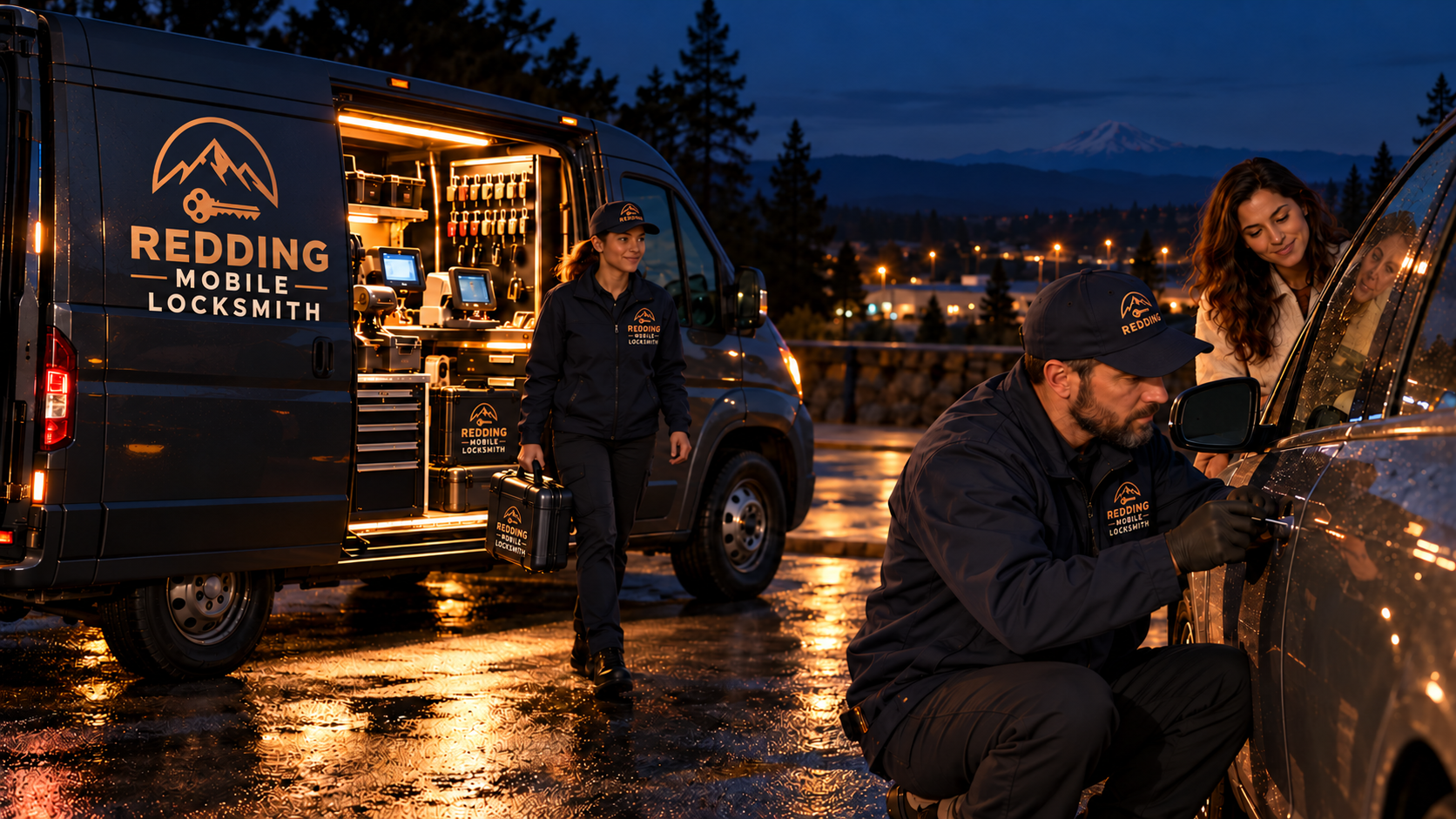
Redding Mobile Locksmith works from a branded service van, and its team wears uniforms. The van carries professional tools, key cutting and programming equipment and common hardware. For a night call that matters, because many fixes can be finished at the spot instead of waiting for a shop to open.
A lockout may need only careful opening tools and patience. A broken key may need extraction tools and a new key cut. A failed lock may need a replacement cylinder fitted on the spot. Equipment on board lets the technician choose the gentlest route that works.
Describing the problem clearly helps the technician arrive prepared. If you know the make of a vehicle or the kind of lock, say so. If you do not, say that too. An honest answer is better than a guess that sends the wrong tools.
The company serves seventeen communities across Shasta and Siskiyou Counties, and Cottonwood is one of them.
A locked gate that stops the van is a common snag. If you can, leave it open after you pass through, or tell the dispatcher how the technician can reach you on foot. A small plan for the gate before the van leaves can prevent a long, cold wait at the road.
Gates, barns and outbuildings
On a ranch or acreage, a lockout may involve a gate, a barn door or a tack room instead of a house. Each calls for different hardware. A gate may use a padlock, a chain or an electric operator. A barn may use a hasp and a heavy latch. A tack room may carry a plain cylinder lock.
Tell the dispatcher about each lock you need opened and which one matters most tonight. If a gate blocks the way to the house, the gate comes first. If an animal needs care, say so, and be ready to explain how to reach it safely.
Keep animals away from the work area. A dog protecting its yard can complicate a visit, and a horse near a gate can be startled by tools or lights. Put animals behind a secure barrier before the van arrives.
After the emergency, think about a plan. A gate with a failing padlock, a barn lock that sticks and a house with only one key are all signs it is time for a calm visit by daylight.
Do not leave a vehicle running unattended while you wait if you can avoid it, and keep valuables out of sight. If the key is inside a running vehicle, tell the dispatcher at once, because it changes how the technician approaches the job and how you should wait nearby.
Cars, trucks and work vehicles
Many Cottonwood households rely on pickups and work trucks, and a locked cab or a lost key can stop a working day before it starts. Night calls for vehicles are among the most common, especially after a long day when keys end up inside.
Tell the dispatcher the vehicle make, model and approximate year if you know them, and say whether it uses a metal key, a transponder key or a push button start. Say if the key is inside, lost or broken. These details help the technician bring the right equipment, as explained on night car lockouts in Cottonwood.
If you have lost every key to a vehicle, read about vehicle key replacement in Cottonwood for what is involved. The same mobile team handles the programming that modern keys need.
If a child or pet is locked inside a vehicle, do not wait for a locksmith. Call emergency services first.
Rural calls also mean sound carries differently. A horn or a flashlight signal can be seen or heard by a neighbor, which may help if you need a place to wait. Do not stray far from your vehicle or property, since the technician will be looking for you at the place you described.
Staying safe while you wait
Waiting is the part people dislike most. Make it as safe as you can. Stay in a lit area if there is one. Keep your phone on and charged. If you have a safe place to sit, such as a neighbor's porch or a friend's car, use it instead of standing on a dark road.
Do not try to force a door or a window in the dark. You can hurt yourself or damage the frame. Do not accept help from a stranger who offers to open it for you. Wait for the technician you called and confirm who arrives before you hand over any information.
Let someone know where you are. A short message to a friend or family member with your location and what happened is a steady habit. If something changes, such as a person approaching or a worsening feeling, call emergency services.
Dress for the weather. Summers in the valley are hot and dry, and winter nights can be cold. Have water and a warm layer if you can, so the wait is less of a strain.
Write down what happened while it is fresh. Note the time, the problem and what you did. If the lock fails again or you decide to rekey, those notes help the next technician. A small habit like this turns a stressful night into useful information for next time. See also Anderson and Shasta Lake for nearby areas the same team serves.
After the door is open
When the job is done, check that everything works. Turn the key several times. Close the door and make sure it latches. Ask the technician about anything that felt rough or worn, since a lock that failed once may fail again.
Think about backup. A spare key held by a trusted person nearby is a sensible safeguard. A rekey may be wise if a key was lost. A lock that is clearly worn may deserve replacement by daylight. The rekey page for Cottonwood explains the options.
If the property is a business or a shared building, consider key control for the long term. See business security in Cottonwood for how that works.
If you want to start a request later, use the form on the contact page. The phone line is coming soon.
Common questions
What should I do first when I am locked out at night?
Check your safety first. If anyone is in danger, call emergency services. If not, find a lit spot, keep your phone charged and gather basic facts: where you are, what is locked and whether anyone is inside. Then request help.
Why does the technician ask for proof of authority?
Opening a lock for the wrong person can cause real harm, so a careful professional confirms the right to open it first. For a home, mail or a utility record works. For a vehicle, a registration paired with identification helps.
How should I describe my location on a rural road?
Use words a stranger can follow. Describe the road, the turn, the gate, the mailbox and any landmark that shows in the dark. Mention gates, dirt stretches and forks in the driveway. Offer to turn on a light or wave a flashlight.
What if I am a volunteer and not the owner?
Say so plainly and have the name of the responsible person ready, such as a board member or the property owner. The technician may want to confirm authority with them. Once that is clear, the job proceeds like any other lockout.
What if a child or pet is locked in a vehicle?
Call emergency services first, before calling a locksmith. A child or animal in a closed vehicle is a danger, and trained responders are the right people to act. A locksmith can help afterward with the lock or key.
How do I request after hours help?
Use the request form on the contact page and describe where you are, what is locked and any safety concerns. The phone line is coming soon, so the form is the way to reach the team for now.