
Home / Dunsmuir / Vehicle Key Replacement in Dunsmuir
Dunsmuir car keys
Vehicle Key Replacement in Dunsmuir: Key Types From Simple to Smart
Imagine a volunteer who holds the only key to a club or church van and loses it before an early event. Here are the types of car keys, from plain metal to smart fobs, and how replacement differs for each.
The only key to a shared vehicle
Imagine a volunteer in Dunsmuir who looks after a van for a church or a club. The van carries supplies, equipment or people, and there is one key, which lives on the volunteer's own ring. On a cold evening, with an early start planned, the ring is gone. Perhaps it fell out of a coat. Perhaps it was left at a meeting. Either way, the van will not move without it.
Dunsmuir sits in the upper Sacramento River canyon in Siskiyou County along Interstate 5 and the railroad, with older homes on steep lots, forest all around and cold winters. A vehicle here is not a luxury. People rely on it to reach work, appointments and events, and a missing key can upend a whole schedule for a group.
The important thing is to know that a key can be replaced, and that the path depends on what kind of key it is. This page explains the types of car keys, from the plainest to the smartest, and shows what replacement involves for each, so that you can plan calmly.
Type one: the plain metal key
Before we go through the types, a word about why this matters. Key type decides how many parts are in play, what equipment the technician brings and what you need to have ready. Knowing yours ahead of time turns a vague request into a clear one, and a clear request is the first step toward a smooth visit.
The simplest car key is a piece of cut metal with a plastic or rubber grip. It has no electronics at all. It works by shape only: the cuts lift the pins in the door lock and the ignition cylinder to the correct heights and let the cylinder turn. These keys were standard on older vehicles and are still found on some work vans and older trucks.
Replacing one is the easiest job. A technician identifies the blank, cuts it to match, and tests it in the doors and ignition. If you have one working key, copying it is straightforward. If you have none, the cut can be worked out from the lock or from the vehicle's identification number, which takes a little more effort but is still a mechanical job.
Because a plain key has no electronic safeguard, anyone who holds a copy can use the vehicle. For a shared van, that is worth thinking about. If the lost key could be found by someone else, consider changing the cylinders so the missing key no longer works. The page about keys for older vehicles from before transponder chips covers this era.
Type two: the transponder key
A transponder key looks like a plain key with a thicker plastic head. Inside the head is a small glass or ceramic chip with no battery. When you turn the key in the ignition, a ring around the cylinder sends a faint radio signal, the chip answers with a coded reply, and the vehicle's computer decides whether to let the engine run.
This is a security feature. A key cut to the right shape will turn the ignition but the engine will not start if the chip is missing or not recognized. That is why replacing a transponder key is two jobs: cutting the blade and programming the chip. A technician uses a diagnostic tool plugged into the vehicle to introduce the new key to the computer.
For a shared van, the extra step can be a good thing. The programming can sometimes remove an old key from the vehicle's memory, so the lost key will no longer start it. The guide on transponder keys explained for night emergencies describes the idea in plain words.
- The blade must be cut to match the door and ignition.
- The chip inside the head must be programmed to the vehicle.
- A cut key alone will usually turn the lock but not start the engine.
- Programming can often remove a lost key from the vehicle's memory.
- Ask what your vehicle supports before the work begins.
Type three: the remote head key
A remote head key combines a transponder key with lock and unlock buttons built into the same head. One piece of plastic holds the chip, the radio transmitter and a small battery, and the blade is attached to it. You press the buttons to lock the doors from a distance and use the blade to start the vehicle.
Replacing one means three things: cutting the blade, programming the chip, and pairing the remote buttons to the vehicle. The last step is separate because the remote uses a different radio code from the immobilizer chip. Some vehicles allow the remote to be paired in a short sequence of steps, while others need a diagnostic tool.
Wear and tear shows up differently on this type. The rubber buttons wear smooth, the plastic case cracks where the ring attaches, and the contacts inside can corrode if moisture gets in. A cold canyon winter, with its swings between a warm cab and freezing air, makes condensation more likely. Keeping the fob dry and out of pockets that hold coins will extend its life.
Batteries matter here. A remote that works poorly may only need a fresh coin cell, which is a simple fix. Before you order a new key, ask whether the old one might be repaired. The page on key fob battery failure at night explains how to tell.
Type four: the flip key
A flip key, sometimes called a switchblade key, folds the metal blade into the body of the fob. Press a button and it swings out. It does the same work as a remote head key, but it is more compact and less likely to wear a hole in a pocket. It also hides the blade from view and protects it from bending.
Replacement is like that of a remote head key, with an added mechanical detail: the blade has to be fitted into the fob and the hinge must work smoothly. A technician cuts the blade, programs the chip, pairs the remote and checks that the blade folds and unfolds without sticking.
Flip keys have more moving parts, so they can wear. If the blade feels loose or the fob will not close, say so. A key that has begun to fail is easier to replace before it breaks than after. See the guide on worn key symptoms for what to watch.
Type five: the smart key and proximity fob
At the top of the range is the smart key, also called a proximity fob. The driver can leave it in a pocket or bag, touch a handle to unlock the door, and press a button on the dash to start the engine. The vehicle and the fob talk by radio all the time, checking for each other.
A smart key has an electronic brain and usually an emergency blade hidden inside, in case the battery dies. Replacing one is more involved than the earlier types. The fob must be paired to the vehicle's computer, and in many cases the vehicle must be told to forget the lost fob. The work needs specialist equipment and careful steps.
If a smart key goes missing, treat it more seriously than a plain key. A lost fob can in some cases be used to start the vehicle if it is within range. Think about having it removed from the vehicle's memory. The page on smart key replacement in plain words covers the details.
What changes between simple and smart
The main differences are the parts to replace and the equipment required. A plain key needs a blank and a cutting machine. A transponder key adds a programming tool. A remote key adds pairing. A smart key adds radio pairing, memory management and an emergency blade. Each step up brings more to get right, and more to check when the work is done.
Time and effort follow the same pattern, although we do not promise specific times. A simple key may be done at the curb in the time it takes to cut and test. A smart key takes longer, because the technician must connect to the vehicle, run the programming steps and test each function. What matters is that the work is done correctly.
Cost also follows the pattern, though we do not list prices here. Ask for an explanation of what you are paying for. A technician should be able to say what the job involves and why. A clear answer is a good sign that the work will be done properly.
What to gather before you ask
Have your photo identification ready, along with proof that you can have a key made for this vehicle. For a personal car, that is usually the registration or title. For a vehicle that belongs to a church, a club or a business, you may need a letter, a registration in the organization's name, or confirmation from an officer. Rules vary, so ask what applies.
If you can, bring or photograph any key you still have, even a broken one. A worn or snapped key can help a technician identify the blank and the cut. Even a photo of the old fob front and back can show the shape, the number of buttons and the brand marks needed to choose the right replacement part.
Collect the vehicle's make, model and year, and find the vehicle identification number on the base of the windshield or the door jamb. Note how many keys you have left, the type of key and what happened. For our volunteer, mention that the vehicle belongs to a group, and name the person who can confirm permission.
The guide on proof of ownership for key replacement gives a longer list. When you are ready, use the request form to send the details in one message.
Shared vehicles need a key plan
A van with one key is a van waiting for trouble. A shared vehicle should have at least two keys, and each should have a known holder. Write down who holds what, and keep one key in a safe place away from the vehicle. If the group has a board or an officer, give them a say in who has a copy.
Consider the people who use the vehicle but do not own it. A volunteer, a driver for an event or a helper who borrows it for a weekend should know where the key lives and who to tell if it goes missing. Clear roles prevent the quiet panic of a missing key and a group of people standing around a cold van.
Think about who should be able to start the vehicle and who should not. A volunteer who drives the van each week might hold a key. A casual helper who borrows it for one event might not. If keys change hands often, a log is useful, and so is a policy that a lost key is reported right away.
When a key is lost, decide as a group whether to replace it and whether to remove the old one from the vehicle's memory. It is easier to make that decision calmly than at the end of a long evening. The guide on managing keys for a shared family vehicle offers ideas that apply to groups too.
Doing this in Dunsmuir after dark
Dunsmuir nights can be cold, and a lost key outside is uncomfortable. Wait somewhere warm and lit, tell someone where you are, and keep your phone charged. Do not wait in an unlit lot if there is an alternative. If the vehicle is at a church or a hall that is closed, think about whether a nearby home or business offers shelter.
Tell the technician if the vehicle is a work van, a pickup or an older model that might have a mix of locks. Some work vehicles have separate keys for the doors, the ignition and a rear compartment, and each may need its own attention. Naming every lock you need upfront saves a second visit.
Describe where the vehicle is parked, including any steep road, narrow street or gate. A technician needs a safe place to park the van and room to work. Mention ice, snow or mud if they are present, since those affect how a driver approaches and how the work is done.
The general service is described on the vehicle key replacement page, and the electronics side is covered by transponder programming. For other Dunsmuir needs, see the night car lockout page and the Dunsmuir overview.
Neighbors and nearby communities
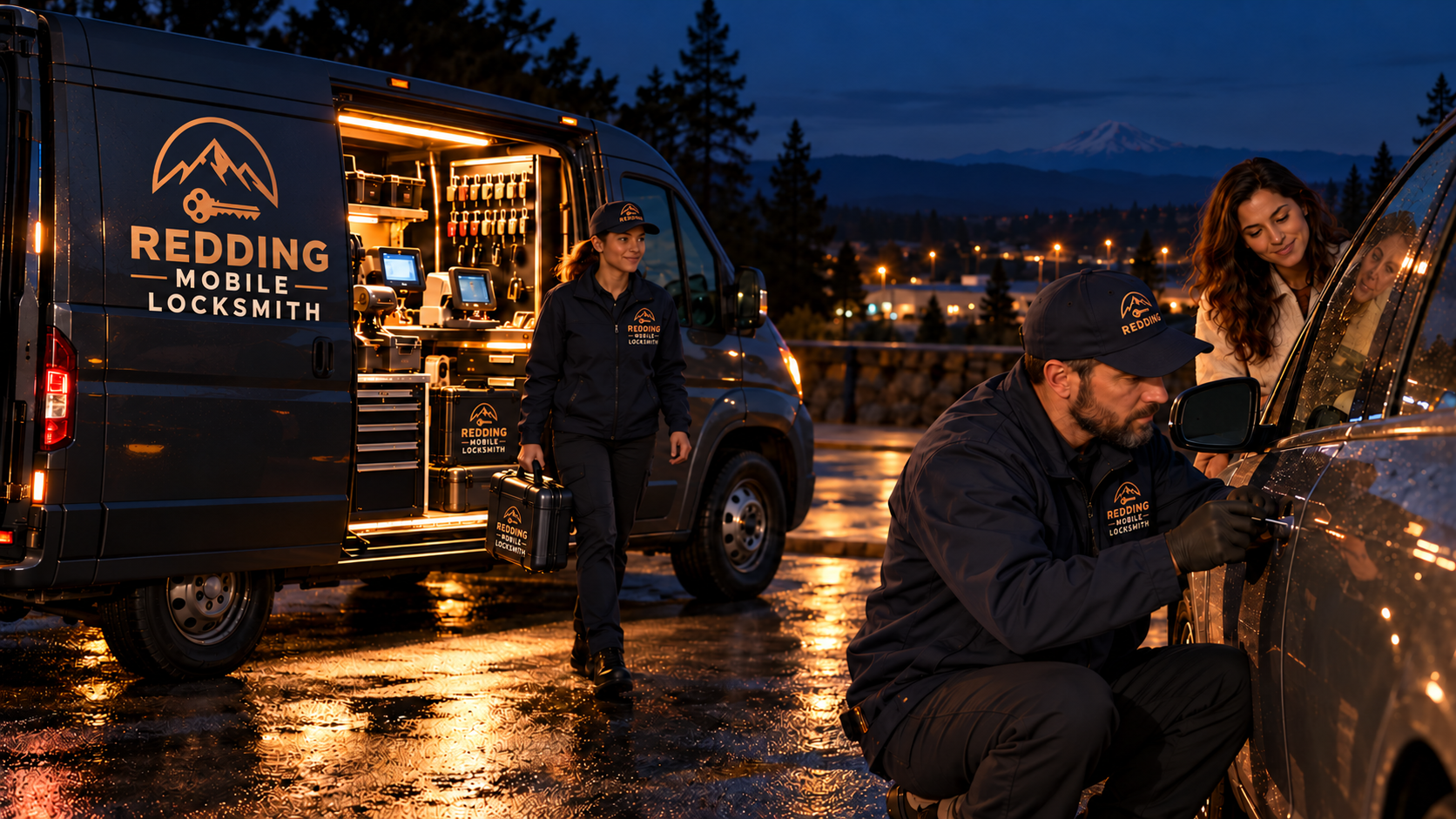
People in nearby communities have their own pages, including McCloud, Mount Shasta and Weed. Redding Mobile Locksmith serves 17 communities across Shasta and Siskiyou Counties with a branded van that carries key cutting and programming equipment.
The phone line is coming soon, so for now the way to ask is the request form on the contact page. Tell us the vehicle, the key type, how many keys remain and what happened.
Common questions
How do I know what type of key my vehicle uses?
Look at the key. A plain metal key with no thick head is a simple key. A thick plastic head usually means a transponder chip. Buttons mean a remote head key. A folding blade means a flip key. No key insertion and a start button on the dash means a smart key. A photo helps.
Why can a new key turn the lock but not start the engine?
Many modern keys carry a transponder chip that the vehicle must recognize. A key cut to the right shape will turn the ignition but the engine will not run if the chip has not been programmed. A diagnostic tool introduces the key to the computer.
Can a lost key be removed so it no longer starts the vehicle?
On many vehicles, yes. During programming the system can be told to forget a lost key. Not every vehicle allows it, so ask what yours supports. For a shared van, it is a sensible question, since a lost key could otherwise be used by someone else.
What proof do I need if the vehicle belongs to a group?
Bring photo identification and proof that you can have a key made, such as registration in the group's name, a letter or confirmation from an officer. Rules vary between situations, so ask what applies. Name the person who can confirm permission, since a technician may call to check.
Is a smart key harder to replace?
Usually it is more involved. A smart key must be paired to the vehicle by radio, often with specialist equipment, and a lost fob should be removed from memory. It also carries an emergency blade that must be cut. Expect a technician to explain the steps and what they involve.
How do I ask for help while the phone line is not available yet?
The phone line is coming soon, so use the request form on the contact page. Give the vehicle make, model and year, the key type, how many keys remain, your location in Dunsmuir and what happened. Details help the technician bring the right blanks and tools.