
Home / Fort Jones / Night Car Lockout in Fort Jones
Fort Jones Car Lockout
Night Car Lockout in Fort Jones: Keep It Calm
A locked car at night is stressful, and more so with a baby in the family. This page gives a steady order of steps for Fort Jones drivers: what to check, what to say on the call, and what to leave alone.
First, is anyone inside the car
The first question is the only one that cannot wait. Is a child, a baby or a pet inside the vehicle? If the answer is yes, call emergency services at once. Do not wait for a locksmith. Do not spend time on anything else. A child or animal in a closed vehicle can be in danger within a short span, especially in heat or deep cold.
Picture a household with a new baby, out for an evening drive. The parents have stopped near a farm gate for a moment, and the car door has closed with the keys inside. If the baby is in the car, the right call is to emergency services first. If the baby is with them, the situation is a lockout and nothing more.
Say this clearly to yourself, because stress makes people do odd things. Emergency services first when a life is at risk. The locksmith comes second. Our page on a child inside a locked car says the same thing in more detail.
If everyone is outside and safe, take a breath. The rest of this page is for that case. Nothing needs to be hurried. The aim is a clean result with no damage to the car.
Why cold nights change the picture
Fort Jones sits in Scott Valley, where winter nights get cold. Cold is a factor in a lockout for two reasons. It is harder on people who are waiting outside, and it affects locks and doors. Door seals can freeze, latches can stiffen, and a handle that works well in summer may feel stuck.
If a door will not open, it may not be locked at all. Ice can hold a door shut around the seal. Before assuming the car is locked, try each door once, including the rear doors and the back hatch. Pull gently. Do not yank or use a tool on a frozen door.
Never pour hot water on a frozen lock or window. It can crack glass and then refreeze. Our page on frozen car door locks on winter nights explains what is safe and what is not.
Keep warm while you work through the checks. Gloves, a coat, a hat. If you have a blanket in a bag or a coat for the baby, keep it with the people, not in the car. Warmth buys you patience, and patience prevents mistakes.
Think about the baby's needs in the cold. If the family is outside, a warm layer matters more than the car. Move the baby and the adults to a sheltered spot if one is available, and keep the group together while waiting. The lockout is a problem for the car, not for the people.
What to check before calling
A short set of checks can save a call or give the dispatcher better information. Try every door handle. Try the trunk or hatch release if it is outside the car. Look through the window to see where the keys are. Check whether the engine is running and whether the lights are on.
Check your pockets and bags again. Many lockouts end when the keys turn up in a coat. Check the ground around the car in case the keys fell. Think about the last place you used them. If someone else has a spare, consider whether they can bring it safely.
Look at the key fob if you have one in hand. A fob with a dead battery can fail to unlock the car, even though the car is not locked out in the usual sense. Some fobs hide a mechanical key inside. Our page on key fob battery failure at night walks through this.
Make notes as you go. What you tried, what happened and what you saw are exactly what the dispatcher will ask about. A short list from a calm person is a gift to anyone trying to help.
Do the checks in a fixed order so nothing is skipped: doors, hatch, glass, engine, pockets, ground. Saying the list aloud helps if you are tired. A second adult can check the list as you go, and a calm voice reading it out steadies the whole group.
- Try every door and the rear hatch once, gently.
- Look through the glass for the keys and note where they are.
- Check whether the engine is running or the lights are on.
- Check pockets, bags and the ground around the car.
- Note anything that looks damaged or unusual.
What to tell the dispatcher
Begin with where you are and whether everyone is safe. Then say what has happened: the car is locked and the keys are inside, or the keys are lost, or the key is broken. Keep it short. The dispatcher will ask the rest.
Give the vehicle details: make, model and approximate year, plus the color if it helps a technician spot it in the dark. These details decide what tools and key blanks are needed. Our page on preparing your vehicle information for the call lists them.
Tell the dispatcher about conditions. Is it dark, snowing or very cold? Is the car on a road, in a driveway, at a field gate? Is there anyone with you who needs warmth or rest? These facts affect how the work is planned.
Use the request form on the contact page until the phone line opens. The form asks for the same facts, so gather them first and send the whole picture at once.
If you are unsure about a detail, say so. Saying that you do not know the exact year of the car is better than guessing. The technician can often work it out from the make and model, or from a registration if you have one with you.
Keys inside a running car
A special case worth naming is the car that is running with the keys inside and the doors locked. The engine may be on, the heater may be on, and the car may be using fuel. It is not an emergency in itself, but it deserves attention.
Do not attempt to stop the engine or move the car by any improvised method. Do not break a window unless someone is in danger. Replacing a window costs far more than a lockout call, and broken glass is a hazard on a cold night.
Tell the dispatcher that the engine is running. Technicians handle this often, and the plan is the same. Our page on keys locked inside a running car goes through what to expect.
If the car is in a place where it could be a hazard, such as partly on a road, say so right away. A technician needs to know how to approach it safely, and you may need to move people out of the way.
What the technician does
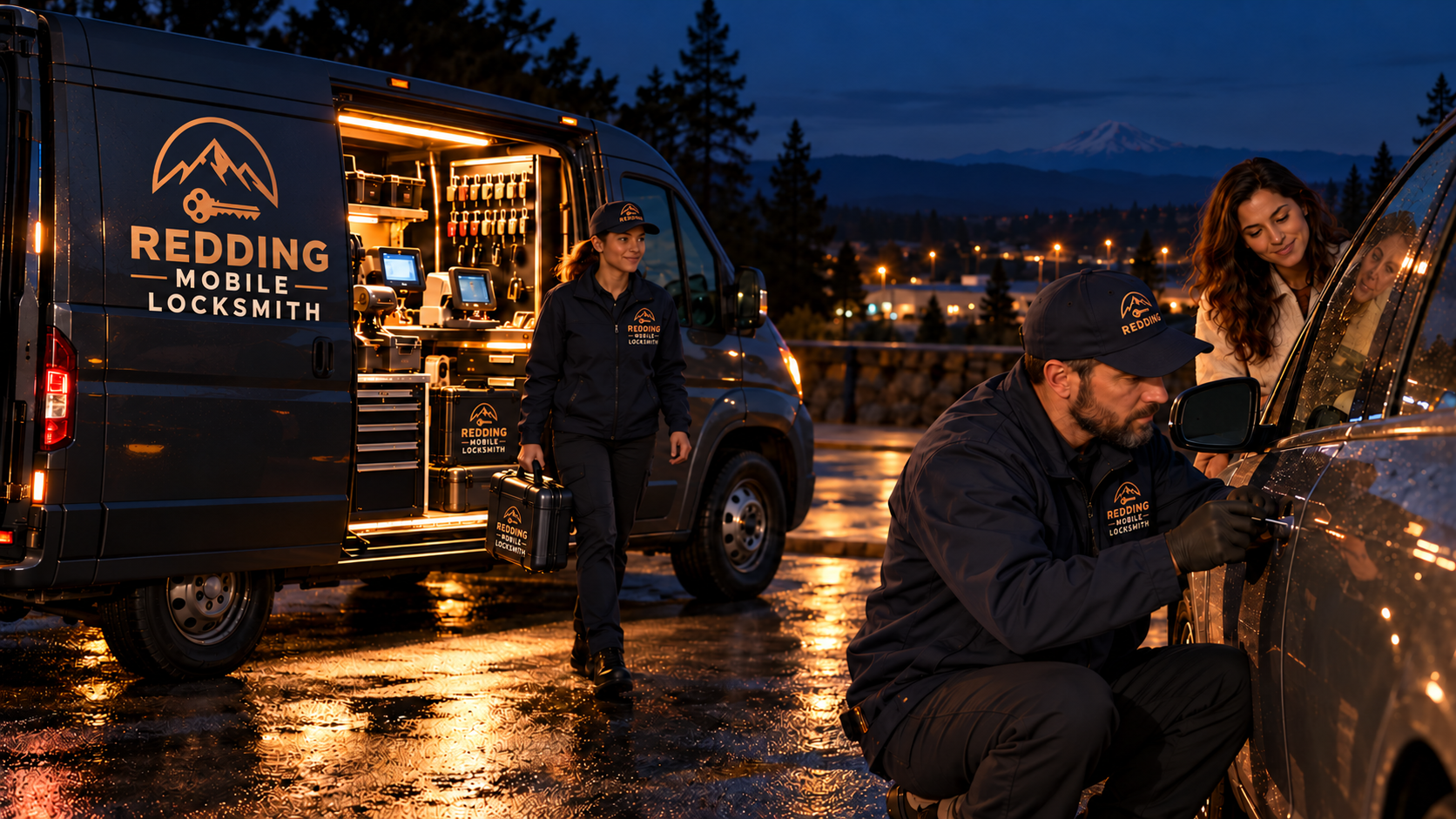
Our technicians arrive in uniforms in a branded service van with professional tools. For a lockout, the aim is to open the door without damaging the car, the paint, the weather seals or the electronics. The method depends on the vehicle, and the technician will choose the one that fits.
Before starting, the technician will confirm that you are the owner or an authorized user. Expect to be asked for something that shows it, such as a registration or a document with your name. This protects you. A car is valuable, and nobody should open one for a stranger.
Once the door is open, check that everything works: the locks, the windows, the interior lights and the doors. Take the keys, check that they are the right set, and make sure the car is secure when you leave. Ask any questions before the technician departs.
If the key itself is the problem, the technician can talk through options such as cutting a new key or programming a replacement. See night car lockout service for the full picture.
A key point for the household is that the technician will not pressure you. If you have questions about the method or about what a replacement key involves, ask them before work starts. A clear plan makes a short job feel simple and leaves you in control of the decision.
What not to do
Do not use a coat hanger, a wedge or a tool from the garage on the door. These tools can scratch paint, tear weather seals, bend door frames and damage wiring inside the door. Modern cars have airbags and sensors that do not respond well to improvised methods.
Do not ask a helpful stranger to force the door. Offers of help are kind, but the risk of damage is real, and damage costs more than a service call. If someone insists, thank them and wait for the technician.
Do not leave the car unattended in an exposed place if you can avoid it. If you must leave, tell the dispatcher where the car is and how to find it, and lock anything of value out of sight.
Do not post your location publicly on social media. A message that says you are alone at a roadside at night invites the wrong kind of attention. Share your location only with the dispatcher and people you trust.
If you are not sure whether a helper is trustworthy, step back and wait. A lockout is rarely worth a risk to your safety or your car. The professional is on the way, and a few more minutes of waiting is better than an unwelcome fix.
Fort Jones roads and rural spots
Fort Jones is a small town in Scott Valley with ranch and farm properties, older homes and small businesses. Many lockouts happen at spots that are not on a street: a field gate, a pull out, a farm yard, a trailhead. Describe your spot as plainly as you can, using landmarks rather than guesses.
Mention the road you are on and the nearest community, and say which way you were heading. If you are near a gate, a fence, a bridge or a sign, say so. If you are on private land, say so too, since the technician may need permission to enter.
Keep your phone where you can see it and keep the volume up. A technician may call to ask a question or to say they are close. Missing a call in a quiet valley is a simple way to lose time.
The same advice applies in neighboring Etna, and you can see that page at night car lockout in Etna. For the whole picture of where we work, read Fort Jones coverage.
In winter, road conditions can add to the time it takes anyone to reach a rural spot, and the dispatcher will tell you if the plan changes. Stay where you can be found, keep your lights on if the car has power, and wait for contact before moving on.
If the keys are lost, not locked in
Sometimes the keys are not in the car at all. They are lost somewhere between the house and the vehicle, or they were dropped or left behind. In that case a lockout may be the first problem and a key replacement the second.
A technician with key cutting and programming equipment can often make a new key at the vehicle. What is involved depends on the type of key. A basic metal key is simple. A key with a transponder chip needs to be programmed to the car. A smart key or fob involves more steps.
Gather what you can. A vehicle registration, a form of identification and the vehicle details make the process smoother. Our page on vehicle key replacement in Fort Jones covers it.
If you think the lost key could be in the wrong hands, mention it. Some vehicles allow old keys to be removed from the system when a new one is programmed. Ask the technician what is possible.
Keep a small card in the glove box or a bag with the vehicle details and the steps from this page. A calm list, written when you are not stressed, is easy to follow when you are. Share it with the other adult who drives the car.
After the car is open
Take a moment to check the car and the keys. Make sure the doors lock and unlock from both sides. Test the key in the ignition if you have one in hand. Confirm that nothing was scratched or bent.
Think about how to avoid a repeat. A spare key kept at home or with a trusted person is the most useful habit. A key fob battery replaced before it fails is another. A routine of touching your pocket before closing the door is another.
If you have a new baby, the habits become even more useful. Packing a car seat, a bag and a stroller is a distraction, and keys are easy to put down. Keep the keys in your hand until the door is shut and the household is inside.
Write down what happened and what you learned. A short note is enough. Next time, you will know what to say on the call, and you will be calmer for it.
If you want to understand the key side in more depth, our guide on transponder keys explained for night emergencies describes what the chip in a modern key does, and why a plain copy from a hardware counter may not start the car.
Common questions
What should I do if a baby or pet is locked in the car?
Call emergency services first. Do not wait for a locksmith. A closed vehicle can become dangerous very soon in heat or cold. Once emergency responders are on their way, you can follow up with a locksmith request if it is still needed.
Could my car door just be frozen shut?
Yes. In cold weather ice can hold a door closed around the seal even though the car is not locked. Try each door gently, including the rear doors and hatch. Do not pour hot water on the door or lock, and do not pry with a tool.
What information will the dispatcher ask for?
Your location, whether anyone is inside the car, the make, model and approximate year of the vehicle, where the keys are, and whether the engine is running. Having these ready helps the technician prepare and speeds the planning.
Will opening my car cause damage?
The aim is to open it without harm to the paint, seals, electronics or door frame. The technician chooses a method suited to your vehicle. Improvised tools such as hangers or wedges cause far more damage than a professional approach does.
What if my keys are lost rather than locked inside?
A technician with key cutting and programming equipment can often make a new key at the vehicle. The process depends on the type of key. Have your registration, identification and vehicle details ready, and describe the situation on the request form.
Is there a phone line yet?
The phone line is coming soon. Until then, use the request form on the contact page. Include where you are, what happened, who is with you and the details of the vehicle, and the team will follow up with the next step.