
Home / Fort Jones / Vehicle Key Replacement in Fort Jones
Fort Jones Car Keys
Vehicle Key Replacement in Fort Jones: Plan the Visit
A lost or broken truck key stops a working day. This page explains what replacing a vehicle key involves for Fort Jones drivers, what to gather beforehand, and how the visit usually unfolds.
A work truck and a missing key
Picture a contractor in Fort Jones who drives a work truck to a job site every morning. At the end of one day, the key is not in the usual pocket. It could be on the ground at the site, in a toolbox, in a coat in another vehicle, or it could be gone. The truck sits, the tools sit, and the next day's work is at risk.
This is the kind of problem that vehicle key replacement exists to solve. The contractor in the picture is hypothetical, but the pattern is familiar to anyone who relies on a vehicle for work: ranch hands, delivery drivers, farm owners, tradespeople and small business owners across Scott Valley.
The good news is that most missing key problems have a clear path. A technician with the right equipment can cut and program a new key at the vehicle in many cases. The sensible first step is to understand what is involved and to gather what the technician will ask for.
This page walks through those steps in a calm order. Use it before you call, and keep it in mind for the future.
What kind of key do you have
The type of key decides how the replacement works. Older vehicles use a plain metal key that is cut to match the locks. Many newer vehicles use a key with a small chip inside, known as a transponder, that talks to the vehicle. Others use a remote or a push button fob that works without a conventional key at all.
A plain metal key is the simplest case. It can be cut from the vehicle's code or from a sample. A transponder key needs to be cut and then programmed so the engine will start. A smart key involves more steps, because the fob must be registered to the vehicle's computer.
If you are not sure which type you have, look at your spare. A thick plastic head often hides a chip. A fob with buttons is probably a remote. A flip key may combine both. Our page on transponder programming explains how the chip works.
Tell the dispatcher what you know. If you have a spare, describe it. If you do not, give the make, model and approximate year of the vehicle, and the technician can work out the rest.
Write down anything printed on the key head, such as numbers or letters. Those marks can sometimes help identify the blank. A photo of the spare, front and back, is a simple way to pass this to the dispatcher on the request form.
What the technician needs from you
The technician needs to know three things: what vehicle it is, that you are entitled to a key for it, and what you have left. Vehicle details include the make, model, year and, if available, the vehicle identification number. This information tells the technician which blank and which programming method apply.
Proof of ownership is the second item. A vehicle key is access to a valuable machine, and no professional should make one for a person who cannot show they own the vehicle or are authorized to use it. A registration, a title or a document with your name and the vehicle details is usually asked for. Our page on proof of ownership for key replacement lists what works.
The third item is what you have. A working spare makes the job easier, since the technician can copy it. If all keys are lost, the process takes more steps, but it is still possible in many cases.
If you cannot find a registration, say so. The technician can often suggest another way to confirm your connection to the vehicle.
If someone else bought the vehicle for you or you share it with family, say so. Ownership paperwork may be in another person's name, and the technician can explain what they need to see in that case.
- The make, model and approximate year of the vehicle.
- The vehicle identification number if you can read it from the dashboard or a document.
- A registration, title or other document that shows ownership.
- Any working key, fob or remote you still have.
- Your exact location and the state of the vehicle.
Cutting a new key
Cutting is the physical step of shaping the key blade. A blank key has a plain blade with the right shape for the lock's keyway. The cutting machine removes metal to form the pattern of peaks and valleys that lifts the lock's pins to the right heights.
If you have a working key, the technician can duplicate its cuts. If you have no key, the cuts can be derived from the vehicle's code, or the lock can be read and the key made to fit. The method depends on the vehicle and the tools available.
The van carries key cutting equipment, so the key can often be made at the vehicle, at the job site or by the road. That matters for a working person. Waiting for a part to be ordered from elsewhere is slow. Having the tools at the vehicle saves a trip.
Once the key is cut, the technician tests it in the door and the ignition. The key should enter smoothly, turn freely and release without sticking. A key that binds is a key that needs adjustment.
Cold weather is hard on key blades and ignitions. Metal contracts, locks stiffen, and a key that turned all summer may resist on a winter morning. If a key feels rough, a spare made now is a gentle way to avoid a snapped blade later.
Programming and what it does
For a transponder key, cutting is only half the job. The chip inside the key holds a code that the vehicle's computer must recognize before it allows the engine to start. A key without the right code may turn in the ignition and still fail to start the engine.
Programming links the new key's chip to the vehicle. The technician connects equipment to the vehicle's system and registers the new key. In some cases, old keys can be removed from the vehicle's memory so that a lost key no longer starts it.
This is why a copy from a hardware counter often fails on newer vehicles. A copy that turns the lock is not a copy that starts the engine. For a clear explanation, see transponder keys explained for night emergencies.
Ask the technician what can be done about old keys. If you lost the key at a public place, having it removed from the vehicle's memory is a sensible step.
Not every vehicle is the same. Some need only a straightforward procedure. Others need more steps or specialized equipment. The technician will tell you honestly what your vehicle requires, and will say so if something cannot be done at the roadside.
Work trucks, ranch pickups and vans
Vehicles used for work see heavy use. Keys are carried in dusty pockets, dropped in mud, hung on shared rings and handed from one worker to another. Key wear is a real issue, and a key that is nearly worn through can snap in the ignition on a cold morning.
If more than one person drives the truck, think about how many keys exist and who holds them. A spare held by the owner is the simplest protection against a stopped workday. A second spare locked in the office is another. Our pages on keys for pickup trucks on ranches and keys for work vans cover common concerns.
Fleet owners, even small ones, benefit from a record of which keys belong to which vehicle. A simple list pays off when a key goes missing. It lets you tell the technician exactly which vehicle you mean.
If you are replacing a key for a vehicle that belongs to a business, bring something that shows the business connection. A document with the company name and vehicle information is useful.
A good habit for a small operation is to mark one spare as the office key and keep it out of daily use. It stays clean, unworn and ready. When a daily key is lost, the office key becomes the sample for the next copy.
Doing it at the job site
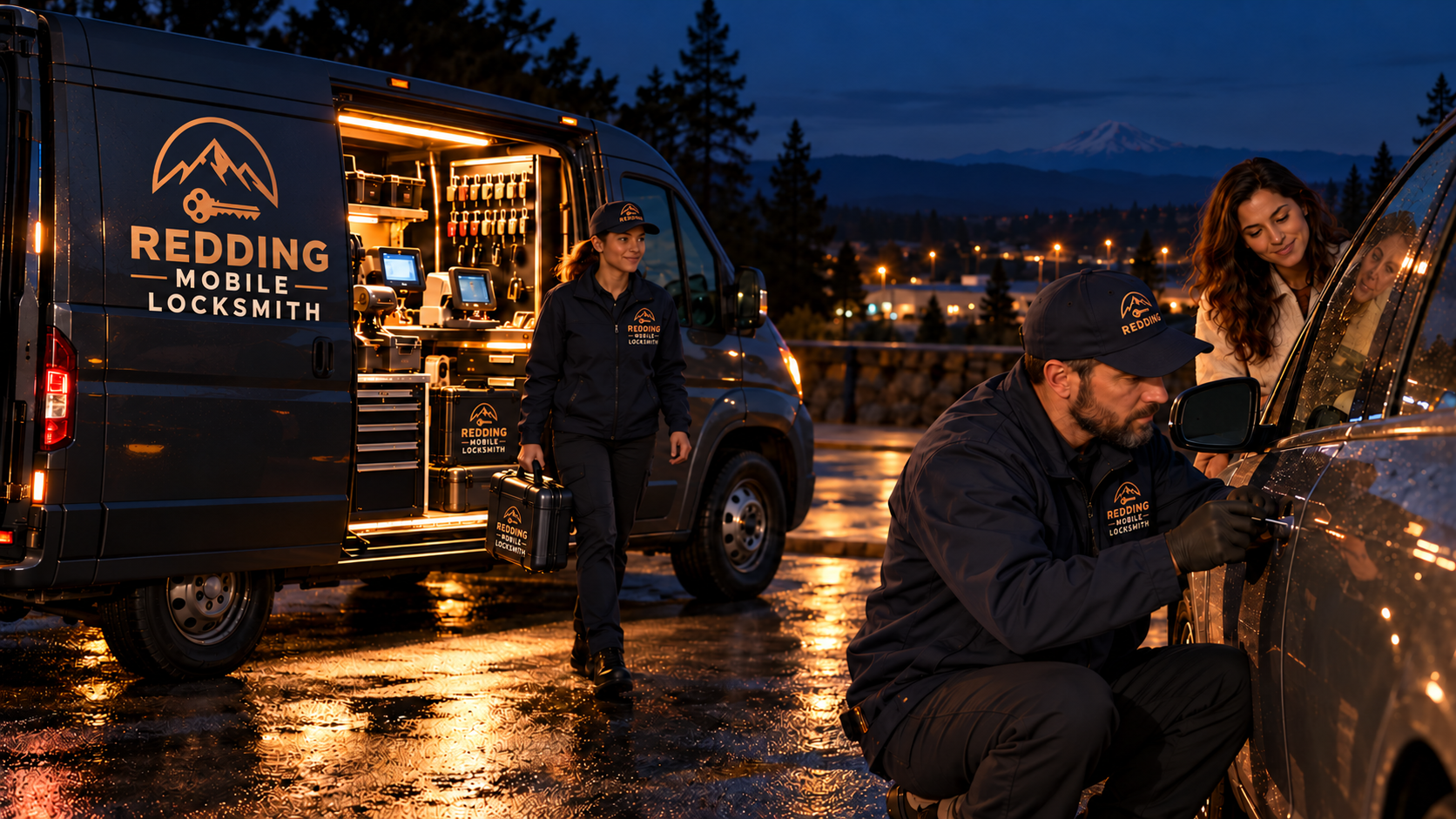
One advantage of a mobile team is that the work comes to you. A technician arriving at a job site in a branded service van can often cut and program a key beside the truck, rather than requiring the truck to be towed.
Prepare the space. Park the vehicle where the technician can reach all the doors, with the door area clear. Make sure there is enough light if the job is after dark. Keep other workers away from the vehicle while the work is under way.
If the vehicle is in a remote spot, give clear directions. Describe the road, any gates, and a good place to park the van. A dispatcher can help you plan the approach.
If the truck is on a farm or ranch, mention animals or hazards. A technician cannot do a good job when watching for a loose dog. A clear note on the request form helps.
Weather can change the plan. In snow or heavy rain, a technician may ask to work inside a shed or barn if one is available. Offer a covered spot if you have one, since keys, tools and electronics all prefer to stay dry.
Timing and planning
Key replacement takes the time it takes. The cutting, the programming and the testing each take care, and a hurried job risks a key that works poorly. Plan for the visit to take as long as the technician says it will, and arrange your day accordingly.
If the truck is needed for work tomorrow, tell the dispatcher so the plan can reflect that. The team works around the clock, so a night visit is possible. Describe the urgency plainly and let the dispatcher say what is realistic.
Prices and arrival times are not listed here. They depend on the vehicle, the key type and your location, and the technician will discuss them with you directly. Ask for an explanation before work begins so there are no surprises.
If you are choosing between making a spare now and waiting until a key is lost, a spare made while you still have a working key is simpler. See why a spare key matters before you need it.
Think about everyone who needs to drive the truck. If three workers share a vehicle, decide how many keys to make and who is responsible for each one. Clear ownership of a key makes it much easier to find when something goes wrong.
If the key is locked inside or broken
Sometimes the issue is not a missing key but a locked vehicle or a broken key. If the key is inside the truck, the first job is to open the door without damage. Our page on night car lockout in Fort Jones covers that.
If a key has snapped in the door or the ignition, do not try to pull out the broken piece with pliers or a knife. You can push the piece deeper or damage the lock. Tell the dispatcher what happened and wait.
A technician can often extract the broken piece and then make a new key from the lock or the code. This is a common job, and it does not usually require a new lock.
If the ignition is worn and the key keeps sticking, consider repair or replacement of the ignition cylinder. A worn ignition will wear a new key down early, so it is worth asking.
When a vehicle has a fob with a remote function, the buttons may need programming separately from the engine start. Ask the technician to test the lock and unlock buttons as well as the ignition. A fob that starts the truck but does not lock it is incomplete.
After the new key is made
Test the new key in every function. Check the doors, the trunk or tailgate if it has a lock, the ignition and the remote buttons if there are any. Start the engine and turn it off at least twice. Do all of this before the technician leaves.
Keep the new key somewhere safe. A key on a shared ring is a key that can be lost again. Many owners add a second key to a different place, such as a lockbox in the office or a drawer at home.
If you have a spare made, test that one as well. A spare that has never been tried is a spare you may not be able to rely on. It takes a minute and prevents a bad surprise.
Write down what was done. The date, the vehicle and the type of key are enough. When the next question comes up, you will have the answer.
Where to start
If you need a vehicle key in Fort Jones, begin with the request form on the contact page. The phone line is coming soon. Describe the vehicle, the key type if you know it, and what happened.
For the broader description of the service, see vehicle key replacement. For how we cover the area, see Fort Jones coverage. Neighbors in Etna can read vehicle key replacement in Etna.
Keep this page in mind for the future. A key lost on a job site becomes a minor problem if you know what to gather and what to ask.
Calm planning, clear information and a professional with the right equipment will get the truck running again.
Common questions
What do I need to get a replacement vehicle key?
You need the make, model and year of the vehicle, proof that you own it or are authorized to use it, and ideally the vehicle identification number. A working spare helps, but a key can often be made even when all keys are lost.
Can a new key be made at my job site?
In many cases, yes. The service van carries key cutting and programming equipment, so a technician can often make and program a key beside the vehicle. This avoids towing and keeps a working day on track where possible.
Why does a modern key need programming?
Many keys contain a chip that the vehicle must recognize before the engine will start. Cutting the blade only lets the key turn the lock. Programming registers the chip, and without it the key may turn in the ignition but not start the engine.
Can old keys be removed from the vehicle?
On many vehicles, yes. When a new key is programmed, the technician may be able to remove lost keys from the vehicle's memory so they no longer start it. Ask about this if the lost key could be in the wrong hands.
What if I have no registration with me?
Tell the dispatcher. Proof of ownership matters, but there may be other ways to confirm your connection to the vehicle. The technician will talk through what is acceptable and will not make a key without being satisfied.
How do I request help in Fort Jones?
Use the request form on the contact page, since the phone line is coming soon. Describe the vehicle, the key type, what happened and where you are, and the team will follow up with the next step.