
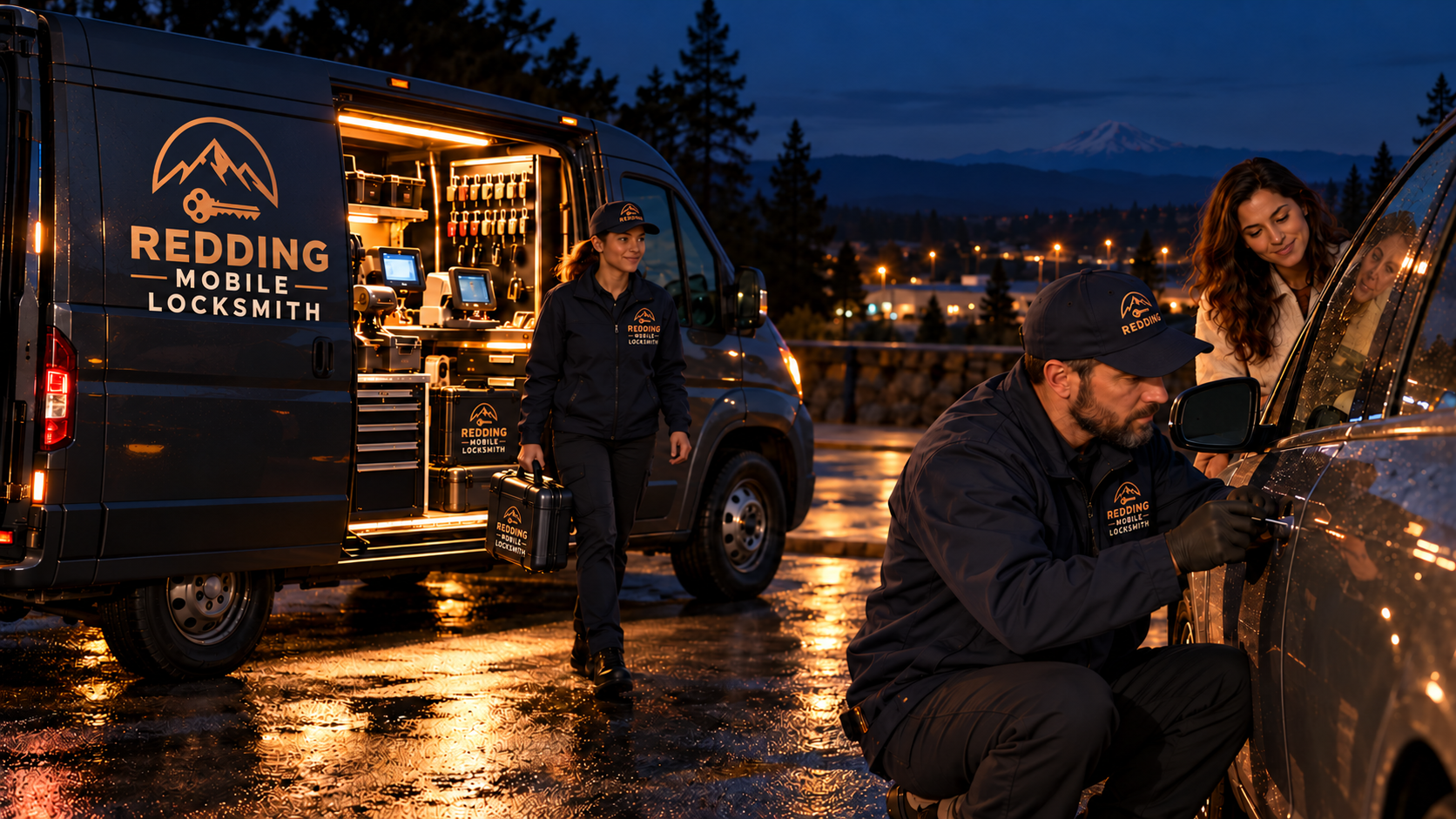
Home / Redding / Night Car Lockout in Redding
Redding, night car lockout
Night Car Lockout in Redding, a Calm Way Through
A locked car at night in Redding is stressful, especially if you are only passing through on the interstate. This page gives you the order of steps, the details to have ready, and what a technician does once the van arrives.
Start with where you are standing
Before anything else, look around. Are you in a lit place with people nearby, or on a dark shoulder? Redding is the largest city in the region and the Shasta County seat, and it sits where Interstate 5, Highway 299 and Highway 44 meet. That means a lot of travelers stop here, and a lot of them stop in unfamiliar spots at odd hours.
Imagine a driver heading north on the interstate late in the evening. They pull off for fuel and a short break, step out, and shut the door with the keys still on the seat. This is a hypothetical picture, but it is a common pattern. The driver does not know the streets, does not know whom to call and may be tired.
If your spot feels unsafe, move to a better one first. A bright entrance, an open business or a populated area is better than a dim corner. The car can wait. You cannot. This is the first rule of the way we handle these calls, and it is the same rule on every night call.
Highway 299 and Highway 44 both feed into town, and Interstate 5 runs through it along the Sacramento River. A driver who exits for fuel may land on a street they have never seen. If you are not sure of the name of the road, read the signs, look for a large building with a visible sign, or check the map on your phone. A clear description is the most valuable thing you can give a dispatcher.
Stay near the vehicle if the area is busy and well lit. If it is not, wait inside an open business or beside the entrance of one. Tell someone where you are, even if it is only a text to a friend. That small step adds a layer of safety while you wait for the van.
The ninety second check before you call
Before you reach out, spend a minute and a half on a calm check. It often solves the problem, and when it does not, the answers make your call much more useful.
Do not pry at the window or the door seal. Prying can bend the frame, tear the weatherstrip and set off a side airbag sensor in some doors. The cost of those repairs usually exceeds the cost of a proper lockout call.
Take a moment to think about how the lockout happened. Did the door close behind you while the keys sat in a cup holder? Did a child press the lock button on a fob? Did a spare key get left in a bag at home? Each answer points to a different next step, and each helps you describe the situation more clearly.
If someone at home or at your destination has a spare, ask them whether they can reach you. In a city the size of Redding that is sometimes possible, though it can take time. Weigh that against the cost of waiting in the dark. If the wait would be long or the spot is not comfortable, a call to a locksmith is the more sensible choice.
- Try every door, including the rear doors and the trunk or hatch.
- Look inside for a second key, a key card or a phone that could open a connected car.
- Check whether the engine is running, since that changes how the technician works.
- Note whether the keys are visible, and where they sit.
- Check the pockets of your coat and bag one more time.
What to tell the dispatcher
The dispatcher needs a short list of facts. Give them in order, and keep your voice level. You do not need to explain how you got locked out.
First, your location, as precisely as you can describe it. Say the nearest cross road, the nearest large landmark, or the exit you used. Second, the vehicle: make, model, year and color. Third, whether the keys are inside, whether the engine is running and whether anyone is in the car. Fourth, how to reach you by phone. Fifth, anything that affects safety, such as a dark lot or a wet road.
Our guide on what to tell the dispatcher is a checklist you can follow word by word. Our page on preparing your vehicle information for the call covers the car details in more depth.
Do not worry about sounding professional. Short plain sentences serve you well. Something like: I am in a lot beside the exit, I drive a gray sedan, the keys are on the seat and the engine is off. That tells the dispatcher nearly everything they need.
Have your identification and proof of ownership within reach. A responsible locksmith will ask you to show that the vehicle is yours before the door is opened. A registration card in your wallet, a photo on your phone or a matching name on the paperwork all help. If the registration is inside the locked car, say so, because there are other ways to confirm ownership.
A child or a pet inside the car
If a child or a pet is inside a locked vehicle, call emergency services first. Do this before you call a locksmith. In Redding, summer days are hot and dry, and a closed car heats up far more than most people expect. Emergency crews can act immediately, and no locksmith visit replaces that call.
After you have called, stay with the vehicle and keep the person or animal in sight. Follow what the emergency operator tells you. A locksmith can be a second step once crews are on the way or have finished.
Our guides on a child inside a locked car and on a pet inside a locked vehicle explain what to do while you wait.
Please do not make the decision alone. Even a few minutes in a hot vehicle can be dangerous, and even a cool day can turn a car into an oven in sunlight. If you cannot reach an emergency line, ask a bystander to call while you stay with the vehicle.
Never break a window unless emergency services tell you to. A shattered window can injure the person inside, and an emergency operator can give you directions that fit the situation. We include this on every page about car lockouts for one reason: it is the most important step.
How a professional opens a locked car
We will not describe bypass methods, because that information helps no one but a thief. What we can say is that a trained technician uses purpose built tools designed to open a vehicle without scratching paint, bending the door or harming the lock. The aim is a car that works exactly as it did before.
Modern vehicles are more complicated than older ones. Many have side airbags, wiring inside the door, and sensors near the window seals. A professional knows where those parts sit and works around them. This is why a pry bar is a bad idea at night, even when the temptation is strong.
A locked car with the keys inside also raises a second question: after the door is open, do you have a way to start the car and to carry a spare key? Our page for night car lockout service covers the process in full, and the vehicle locksmith page explains the wider work done on cars.
Ask the technician what they plan to do before they start. A good professional will explain the approach in plain words, tell you what to expect and protect the finish of the car while they work. If a technician cannot or will not explain, that is a warning sign worth listening to.
Once the door is open, check that everything works. Try the lock and unlock buttons, the windows and the interior lights. If you notice anything unusual, mention it before the technician leaves. Most lockouts end with no change at all to the vehicle, which is exactly how it should be.
Running engine and keys inside
A common version of this problem is the car that is still running with the keys on the seat. It sounds harmless, but it carries risks. The car can burn fuel, overheat in warm weather, or be driven off by someone else if a door unlocks. Some vehicles also lock their doors automatically after a short time, which is how people end up locked out of a running car.
If this is your situation, say so at the start of the call. Do not leave the area unattended for long. Stay where you can see the vehicle. If you feel unsafe, move away and keep the car in view from a better spot.
Read our guide on keys locked inside a running car for the steps worth taking and the ones to avoid.
Weather matters here. On a hot Redding afternoon, a running car with a closed cabin can become uncomfortable in warm weather, and the engine may overheat if it idles for a long time. On a cold night in the mountain passes beyond town, a running car is a source of warmth that you cannot reach. Either way, tell the dispatcher about the engine at the start.
Some owners ask whether they should shut the engine off remotely. If your key fob or phone app can do it, that may be a reasonable step, but do not trigger anything that could lock the car further. When in doubt, ask the dispatcher before you press anything.
Push button starts and key fobs
Many newer cars have a push button start with a proximity fob. If the fob is in your pocket, you can often still open the car by hand with a hidden mechanical key. Look for a small release on the fob or the handle. If the fob battery has failed, the car may still start when the fob is held against a marked spot near the start button, as the owner's manual explains.
If the fob is inside the car, the situation is a plain lockout and a technician can help. If the fob is lost, a replacement must be programmed to the vehicle. Our guides on push to start vehicles and lockouts and key fob battery failure at night describe these cases.
A dead fob battery is a more common cause of trouble than people realize. The warning signs include a reduced range, a delay in response and a dashboard message about the key. Replace the battery before it fails, and carry the small mechanical key that is hidden inside most fobs.
If the vehicle does not recognize the fob after the battery is replaced, the fob may have lost its connection to the car. That needs reprogramming rather than a new battery. A technician with the right equipment can pair a fob to the vehicle again.
When the key is lost, not locked inside
A lockout is not the same as a lost key. If your keys are not inside the car and not in your pockets, the problem is larger. You may have dropped them, left them in a shop, or lost them on the road. Opening the door will not start the car.
For a lost key, a technician can cut a new blade and program a new chip or fob to the vehicle, using the equipment carried in the van. Have the registration, the vehicle identification number and your identification ready, since a responsible locksmith will want proof that the vehicle is yours. Our page on vehicle key replacement in Redding explains what is involved.
Before you decide the key is gone, retrace your steps. Check the place where you last used it, the pockets of the clothes you wore, the seat and floor of a friend's car and the shop where you stopped. A lost key found in ten minutes saves a lot of effort.
If you still have one working key, say so. A duplicate is generally a simpler job than creating a first key from nothing. If you have no working key at all, the process takes longer, since the technician must generate a new credential from the vehicle data. Be patient and have your documents ready.
Other Redding pages that may help
Redding has six pages written for local needs. If you also need an emergency at your home, see the page on a night house lockout in Redding. If you want locks changed, read about rekeying locks in Redding. For a shop or office, see business security in Redding.
Our main Redding area page gathers all of these together. If you are traveling south or north on the interstate, you may also want the pages for Anderson and Shasta Lake, since lockouts do not respect city lines.
Our vehicle key replacement service page and our transponder programming page cover the technology behind modern keys in more detail. If you want to understand why one key works and the other does not, read the guide on when one key works and the other does not.
Preparing for the next time
Once the door is open and the night settles, use the moment to prevent a repeat. Make a spare key and keep it somewhere other than the car. Add the vehicle details to a note on your phone. If you travel often on the interstate, consider a small magnetic or keychain spare held by a person you trust.
Check your fob battery before long trips, and carry a charged phone or power bank. Keep your registration in a safe place that is not inside the vehicle. If you use a hidden key box, think about the location carefully, and never leave a spare where a stranger would look first.
You can read more in our guide on why a spare key matters before you need it. Our request form is the way to start a call, since the phone line is coming soon.
A small habit helps a lot: before you close the door of a parked car, touch your pocket or look at your hand. It takes a second and prevents a long night. Another habit is to keep the spare key inside your wallet case or a travel bag that stays with you.
If you rent cars or drive fleet vehicles, ask the company what to do when a lockout happens. Our guide on rental car lockout steps explains why the rental company usually needs to be involved.
Common questions
What should I do first if I lock my keys in the car in Redding?
Make sure you are somewhere safe and lit. Try every door and the trunk, look for a spare key, and note whether the engine is running. If a child or pet is inside, call emergency services before anything else. Then give the dispatcher your location and vehicle details.
Will opening my car damage the door or paint?
A trained technician uses purpose built tools meant to open a vehicle without harm to the paint, the weatherstrip or the lock. The risk of damage comes from prying, coat hangers and improvised tools. If you want to avoid repair costs, do not try those methods before calling.
What details does the dispatcher need?
Your exact location, the make, model, year and color of the vehicle, whether the keys are inside, whether the engine is running and whether anyone is in the car. Add a callback number and any safety concern, such as a dark lot. Clear details help the right equipment come on the van.
Can you help if I am only passing through Redding on the interstate?
Yes. We serve travelers as well as residents. Say where you are, what exit you used or which road you are on, and describe the car. Stay somewhere lit and populated while you wait, and keep your phone charged so the dispatcher can reach you.
What if my car key is lost instead of locked inside?
A lost key is a different job from a lockout. A technician can cut a new blade and program a chip or fob to the vehicle. You will need proof of ownership and identification. Say plainly that the key is lost when you describe the problem.
How do I contact you if the phone line is not live yet?
The phone line is coming soon. For now, use the request form on the contact page and include your location, vehicle and a number where you can be reached. Keep the phone with you and answer calls from unknown numbers, since the dispatcher may call to confirm.