
Home / Lakehead / Business Security in Lakehead
Lakehead business doors
Business Security in Lakehead: Keys, Doors and Closing Routines
Small businesses around Lake Shasta run on a handful of keys and a few doors. This page explains key control, hardware and closing routines so access stays in the hands of the people who should have it.
Security starts with who holds the keys
Most business break ins do not begin with a broken door. They begin with a key that nobody tracked. A former employee, a cleaner who left, a family member who helped out one summer, a vendor who once made a delivery. Each of them may still hold a working copy.
Business security in Lakehead is mostly a question of access. Who can open the front door, who can open the back, who can open the office inside, and who can do so at night. Until you can answer those four questions without guessing, better hardware only hides the problem.
Start on paper. List every door, every key that fits it and every person holding one. Most owners find at least one entry they cannot explain. That entry is where the work begins.
A useful test is to ask what would happen if one particular key vanished tonight. If the answer is that you would have to change nothing, you have either a very small operation or a gap in your thinking. Most owners find that a single lost key would force them to replace more than they expected, and that is a sign the key plan needs attention.
The Lakehead setting and what it means for doors
Lakehead sits at the northern end of Lake Shasta, near Interstate 5. The community serves full time residents and seasonal visitors, and its businesses follow that rhythm. A shop, an office or a service building may be busy in summer and quiet in the colder months, with long stretches when nobody is on site.
Quiet buildings need dependable hardware. A door that is rarely opened can drift out of alignment, swell with damp or stiffen from cold. When an owner arrives after weeks away and the lock will not turn, that is both an inconvenience and a risk, because a struggling lock invites forced entry.
Mountain and lake weather also tests exterior hardware. Moisture, dust, pollen and temperature swings wear on cylinders and latches. Choosing hardware made for exterior use and checking it once or twice a year costs little compared with a failed door in the middle of a busy weekend.
Think about the approach to your door, too. In the colder months, ice on a step or a drift of snow against a door can make a lock hard to reach and easy to damage. In summer, dust and heat bake grease inside cylinders. A short seasonal walk around the building to try every lock is a habit worth building.
A hypothetical picture: the college student sharing a rental
Imagine a college student who shares a rental house with two roommates and also works part time at a small lakeside shop. The house has one front door key that went through three hands. The shop has a back door key that the owner hands over on Friday evenings so the student can close.
Nothing here is unusual, and it is invented purely as an illustration. But look at what it shows. Two sets of keys, six or more people who have held them, and no one in charge of either set. Both the house and the shop would be more secure after a short list of simple decisions.
The student should know which keys are theirs to carry home and which stay at the shop. The owner should know who closes and when. And everyone should know what to do if a key goes missing: tell the owner that very evening, so a rekey can be scheduled instead of ignored.
The lesson is not about students or shops in particular. It is that informal arrangements work until the day they do not. Putting a few rules on paper turns a loose habit into a system, and a system survives a lost key, a new hire or a move.
Key control in plain terms
Key control means you decide who can have a key and nobody else can add to that group. The simplest form is a log. Write down who holds each key, the date it was given, and the date it came back. It sounds dull, and it works.
The second layer is the key itself. An ordinary key can be copied at nearly any hardware counter. A restricted key system uses blanks that are only cut by an authorized source, and often requires identification and a signed authorization before extra copies are made. Technicians can explain which options are available for the hardware you already own.
The third layer is the lock. If a key is ever lost or not returned, the lock can be rekeyed so that the old key is useless. The rekey service page explains the process, and it is usually far less costly in time and disruption than replacing every lock on the premises.
Master key systems deserve a word of caution. They add convenience, but they also create a single key that opens many doors. If you use one, keep the number of copies very small and treat any loss as a reason to rekey the whole group.
- Keep a written list of every key holder and the doors each key opens.
- Collect keys the day someone leaves a job, not weeks later.
- Rekey when a key is lost, unreturned or held by someone you no longer trust.
- Avoid stamping the business name and address on a key.
- Store spare keys in a locked place that only a few people can open.
Door hardware that does the real work
A strong lock in a weak door is only half a solution. Check the door itself. A steel or solid core door resists force better than a hollow one. The frame should be solid, and the strike plate, which is the metal piece the bolt enters, should be fastened with long screws that reach the framing behind the jamb.
The deadbolt matters more than the knob. A deadbolt throws a solid metal bolt into the frame and does not retract when someone pushes a card against it. A knob latch can often be slipped open from outside. If your entry still relies only on a spring latch, a deadbolt is among the most valuable upgrades.
Commercial doors may also use a rim exit device, often called a panic bar, that lets people leave in an emergency while keeping the door locked from outside. Never chain or block such a door to make it feel more secure. Safe exit is part of security, and codes about exits vary, so ask a qualified person when in doubt. The business door hardware page covers these devices in more depth.
Hinges are a quiet weak point. Exterior doors that swing outward expose their hinge pins, so look for hinges with set screws or non removable pins. A door that cannot be lifted off its hinges takes away an easy way in that has nothing to do with the lock at all.
Staff turnover and the access handoff
Staff change often in seasonal places. Each change is a moment when a key can slip away. A written handoff keeps this tidy: the new person signs for their key, and the departing person returns theirs. Make it part of the same conversation as the final paycheck conversation, not an afterthought.
Where turnover is frequent, consider changing how people get in. Some owners move to keypad deadbolts so a code can be changed in seconds when someone leaves. Others keep mechanical keys but rekey on a set schedule, such as the start of each season. Both are reasonable. The right choice depends on how many people need access and how much risk you can accept.
Do not forget the people who are not staff. Cleaners, delivery drivers, repair crews and landlords all enter buildings. Decide whether they get a key, a code, or an escort, and write that down too.
Finally, think about what a new person needs to know in their first week: which door is theirs, what to do when a lock sticks, and who to call if a key is lost. A page of plain instructions kept in the office answers most questions before they become problems.
Closing routines that protect the building
A good closing routine is short and the same every night. Walk the whole space. Check the back door, any side doors and any windows that open. Look at the storeroom and the office door. Lock each door, then try the handle to make sure it caught.
Lighting belongs to this routine, though it is not a lock matter. A well lit entry discourages casual attempts. If you can, leave a small light on in the main room so passersby can see inside. Keep cash and valuables out of sight and locked away.
Finally, take your keys with you and do not hide one on the property. A key under a mat or in a planter is the first place a thief will look. If the last person to close forgets a key inside, call for help rather than forcing a door. The guide on a store owner locked out at closing time walks through that moment step by step.
Closing in winter adds a step. Check that doors latch fully against cold and swollen frames, since a door that looks closed may not have caught. Try the handle, then push on the door itself. A habit of testing, not assuming, prevents the sort of overnight surprise that is easy to avoid.
After hours lockouts at a business
Nights happen. A manager closes up, steps outside, and the door swings shut with the keys on the counter. Or a key snaps in a cold lock. Or a lock refuses to turn after a long wet week. These are ordinary events, and they are easier to handle when you stay calm.
When you request help, expect questions. A technician needs to know that you have authority over the building before opening it. Be ready to explain your role, and keep a business license, a lease, a utility bill or other proof within reach if you can. What counts can vary, so ask when you contact the team.
If you suspect forced entry, stay outside and call emergency services before anything else. Do not walk in to check. Once the building is cleared by the proper authorities, a technician can secure the doors again. The after hours emergency page explains the usual flow.
One more point about after hours calls. Tell the dispatcher whether anyone is inside the building, whether an alarm is sounding, and whether the door is a glass storefront, a steel back door or a wooden entry. Those three facts shape the tools the technician brings. Also say whether there is a safe place to wait that is lit and not exposed to the road.
Small properties and shared buildings
Not every business has a single door. A small property around the lake might include an office, a storage shed, a gate and a boat or equipment lot. Each opening needs its own thought. Padlocks on gates, deadbolts on the office and a separate lock on the storage shed can all be arranged around a simple key plan.
Shared buildings add another layer. When several tenants share a hallway, a landlord may hold a master key while each tenant holds their own. A master key system is built on purpose, with a pattern that lets one key open many locks. It is useful, and it also raises the stakes for losing a master, so it deserves extra care.
If you manage a unit that is turning over between tenants, a rekey at turnover is common practice. It lets the next tenant begin with keys nobody else has held. See the new lock installation page when old hardware is beyond saving.
When you plan for a property like this, walk it as a stranger would. Which door looks easiest from the road? Which latch can be reached from outside? The weak points you spot in daylight are the ones to fix first, and a technician can advise on the hardware once you have a list.
Getting help in and around Lakehead
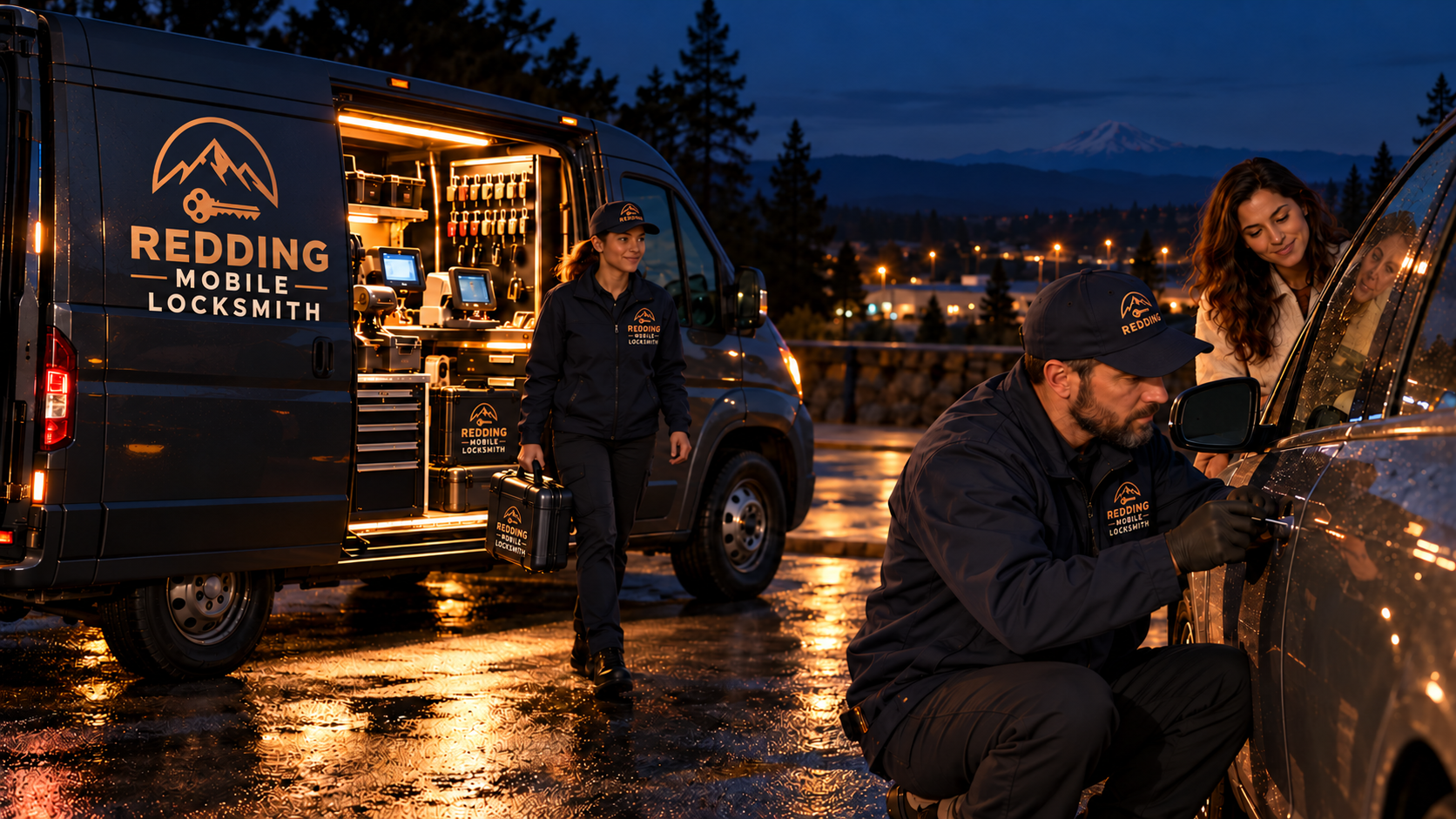
Redding Mobile Locksmith is a 24 hour mobile service with uniformed technicians and a branded van carrying key cutting equipment, tools and common hardware. We serve Lakehead and the nearby communities of Sims and Shasta Lake. See the Lakehead coverage page for the full list of local services.
Neighbors may find the Sims business security page helpful, since many of the same ideas apply to a small property in the canyon. For the larger service description, the business security service page covers the complete range.
The phone line is coming soon. For now, use the request form and describe the doors, the type of business and any urgent concerns. The more detail you give, the better prepared the technician will be when they arrive.
Before you finish reading, take two minutes to write down the doors on your property. Next to each, note the lock type if you know it and how many keys exist. That short list is the most useful thing you can hand a technician, and it doubles as the first page of your key log. Keep a copy off site so it survives a bad night.
Common questions
What is key control for a small business?
Key control is a simple system for knowing who holds every key and which doors it opens. It usually means a written log, a rule for returning keys when someone leaves, and a plan to rekey if a key goes missing. It does not require expensive equipment, only steady habits.
Should I rekey after an employee leaves?
If that person held a key and you are not sure every copy was returned, a rekey is the careful choice. It makes any old copy useless without replacing hardware. Many owners rekey at the end of a season or after a change in staff to keep things simple.
Is a keypad lock better than a key?
Neither is better in every case. A keypad lets you change a code in moments when someone leaves, which suits high turnover. A mechanical key suits places where power or batteries are a concern. Many businesses use both on different doors. A technician can help match the lock to how your team works.
Can you help if I am locked out of my shop at night?
Yes, as an after hours mobile service the team can help with business lockouts. You will be asked to show that you have authority over the building. Describe the door, the type of lock and where you are waiting. Wait somewhere safe and well lit until the technician arrives.
What if I think someone broke in?
Stay outside and call emergency services first. Do not enter to check. Once the scene is safe and the proper authorities have finished, a technician can secure damaged doors and locks. Do not touch the entry point more than needed, in case it is part of a report.
How do I ask for a visit?
Use the request form on the contact page, since the phone line is coming soon. Tell us the doors involved, the lock types if you know them, your role at the business and any safety concerns. Clear details help the right tools and hardware ride along in the van.