
Home / Yreka / Business Security in Yreka
Yreka business security
Business Security in Yreka: Key Control and Door Hardware for Small Properties
Shops, offices and small properties in Yreka share one problem: too many keys and too little record of who holds them. Here is how key control and sound door hardware keep a building secure.
Security starts with the doors people actually use
Yreka is the Siskiyou County seat along Interstate 5, and its commercial life shows it. Older downtown buildings stand beside county and professional offices, while neighborhoods and rural edges hold small shops, workshops, storage buildings and second properties. These places differ in size, but they share a plain truth: a property is as secure as its weakest door and as controlled as its key list.
Security rarely fails in dramatic ways. It fails when a back door is propped open on warm days, when a key is lent and never returned, when a lock is so worn that it opens with a nudge, or when nobody remembers who has the spare. The tools that fix these problems are ordinary: well chosen hardware, a clear record of keys and a habit of checking.
This page treats business security as a practical craft. It explains key control, door hardware and the sensible order in which to improve them, in the steady voice of a dispatcher who has seen the same small problems many times.
A cabin owner returns after weeks away
Imagine a seasonal cabin owner who arrives at a small mountain property after several weeks away. The gate lock sticks, the door swells in its frame, and a window latch that once held firm has gone loose. Nothing is missing, but the owner has a creeping doubt: has anyone been here, and who else has a key?
That doubt is the heart of key control. A property that sits empty for long stretches needs locks that work and a list of people who can enter. The owner might discover that a caretaker kept a copy, that a previous owner never returned theirs, and that the padlock on the shed has the same key as the padlock on the gate.
The lessons apply equally to a small shop that closes for a season, an office that shares a building, or a workshop that is quiet for weeks. A short audit of keys and hardware, done once and kept up, brings the same relief the cabin owner wants.
Key control in plain terms
Key control means knowing how many keys exist, who holds each one and what each one opens. It is not complicated, but it takes honesty. Start with a simple log: a list of doors, a list of keys and a list of people. Match them. Where the match is unclear, assume the key is out in the world and plan to change the lock.
Common keys are the weak point. Most standard keys can be copied at any store with a blank and a machine. A stamp that says Do Not Duplicate is a request, not a barrier. For stricter control, restricted key systems use blanks that are not sold openly and are cut only with authorization. Ask a technician whether such a system fits the size and budget of your property.
Rekeying is the simplest reset tool. If a key goes missing or an employee leaves, the cylinders can be changed so old keys stop working, while the hardware stays in the door. The page on rekeying in Yreka describes the process step by step.
- Keep a written list of every key, who holds it and what it opens.
- Collect keys when someone leaves a job or a lease.
- Do not rely on a Do Not Duplicate stamp to stop copies.
- Rekey after a loss or a change in who needs access.
- Consider a restricted key system for larger or busier properties.
The hardware that carries the load
A door is a system of parts. The slab or leaf, the frame, the hinges, the latch, the deadbolt, the strike plate and the handle each have a job, and the weakest one decides how well the whole door holds. A strong deadbolt in a soft frame is only as good as the frame. Hinges that can be removed from the outside defeat a lock on the other side.
On a typical commercial or small property door, the deadbolt should extend into a reinforced strike plate that is screwed into the framing, not just the trim. Long screws matter more than most people expect. The bolt itself should reach well into the strike, with no wiggle room. Check that the door closes squarely and that the latch engages without a hard shove.
Think about who can reach the door and when. A rear entry facing an alley, a side door hidden by a fence or a loading door used once a week each deserve the same quality of lock as the front, because that is where trouble tends to look first. Make sure each of these doors has a working deadbolt, solid hinges and light enough to see by. A door nobody watches should never be the easiest one to open.
Glass in or beside the door is another consideration. A deadbolt that can be reached by breaking a pane and turning a knob offers little protection. A double cylinder deadbolt, which needs a key on both sides, is one answer, although there can be safety concerns about exits. Ask what rules apply to your building before choosing.
Doors that close themselves: closers and panic hardware
Many commercial doors need to close on their own, so a door closer is mounted at the top. It is a spring and hydraulic arm that pulls the door shut at a controlled speed. A closer that is set too weak leaves the door ajar, and one set too strong slams it. Either can leave a lock unlatched or damage the frame over time.
Public and employee exits often use panic hardware, a horizontal bar that releases the latch when pushed. It lets people leave without a key while keeping the door locked from the outside. Some versions can be set to lock out entry, or to allow entry with a key. These devices are life safety products, and the rules around them vary, so ask the authority that oversees your building before changing one.
A technician can check that panic bars move freely, that latches retract fully, and that the strike lines up. The page about business door hardware describes this kind of work in more depth.
Older downtown buildings and their quirks
Older downtown buildings in Yreka can have doors that were built for another era. Heavy wooden slabs, glass paneled entries, transoms above the door, and hardware that has been patched many times are all common. Some carry mortise locks, where the latch and deadbolt live in a pocket in the edge of the door, and others have a surface mounted rim lock added later.
These doors can usually be secured well without losing their character. A modern cylinder can often be fitted into an older mortise body, and a reinforced strike plate can be added to an old frame. A technician will weigh whether to repair, upgrade or replace, and will explain the reasons in plain language.
If your building is historic, check what rules apply before you change visible hardware. Requirements vary and are decided by others, not by the locksmith. What a technician can do is describe the options and make the work as unobtrusive as possible.
Offices, shared buildings and who holds what
In an office or shared building, doors multiply and so do keys. There may be an outer door, an inner suite door, a storage closet, a back entry and a file room. Each has its own people who need access. A master key system lets one key open several locks while each lock also has its own key, which keeps access layered instead of all or nothing.
Think about how tenants and staff will actually behave. A key on a hook by the door tends to walk away, and a key hidden outside is a key for anyone patient enough to look. Ask each person to keep their key on their own ring and report a loss right away. A culture of reporting loses matters more than any lock you can buy.
Master keying is useful, but it adds complexity and some risk, since a lost master key affects many doors at once. For a small office, it may be enough to set a few locks to the same key. A technician can explain the trade offs and propose a layout that fits the building and the people who use it.
Whatever the system, plan for changes. People join and leave, tenants move, and spaces are reassigned. A building that rekeys at those moments stays under control. A building that does not will slowly lose track of who can enter. See the overview of business security for the general picture.
Rural edges, gates and outbuildings
At the rural edges of Yreka, security includes gates, barns, sheds and equipment buildings. These often rely on padlocks, which are only as strong as their shackle, body and the hasp they are fastened to. A good padlock on a weak hasp is a weak lock. Look at the screws, the metal and how the hasp is mounted to the door and frame.
Gates deserve the same care. A chain and padlock is common, but the chain should be sturdy and the lock should be placed where it is hard to cut. Keyed alike padlocks, where several locks open with one key, save carrying a ring of keys, although they raise the stakes if the one key is lost. Think about how many locks share a key.
For a property that sits empty, check the locks each time you arrive. Look for scratches, loose screws and doors that no longer close well. A short walk around on each visit catches small problems before they turn into large ones.
After hours problems: lockouts and failures
Business trouble does not keep business hours. A shop owner locks up and finds the key broke in the lock. A manager arrives in the dark to find the door will not latch. An employee leaves the only key inside. When these things happen after dark, calm matters more than speed, because forced entry often costs far more than patient work.
If you are locked out of a business, first check whether anyone else holds a key, such as an owner, a manager or a landlord. If the building has an alarm, think about what will happen when the door opens. Tell the technician about any alarm, since a surprise can add to the night's trouble. Stay somewhere safe and lit while you wait.
The guide on a commercial building lockout after hours walks through the steps, and the after hours emergency page for Yreka describes how to stay safe and give the details that matter.
Yreka sees hot dry summers and cold winters, and hardware feels both. Metal expands in heat and shrinks in cold, wood swells with damp and dries out again, and grit blows into every opening. A deadbolt that moves easily in July may drag in January. A latch that catches cleanly in spring may miss the strike in a hard freeze when the door has shifted a fraction.
Ask a technician to look at moving parts at the change of seasons. Cylinders benefit from cleaning and the right kind of lubricant, never heavy oil that gums up the pins. Hinges can be tightened, screws can be reset into fresh wood, and a strike plate can be adjusted by a small amount so the bolt lines up again.
For the cabin owner and anyone with a seasonal property, a visit before the quiet months and another when you return is a sensible habit. Doors left closed for weeks can seize. A little care now saves a stuck lock on the first cold night of the year.
A sensible order for improving a small property
If the list feels long, take it in order. Start with the keys: write down who has what, and rekey if there is any doubt. Next, look at the doors you use most, and make sure each latch and deadbolt works smoothly. Third, reinforce the strike plates and hinges. Fourth, inspect gates, outbuildings and padlocks.
Then consider lighting and visibility. A well lit entry discourages trouble and helps you work at night. Motion lights over a back door, a clear sightline from the street and trimmed shrubs near the entry all help. These are lock adjacent steps that do not involve a locksmith but make the locks more useful.
Finally, set a schedule. A short check twice a year, with a look at the keys and a test of each lock, keeps problems from piling up. The install new locks page explains what is involved if a lock needs to be replaced.
Help across Yreka and the county
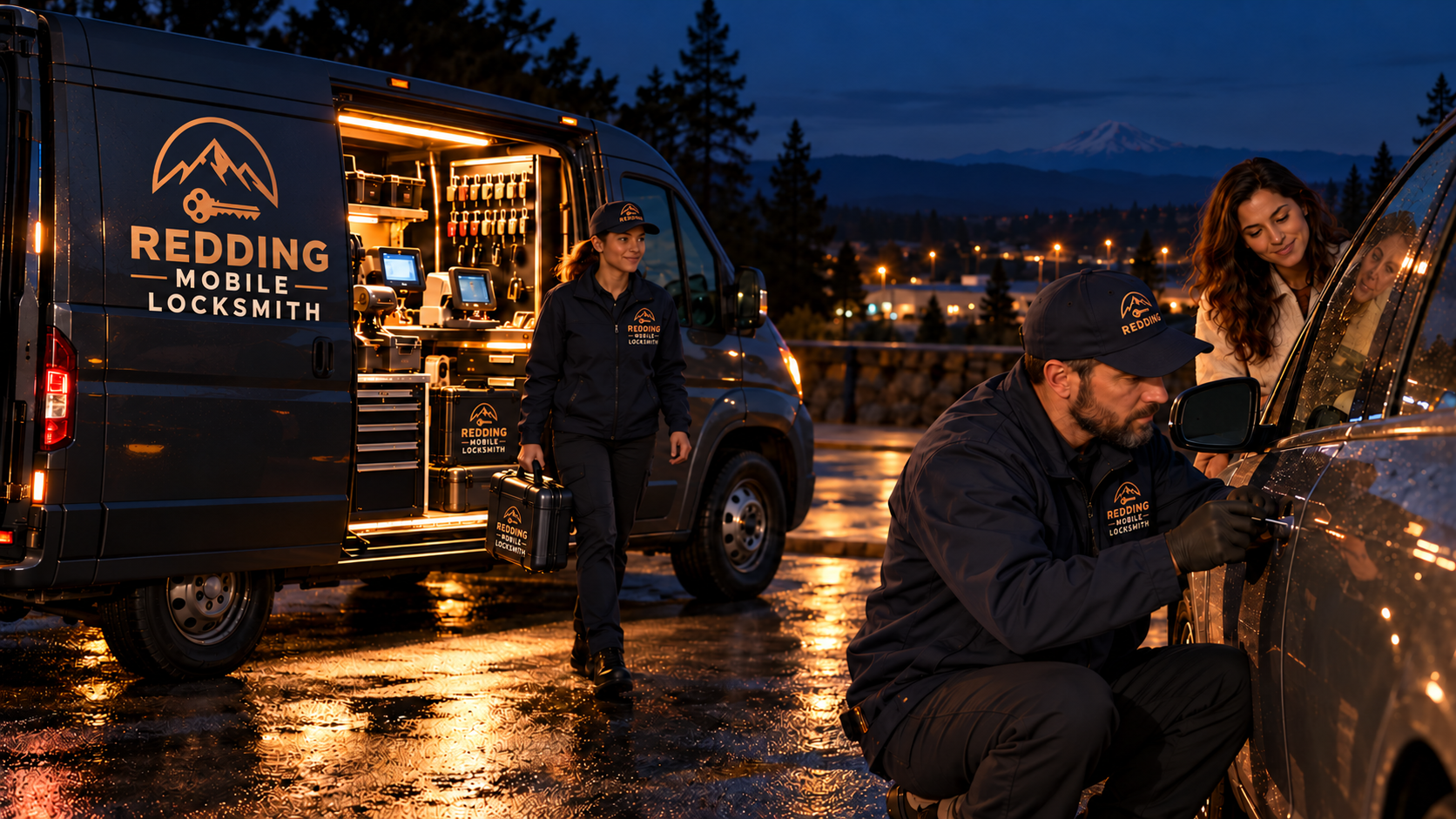
Redding Mobile Locksmith serves 17 communities in Shasta and Siskiyou Counties with a branded van and uniformed team, and carries tools, key cutting equipment and common hardware. For Yreka specifically, see the Yreka overview, plus the pages on a night house lockout and vehicle key replacement.
Neighbors in Montague and Weed will find their own pages. The phone line is coming soon, so for now the way to ask is the request form on the contact page. Describe the doors, the hardware you see and what is going wrong.
Common questions
What is key control and why does a small business need it?
Key control means knowing how many keys exist, who holds each one and what each opens. Even a small shop or office loses track over time as people come and go. A simple written list, plus rekeying when keys go missing, keeps access limited to the people who should have it.
Does a Do Not Duplicate stamp stop someone from copying a key?
No. The stamp is a request, and many stores will copy such a key anyway. For real control you need a restricted key system, which uses blanks that are not sold openly and are cut only with authorization. A technician can tell you whether such a system suits your property.
What makes a commercial door secure?
Security depends on the whole system: the slab, frame, hinges, latch, deadbolt and strike plate. A strong deadbolt in a weak frame is only as good as the frame. Long screws in the strike plate, solid hinges and a door that closes squarely all matter more than any single fancy lock.
Can my older downtown door be made secure without replacing it?
Often yes. Many older mortise and wooden doors can take a modern cylinder, a reinforced strike plate and better screws. A technician weighs whether to repair, upgrade or replace. If your building is historic, check what rules apply to visible hardware before making changes.
What should I do if I am locked out of my business after dark?
Stay calm and safe. Check whether an owner, manager or landlord holds a key. Tell the technician about any alarm system, the type of door and what you tried. Forced entry often causes more damage than patient work, so avoid pulling or prying while you wait.
How do I ask for a business security visit if there is no phone number yet?
The phone line is coming soon, so use the request form on the contact page. Describe the doors, gates and outbuildings, how many keys you have, and what problem you want solved. Details help the technician bring the right cylinders, strike plates and tools.