
Home / After dark / Keys left at a business or with a valet
Shared key guide
Keys Left at a Business or With a Valet: What to Do When Something Goes Wrong
Handing your keys to someone else is normal. It becomes a problem when the keys are missing, the person has gone home or the vehicle will not start. This guide walks through the situation in order, without drama.
Why this problem happens more often at night
Picture a restaurant, an event hall or a repair counter at the end of the evening. Staff are tired. Shifts change. A tray of keys sits behind a counter, and one tag has slipped off its hook. Nobody did anything unusual. The system simply ran out of attention at the end of the night.
Night is also when the usual fixes are shut. The manager is off duty. The office is dark. The person who knows where the spare tray lives has left. You are standing outside, with a vehicle you cannot move, and only a few people left to ask.
This guide treats that moment as a procedure. It does not blame anyone. It shows what to check, what to ask and when a locksmith helps and when one does not. The first rule is that a calm, specific question gets better answers than an angry one.
Everything here is general. Businesses run their key handling differently, and their rules are theirs to explain. What follows are questions you can ask and steps you can take, not claims about what any business must do.
First, work out which problem you actually have
There are really four different problems hiding under the same sentence. The keys may be missing. The keys may be present but locked in a room you cannot enter. The keys may have been handed to the wrong person. Or the keys may work, and the vehicle itself has a fault.
Each of these has a different answer. Missing keys need a search and, if that fails, a replacement. Keys in a locked room need someone with access. Keys given to the wrong person need a calm conversation and a safe plan. A vehicle fault needs a diagnosis, and a key replacement would not help at all.
Ask direct questions to sort them out. Where are my keys now? Who handled them last? Is the vehicle where I left it? Does the staff member in front of me have authority to release them? Write down what you hear, because details blur easily late at night.
Keep in mind that a business may hold your keys for a legitimate reason. A repair counter may keep them overnight on purpose, with the vehicle inside a locked bay. In that case, the right fix is a call in the morning, not a locksmith.
- Ask where the keys are and who last handled them.
- Ask whether the vehicle is still where you left it.
- Ask who on site has authority to release keys.
- Ask whether there is a log, a ticket or a tag number for your vehicle.
- Write down names, times and anything you are told.
What to say to the staff, and how to say it
Start with the facts and keep your voice level. Say your name, describe the vehicle and give the tag or ticket number if you hold one. Ask what the business can do tonight. Many problems clear up when the staff member knows exactly what to look for.
If the staff member says the keys cannot be found, ask who else might know. Ask whether a manager can be reached by phone. Ask whether there is a written process for lost keys. These are fair questions that a well run business can answer.
Do not accuse anyone of taking anything. Even if you feel certain, an accusation closes doors. A plain statement works better: your keys are not where they should be, and you need help finding them or replacing them.
If the discussion gets tense, step away. Move to a lit, visible spot. You can continue by phone or in the morning. The vehicle will still be there, and a fresh conversation often goes better than a worn out one.
Check the vehicle before you assume the worst
If you can safely reach the vehicle, look at it. Are the doors locked? Is anything different inside? Is the alarm light behaving as usual? A short walk around tells you whether the vehicle was moved or entered. Do this only in a lit area with other people near.
If something looks wrong, such as a scratch you do not remember, an open door or a missing item, stop. Do not touch more than you need to. Take photos if you can. Report it to the business and to the proper authorities, depending on what you find.
If the vehicle is untouched and simply locked, you may only have a key problem. In that case, a locksmith can help in a different way. A technician can open the vehicle if the keys cannot be recovered, and can make a new key from the vehicle itself. Our night car lockout service page explains the first part, and vehicle key replacement explains the second.
- Walk around the vehicle in a lit area with other people near.
- Look for open doors, scratches or moved items.
- Take photos before touching anything that looks wrong.
- Report anything unusual to the business and the proper authorities.
- Leave the vehicle alone if it looks untouched and locked.
When the valet has the key and the vehicle is gone
This is the case that worries people most, and it is often the least dramatic. A valet may have parked the vehicle in a lot you cannot see. A shift worker may have moved it. The vehicle may be safe and the key may be on a board you cannot reach.
Ask where the vehicle is parked and ask to see it. Ask the staff member to walk with you if you are not comfortable going alone. If the answer is that the vehicle cannot be found, ask for a manager and write down the time you asked.
If you have a spare key, you may be able to retrieve the car yourself and sort out the missing key in daylight. Bring identification and proof of ownership if you can. Staff are right to ask for them before releasing anything.
If the vehicle is gone and nobody can say where, report it to the proper authorities and give them the year, make, model, color and plate. Do not search alone at night.
If a fob works the doors but will not start the engine, say so clearly. That detail tells a technician whether the fob signal, the chip or the vehicle is the likely source of the trouble.
- Confirm the key in your hand is the one you handed over.
- Check whether the fob button changes the door locks.
- Look at the dashboard for any warning light when you try to start.
- Note whether the fob has been dropped, wet or separated from its ring.
- Tell the technician exactly what the vehicle does and does not do.
When the keys are found but do not work
Sometimes the keys come back and the car still will not start. A few things can cause this. A smart fob may have been dropped or had its battery drained. A transponder key may have been separated from its ring and damaged. The key may be the wrong one, handed over from a similar tag.
Check the plain things first. Is it your key? Does it match the shape of the one you gave? Does the vehicle respond to the door button? Our guides on key fob battery failure at night and a dead car battery and door locks explain how to tell these problems apart.
If the key is the right one and the vehicle still does not respond, a locksmith can test the key and the vehicle together. This is a diagnostic job, and it comes before any replacement. Describe what happens on the dashboard when you try to start.
Be realistic about the night. Some jobs, such as clearing and re adding keys, take careful work and time on the vehicle. A technician will explain what is needed before starting, and you can decide with full information.
What a locksmith can do, and what one cannot
A mobile locksmith can open a locked vehicle when you can prove it is yours. A locksmith can cut and program a new key on many models, using equipment carried on the van. A locksmith can clear a lost key from the vehicle's memory on many models, so the missing key cannot start the car.
A locksmith cannot make a business release your keys. A locksmith cannot recover keys from a locked room unless the business gives permission. A locksmith cannot tell you what a business did or did not do with your keys. Those matters belong to you and the business.
The practical question is whether replacing the key saves you more time than waiting for the original. Sometimes it is. Sometimes the keys will be back in the morning and the wait is simpler. That decision is yours, and a good technician will help you weigh it honestly.
Ask that the work be described in plain language before it starts and written plainly on the invoice afterward. A short record is useful if the business, an insurer or a family member later asks what happened.
Proof and identification, both ways
Expect to be asked for proof at every step. The business may ask for identification before releasing keys. A locksmith will ask for identification and proof of ownership before making a key. These checks protect your vehicle, and they apply to you as much as to anyone else.
Prepare them in advance if you can. Photo identification is the first item. Registration or title is the second. If you handed over a tag or a ticket, keep it with you. Our page on proof of ownership for key replacement goes into detail.
Ask for the same from the other side. A technician arriving at night should wear a uniform and arrive in a branded van, and you can ask for identification. Our guide on confirming who is arriving explains what to look for.
Also consider the other side of the problem. If you are the one who handed the keys to someone and then lost the paperwork, you can still prove ownership with registration and identification, so do not assume the night is lost.
- Photo identification in your name.
- Registration, title or other proof of ownership.
- The ticket, tag or receipt the business gave you.
- Year, make, model and trim of the vehicle.
- The names and times of anyone you spoke with.
Vehicle security after the keys were out of your hands
Once your keys have been with someone else, you cannot prove nobody made a copy. Most staff are honest, and most copies are never made. Still, a calm owner thinks about the risk once and decides.
Your options depend on the key. A plain metal key can be copied almost anywhere. A transponder key needs the chip paired, which makes casual copying harder but not impossible. A smart fob is harder still. Our guide on transponder keys explained for night emergencies describes the differences.
If you want to be sure, ask about reprogramming. On many models, a technician can clear all existing keys and add only the ones you hold. That removes any copy you do not know about. It is a clean answer to an uncertain situation.
Pick a routine you will actually follow. A habit that takes ten seconds, such as a photo of the ticket, is more useful than a long checklist you forget by the next outing.
Preventing the problem next time
You cannot control a business's process, but you can control your side. Before you hand over a key, remove anything that does not need to travel. A house key, a gate key and a work key do not belong on a valet ring. Keep a separate small ring for service stops.
Photograph the vehicle and the ticket when you hand it over. Ask where the keys are stored and when the business closes. Know who to ask for if something goes wrong. Keep a spare key somewhere safe and away from the vehicle.
Our guide on why a spare key matters explains how a spare turns a long night into a short one. If several people share a car, managing keys for a shared family vehicle gives a simple routine.
- Hand over only the key the vehicle needs.
- Take a photo of the ticket and the vehicle.
- Ask where keys are kept overnight.
- Keep a spare in a safe place you can reach.
- Save the business hours in your phone.
Asking for a key made on site
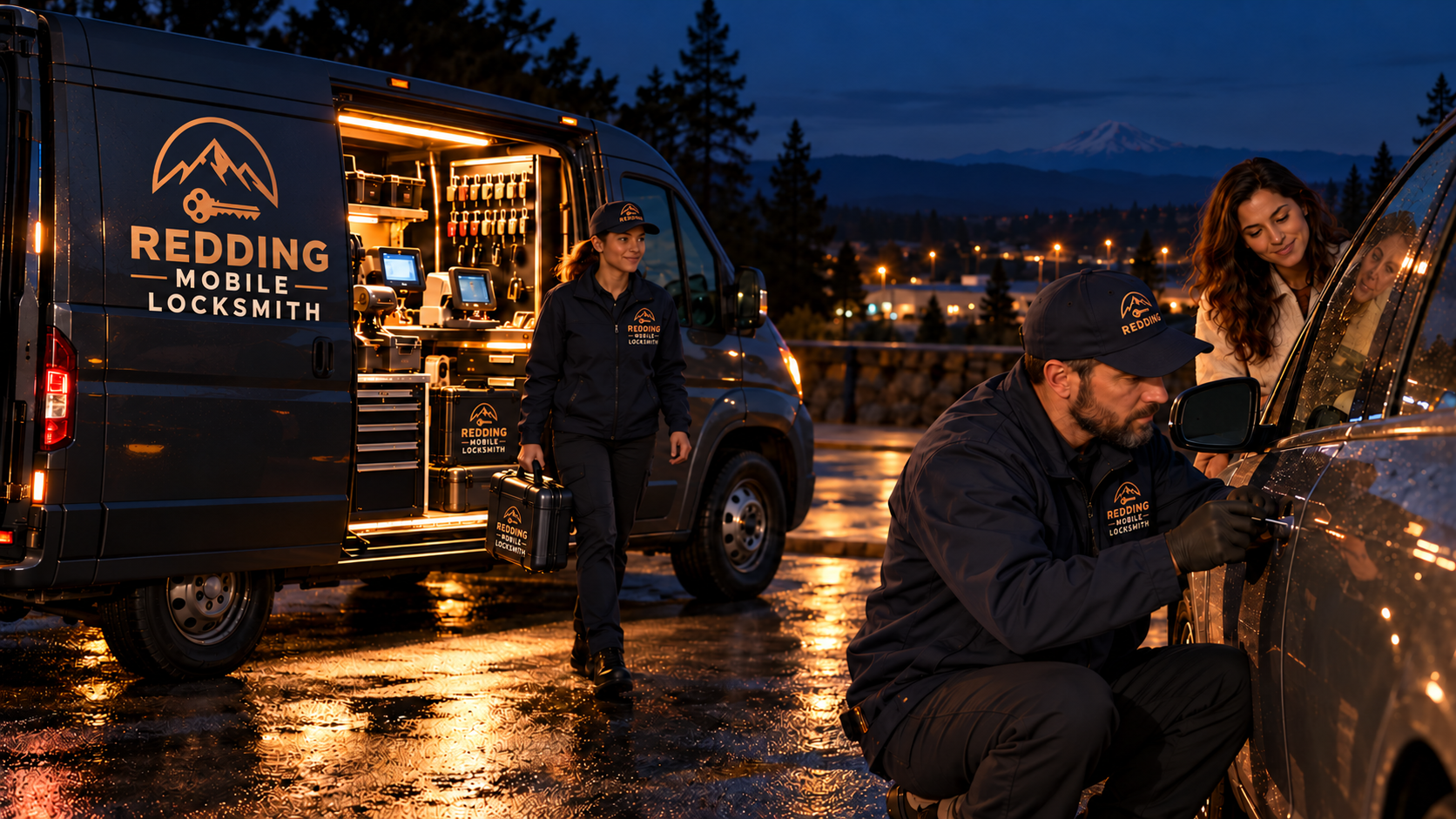
Redding Mobile Locksmith is a 24 hour mobile service for Shasta County and Siskiyou County. The branded van carries cutting and programming equipment, so many key jobs can be done at the vehicle. The phone line is coming soon.
Use the request form on the contact page. Say where you are, which business has your keys, what is wrong and what you have in hand. Add the vehicle details. A clear request helps the team bring the right equipment.
If you are in a larger town, the Redding and Anderson pages describe local needs. The after hours emergency page explains how night requests are handled.
Common questions
What if the valet cannot find my keys?
Stay calm and ask who else might know, such as a manager or the last person on shift. Ask whether the business has a lost key process and write down names and times. If the keys do not turn up, a locksmith can open and re key the vehicle, making a new key on many models.
Can a locksmith help if my keys are locked in the business?
Not with the business's rooms. A locksmith can help with your vehicle, by opening it and making a new key if the original cannot be reached. Getting keys out of a locked office needs someone with authority at the business, so ask the staff or a manager first.
Is it worth replacing the key if the originals will come back tomorrow?
It depends on how urgent the vehicle is for you tonight and how comfortable you feel about the keys being out of your hands. Waiting is often simplest. If you need the car now, or want to be sure no copy exists, replacement and reprogramming is a reasonable choice.
Do I need proof the vehicle is mine?
Yes. A locksmith will ask for photo identification and proof of ownership before opening a vehicle or making a key. The business may ask for your ticket or tag. Have all of them ready, plus the year, make, model and trim.
What if I think the keys were copied?
There is no way to know for sure. If it worries you, ask about reprogramming. On many models, a technician can clear all stored keys and add only the ones you hold, so unknown copies stop working. Older keys with no chip may need a lock change instead.
Should I report a missing vehicle right away?
If the vehicle is not where it should be and nobody can say where it is, yes. Contact the proper authorities and give the year, make, model, color and plate. Do not search alone in the dark. A report creates a record and starts the right process.