
Home / After dark / Rental car lockout steps
Rental car guide
Rental Car Lockout Steps: What to Do When the Car Is Not Yours
A lockout is stressful in your own car. In a rental, in a town you do not know, at night, it feels worse. This guide gives a calm order of steps and explains who needs to be involved.
Why a rental lockout feels different
In your own vehicle, you know the key, the spare and the habits of the car. In a rental, you know none of them. The key style may be unfamiliar. The door lock behavior may be new. You may not even know where the rental paperwork is.
You are also not the owner. The vehicle belongs to a company, and the company has rules about who may open it, who may work on it and who pays. Those rules are in your agreement or on a card inside the folder. A locksmith will ask about them, and so should you.
Travelers in Shasta County and Siskiyou County often arrive at an airport, drive on Interstate 5 or Highway 299, and stop at a trailhead, a lake or a motel in a town they have never seen. A lockout in those places can mean a long distance from the nearest help. Calm preparation is your strongest protection.
The steps below put safety first, then paperwork, then the key. Follow them in order and you will make fewer mistakes under pressure.
Step one: be safe where you are standing
Before you think about the car, look at your surroundings. Are you in a lit area? Are other people nearby? Is the weather a concern? A parking lot at a lake, a trailhead in the dark or a roadside turnout can be quiet and cold. If the place feels unsafe, leave it on foot toward a lit building or a staffed business.
If you are traveling with others, keep them together. If you have children or a pet in the car, this is a different situation altogether. Call emergency services first and say that a child or an animal is inside a locked vehicle. Do not wait for a locksmith in that case. Our guides on a child inside a locked car and a pet inside a locked vehicle explain the reasoning.
If the engine is running, note it. A running car is a different problem from a parked and locked one. Read keys locked inside a running car for the steps that apply.
Once you are safe, take a breath and move to the next step. Nothing here needs to be solved in the first minute.
- Move to a lit area with other people if you can.
- Keep your travel companions together.
- If a child or an animal is inside, call emergency services first.
- Note whether the engine is running.
- Take a slow breath before making any decision.
Step two: find your rental paperwork
Look for the agreement, the contract number and the customer service line of the rental company. These may be on a folder, a card, an email on your phone or the key tag itself. If the keys and the paperwork are both inside the car, check your phone for the booking email or confirmation.
The agreement often says what to do in case of a lockout. Some companies run a roadside assistance line that covers lockouts as a service. Others expect you to contact a locksmith and handle the matter yourself. You will not know which applies until you read or ask. Do not assume.
Write down the plate number and the vehicle description. Even without the paperwork, you can usually describe the car: the make, the model, the color and the plate. The rental company or the locksmith will need those details to confirm which vehicle is involved.
If you cannot find any paperwork, say so plainly when you call. A rental company can look up the booking from your name and the pickup location.
Take a photo of the paperwork with your phone as soon as you can, before the next stop. It costs nothing, takes a few seconds and means a locked car never locks your paperwork away with it.
Step three: call the rental company first
Call the company before anyone touches the car. This protects you in a few ways. The company knows its vehicles and its rules. It may offer a service of its own, or it may authorize a specific type of help. It may also want a record of the event.
Ask direct questions. Do you cover lockouts? Do you have a roadside line? Do you allow a local locksmith to open the vehicle? Will I need written authorization? Who pays, and how is that arranged? Write down the answer, the name of the person who gave it and the time.
Also ask whether a spare key exists and where it is. Rental fleets often hold spares at the pickup location, and delivering one may be an option. In a remote area it may not be practical, but ask anyway.
Do not agree to anything you do not understand. If the representative cannot answer, ask for a supervisor or call back later. A short delay is better than a wrong step that causes trouble at return.
- Do you cover lockouts under the rental agreement?
- Is there a roadside assistance line I should call?
- May a local locksmith open the vehicle, and do you need to authorize it?
- Is there a spare key I can retrieve, and from where?
- How will any cost be handled, and what proof will you want?
Step four: decide between the company and a local locksmith
You have two main options. You can wait for whatever the rental company sends, or you can call a local mobile locksmith. The right choice depends on where you are, how long the company says it will take and how safe your location is.
In a larger town like Redding or Anderson, help may be nearby. In a mountain town in Siskiyou County, such as Mount Shasta or Dunsmuir, a company vehicle may be a long way off. A local locksmith with a van may be the practical answer.
If you use a locksmith, tell the rental company first, unless the agreement says otherwise. The company may have rules about damage and about who may open the car. Keep the invoice. You may need it later.
Our night car lockout service page explains how a professional opens a vehicle without damage and why that matters on a vehicle you do not own.
- Photo identification in your name.
- The rental agreement, booking number or confirmation email.
- The rental company name and customer service details.
- The plate number and the vehicle year, make, model and trim.
- Your location in plain words, including the nearest road.
What the locksmith will ask you for
A locksmith opening a vehicle must be sure the person asking has the right to do so. In a rental, that means proof tied to the rental. Expect to be asked for your photo identification and your rental agreement or booking details. Some technicians also ask to see the plate against the paperwork.
This is not a sign of distrust. It is how a responsible professional protects the vehicle owner and you. If you have the agreement on your phone, show it. If you do not, give the company's name and the contract number and let the technician verify it.
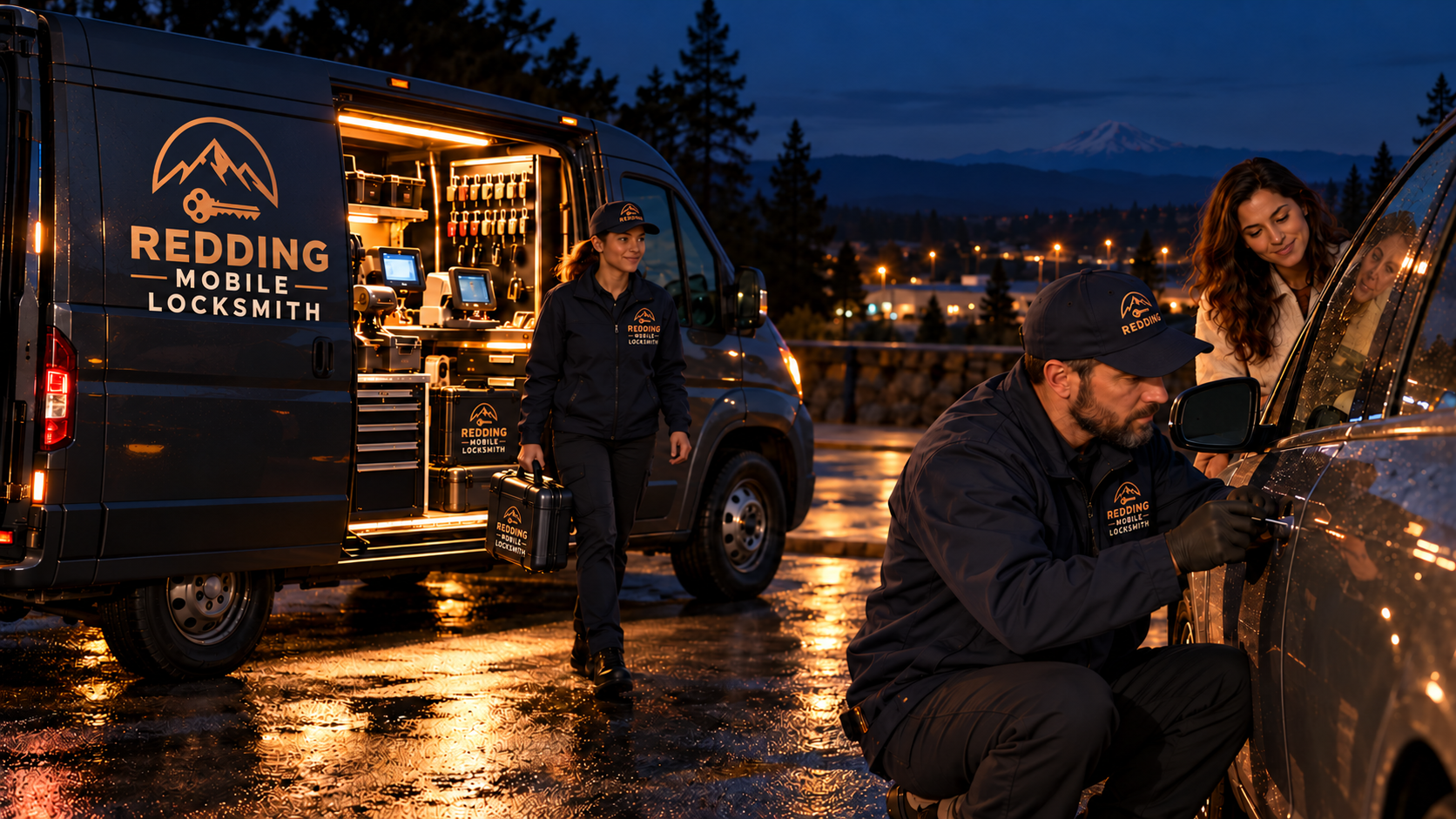
You should also expect the technician to introduce themselves and show identification. A uniform and a branded van are part of how Redding Mobile Locksmith identifies its team. Our guide on confirming who is arriving explains what to check.
Prepare the vehicle details, too. The year, make, model and trim help the technician bring the right tools. Key types vary by model and year, and a rental can be any of them.
Remember that the door is only the first part. A rental also has a trunk, a glove box and sometimes a fuel door that locks. Ask the technician to confirm that everything works normally before they leave.
- Purpose made tools are placed with care around door seals and wiring.
- Airbag parts and electronic locks inside the door are left untouched.
- Paint and weather seals are protected throughout.
- You inspect the vehicle with the technician after it opens.
- Anything unusual is photographed and reported to the rental company.
How a professional opens a rental without harm
A rental car returns to the company in a condition that is checked. Scratches, dents and damaged seals are noted. A careless attempt to open a door can leave marks that you will be asked about later. A professional uses purpose made tools that are designed to open a vehicle without damaging paint, weather seals or door linings.
Most vehicles today have electronic locks, side impact airbags in the doors and wiring inside the door panel. Tools are placed with care so none of these parts is touched. This is not a place for improvised methods or force.
If you are tempted to use a coat hanger or a wedge from a friend, stop. It may damage the vehicle and leave you responsible for the cost of repair. A professional visit is usually simpler than a repair bill.
After the door is open, check the vehicle together. Look at the paint, the seals and the interior. If anything looks different, mention it right away and take photos.
If the rental has a smart fob, the battery can be the whole problem. A weak fob battery can leave you locked out even though the fob is in your pocket. Our guide on key fob battery failure at night explains how to tell the difference.
If the key itself is gone
Sometimes the problem is not a lockout. The key is missing. You may have dropped it on a trail, lost it at a lake or left it at a restaurant. A rental key may be a transponder key or a smart fob, and either one needs the right equipment to replace.
The rental company may require that you tell them, because the key is its property and may have a replacement process of its own. Some companies will send a spare or tow the vehicle. Others allow a locksmith to make a key. Ask before you authorize anything.
Be careful with ownership. A locksmith can make a key for a vehicle only when the right party has authorized it. In a rental, that is usually the company. Our guide on proof of ownership for key replacement explains why the permission matters.
Read a lost key and vehicle security too, since a missing rental key raises the same security question as any other.
Hot weather deserves extra caution on a long wait. Dark upholstery, steering wheels and seat belt buckles get hot enough to hurt. Keep your hands away from them until the vehicle has been opened and allowed to cool.
Cold nights, hot afternoons and remote stops
Weather shapes how long you can safely wait. In the valley, summer afternoons are hot and dry, and a closed vehicle heats up sharply. In the mountain towns, nights are cold and snow is possible. A wait of an hour can be pleasant or dangerous depending on the season.
Make a plan for the wait. In heat, find shade and water and stay out of the sun. In cold, put on every layer you have and shelter in a building if you can. Do not leave a child or a pet inside any vehicle, even while you wait.
Remote stops add distance. Trailheads, lakeside lots and roadside turnouts along Highway 299 or Highway 89 can be far from help. Our guides on trailhead lockouts and lakeside parking lockouts describe how to prepare for that kind of wait.
Read summer heat and vehicle lockout safety and mountain roads, cold nights and lockouts for season specific steps.
Keep a spare pair of shoes, a jacket and a water bottle in your day bag when you travel. These small items turn a stressful wait into an ordinary one. Pack them where you can reach them without the trunk.
- Wear every layer you have in cold weather.
- Find shade and drink water in hot weather.
- Keep your phone charged and on low power mode.
- Stay in a lit place near other people.
- Never leave a child or a pet in a vehicle.
Keeping your belongings safe while you wait
Your bags may be in the locked car. Your phone may be in your pocket. Your wallet may be inside. Count what you have with you and what you do not. If your phone has low charge, put it in a low power mode.
Do not leave the vehicle for long, but do not stand next to it alone in the dark either. If you must leave, tell someone where you are going and when you will return. Ask a staff member at a nearby business to watch the area, if they are willing.
If valuables are visible inside the car, shift your position to stay near them without drawing attention. A calm, aware stance beats an anxious one.
Our guide on waiting for help in a parking lot lists simple habits that keep you safe while you wait for a technician.
Sending a rental lockout request
Redding Mobile Locksmith is a 24 hour mobile service across Shasta County and Siskiyou County. The branded service van carries professional tools, key cutting and programming equipment. The phone line is coming soon, so start with the request form on the contact page.
In the request, say that the vehicle is a rental. Name the rental company if you know it. Include the vehicle year, make, model and trim, your exact location in plain words and whether the engine is running. Mention anyone with you who needs shelter.
Our vehicle locksmith service page explains the range of vehicle work available, and the after hours emergency page explains how night requests are handled in general. The coverage section lists the communities we serve.
Common questions
Who do I call first when I am locked out of a rental car?
Make sure everyone is safe, then call the rental company. It may cover lockouts, offer a roadside line or ask you to use a local locksmith with authorization. If a child or a pet is inside, call emergency services first and do not wait for anything else.
Will a locksmith open a rental car for me?
Often yes, with the right proof. Expect to show photo identification and your rental agreement or booking details. The technician may also check the plate. It is wise to tell the rental company before work begins, in case the agreement has rules about who may open the vehicle.
Who pays for a rental lockout?
That depends on your agreement, any roadside plan attached to it and the company's policy. Ask the company before you authorize work. Keep the invoice and the name of the person you spoke with, so you can show what was done and why.
What if the rental key is lost and not locked inside?
Tell the rental company at once. A rental key is its property, and it may have a replacement process. A locksmith can make a key on many models, but only with the right party's permission. Ask what the company allows before work starts.
Could opening the car damage it?
A professional uses purpose made tools to open the vehicle without harming paint, seals or door parts. Improvised tools can cause marks that you may be asked about at return. Check the vehicle with the technician afterward and photograph anything that looks different.
What details should I have ready?
Have your photo identification, the rental agreement or booking number, the company name, the plate, and the vehicle year, make, model and trim. Also know your location in plain words and whether the engine is running. These details help the team bring the right equipment.