
What rekeying actually changes
Inside most door locks is a cylinder with a row of small pins. Each pin has a set height, and the key lifts every pin to exactly the right level so the cylinder can turn. Rekeying means taking the cylinder apart and setting the pins to a new pattern that matches a new key. The old key still enters the lock, but it no longer turns.
The lock body, the deadbolt, the handle and the finish all stay in place. Only the inside of the cylinder changes. That is why rekeying is usually simpler than replacing hardware, and why the door looks the same afterward. The household gets new keys, and the old ones become scrap metal.
It helps to think of the key and the lock as a pair that was matched at the factory. Rekeying breaks that pair and builds a new one. Anyone who held a copy of the old key, including a former tenant, an old friend or a stranger who found it, loses access.
The volunteer who holds the only key
Imagine a volunteer at a small community club in Anderson who is handed the only key to the hall. The previous caretaker moved away. Nobody knows who else has a copy, because over the years board members, cleaners and event hosts have all borrowed it. The volunteer wants to be responsible, but there is no list.
That is a classic rekey situation. The lock may be in perfect shape. The problem is that the key is no longer a controlled thing. Rekeying resets the count to zero. After the work, the volunteer holds the first key of a new set, and each copy afterward is a decision.
Churches, clubs, sports leagues and neighborhood groups face this often. Keys pass from hand to hand and are rarely collected. The cure is not suspicion of anyone. It is a clean start with a written list of who holds what. For a business with staff, see business security in Anderson too.
In practice the volunteer should also write a short note for the group. It says who holds a key, who asked for it and when it comes back. A note like this takes a few minutes at a table and prevents years of confusion. When the next volunteer takes over, the handoff is a list and a key, not a rumor.
Rekey after you move in
When you move into a home, you do not know how many keys exist. The seller, the builder, the previous renter, a real estate visitor, a cleaner and a contractor may each have had one. Most of them are honest. You still cannot know, and that uncertainty is the reason to rekey.
Rekeying on the first day gives you a known starting point. It also lets you put every exterior door on one key. In a lot of Anderson homes, the front door, the back door and the garage entry each take a different key, and a household ends up with a heavy ring. A rekey can unify them where the hardware allows.
Ask the technician what the hardware allows. Some locks from different makers cannot be keyed to match. In that case, the technician may suggest swapping a lock so the set works together. See installing new locks for how that option works.
Newer homes and older homes behave differently here. A newer house may have builder grade locks with identical keys on several doors, which makes unifying easy. An older house may carry a mix of hardware added over decades, and one door may hold a lock that is older than the owner. The technician will tell you which doors are simple and which need thought.
Rekey after a breakup or a household change
A relationship that ends is also a key event. A former partner may still hold keys, and good intentions do not change the fact that they have access. You do not have to be afraid of anyone to want the locks changed. It is a clean, practical step.
The same applies to a roommate who moves out, an adult child who leaves, or a family member who no longer lives there. Ask them to return keys, but do not rely on the return. Copies are easy to make, and you cannot tell if one exists. Rekeying answers the question permanently.
If a situation feels unsafe, put safety first. Contact the people and services who are there to help, and tell the locksmith only what is needed to do the job. A technician does not need your story, only the doors and the timing. You can also ask whether the work can be done in one visit.
If a former partner also has a key to a vehicle, the same thought applies. A car key can be reset or reprogrammed so older ones stop working. Read about vehicle key replacement and ask about the security options for your model. Doors and cars deserve the same attention, because a home address is often in the glove box.
Rekey for a new tenant
Landlords in Anderson often rekey between tenants. A rental changes hands, and the previous renter may have copies. A new cylinder pattern means the old resident cannot walk back in. It also protects the landlord, because a clear record shows the unit was secured before the new tenant arrived.
If you are a renter, ask your landlord before you rekey. Many leases say who may change locks, and rules vary. Do not assume the choice is yours alone. If a landlord agrees, ask for a written note so the work is on record.
For a landlord with several doors, plan the work as a set. A technician can rekey a number of locks in one visit, and can key them alike if you want one key for the unit. Keep a simple list of which key opens which door, and keep it away from the property. Read more under rekey locks on the service page.
Between tenants, check the less obvious locks too. Mailbox keys, shed padlocks, gate locks and storage doors are easy to forget. A unit is only as secure as its least attended lock. Ask the technician to include these in the plan if they are part of the rental.
Rekey after a lost key
A lost key is not always a reason to rekey. If it fell down a drain in your own driveway and nobody could connect it to your address, you may decide the risk is low. If it was on a ring with a car key, a mailbox tag or a business card, the risk goes up. Use judgment, and use caution if you are unsure.
The factor that matters most is whether the finder can learn which door the key opens. A bare key in a parking area is much less dangerous than a key with an address on a tag. If your address is on your keys, change that habit and consider rekeying.
When a key goes missing on the road, read lost keys after an evening event for the steps. Then decide about the home. It is easier to rekey on a quiet afternoon than to lie awake wondering who might have your key.
If you decide not to rekey, take smaller steps. Watch for any sign that someone has tried the door. Keep the porch lit. Make a plan so you can act that very night if something seems wrong with the details of who to call already written down. A decision to wait is fine when it is a decision, not an accident of forgetting.
Rekey or replace the lock
Rekeying works well when the lock is in good shape. If the lock is worn, loose, damaged or very old, replacement may be the better choice. Replacing gives you a new mechanism, not only a new pattern.
A technician can tell by looking and testing. A lock that turns smoothly, latches fully and shows no damage is a good candidate for rekeying. A lock that sticks, feels gritty, or has a loose handle may need more. Our page on broken lock repair explains what failure looks like.
Replacement also opens the door to upgrades, such as a heavier deadbolt or a keypad. Those are choices, not requirements. Ask the technician to explain the difference in security and in convenience, and decide in daylight if you can.
Keep in mind that a rekey changes the key but not the door. A weak frame, a short screw in a strike plate or a loose hinge will still be weak after rekeying. Ask the technician to look at the door as a whole. A good lock in a bad frame is only half a solution.
- Rekey when the lock is sound and you only need to cancel old keys.
- Replace when the lock is worn, damaged or does not close fully.
- Add a deadbolt when a door has only a knob lock.
- Consider a keypad when many people need access at different times.
- Ask for a written list of what was done at each door.
Keys, copies and who may make them
Some keys carry a stamp that says do not duplicate. That stamp is a request, not a barrier, and many shops will copy a key without comment. Do not rely on it. If control of copies matters to you, a rekey is the stronger step.
Some locks are sold as restricted systems, where copies can only be made with a card or authorization from the owner. If you have such a system, tell the dispatcher, because the process is different. Ask what the technician can do on site and what needs a separate step.
Whatever you choose, treat each new key as a record. Count the keys cut at the visit and write the number down. If three keys were cut, three should exist. If one goes missing, you know it the same week, not three years later.
How the visit works
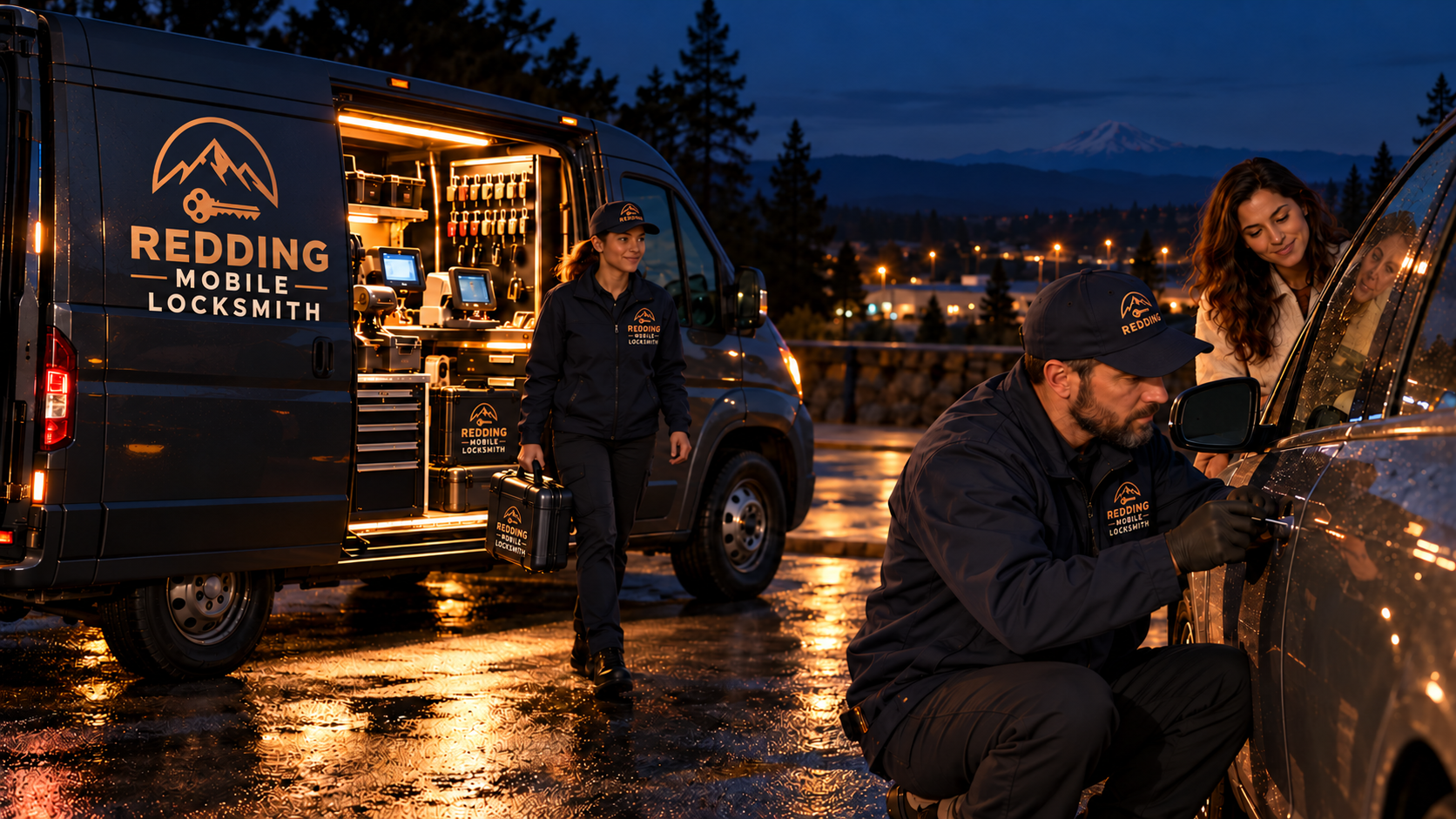
A mobile locksmith comes to the property with the tools and key blanks needed. The technician removes the cylinders, resets the pins, cuts the new keys and puts everything back. Each lock is then tested with the new key. The old key is tried to confirm it no longer turns.
You should be present or have a trusted person present. The technician needs to know which doors to work on. Walk them around the exterior and point out each lock. Include side doors, garage entry doors, sheds and gates that use a key.
Rules about who can authorize the work vary. A tenant, an owner and a manager each have different standing. Be ready to say which you are, and have proof that fits. Why a locksmith may ask for identification explains the reasoning.
The work happens at your door, in whatever weather the night or the day brings. Anderson summers are hot and dry, and winters are cool and damp. Heat and moisture both change how a door swells and how a lock moves. A technician will account for this when they test each latch and bolt.
What to prepare before the visit
Count the locks. Walk around the property in daylight and write down each door that has a keyed lock. Include the garage entry and any door to a shop or outbuilding. This gives the dispatcher a real number, and the technician can pack accordingly.
Gather the keys you still hold. The technician can sometimes use an existing key to work more cleanly. If every key is lost, tell them, because the approach changes. Decide how many new keys you need for the household, and who gets them.
Think about whether any doors should match. A household that wants one key for the front, back and garage should say so up front. If you are responsible for a group building, decide who gets a key and who does not. The request form on the contact page lets you list these details in advance.
After the rekey
Test every door yourself. Lock and unlock each one twice with the new key. Pull the handle after locking it. If any lock feels different from before, tell the technician right away. A small adjustment is easy while they are still on site.
Label and store the new keys with care. Do not put the address on a tag. Give each person only what they need. Keep a spare in a safe place that is not at the property. For a shared group like a club, write down who holds each key and when they received it.
Plan a yearly check. A rekey sets a new baseline, but baselines age. People come and go, and keys multiply. For the full set of home services, see home locksmith. For nearby households, Shasta Lake and Redding are served by the same team.
If something about the new keys bothers you in the first week, say so. A key that sticks, a bolt that drags or a lock that feels different is worth a second look while the work is fresh. Use the contact page to describe what you notice, and include the door and the time it happened.
Common questions
Does rekeying mean I need new locks?
No. Rekeying changes the pin pattern inside your existing cylinder so a new key fits and the old key does not. The lock body, handle and finish stay as they are. A technician may suggest replacement only if the lock is worn, damaged or does not match the other locks.
Can all my doors use the same key?
Often yes, if the locks are the same type and size. The technician can key them alike during the visit. If your locks come from different makers, some may not be able to match, and the technician can suggest changes. Tell them your wish when you request service.
Will the old key still go into the lock?
It may still enter the keyway, but it will not turn the cylinder. That is the point of rekeying. The technician will test the old key at the end to confirm that it no longer works, so you can see the result for yourself.
Should I rekey if I only lost a key once?
It depends on where it was lost and whether the finder could link it to your home. A bare key in a public spot is a lower risk than a key with an address. If you feel uneasy, rekeying removes the question entirely and is a calm solution.
Can a tenant rekey without asking the landlord?
Lease terms and local rules vary, so ask your landlord first and keep the answer in writing. Many landlords prefer to arrange the work themselves. If you both agree, a locksmith can still do the rekey and provide keys to the right people.
How do I request a rekey right now?
The phone line is coming soon. Use the request form on the contact page to say how many locks you have, what happened and whether you own or rent. That helps the team plan the visit.