
Home / Redding / Vehicle Key Replacement in Redding
Redding, car key replacement
Replacing a Lost or Broken Car Key in Redding
When a car key is lost or snaps at night, the job is more than cutting metal. This page explains what a replacement involves in Redding, what to gather first, and how the work is done at your vehicle.
When a key goes missing at the worst hour
Picture someone finishing a long work shift in Redding. It is late, the parking lot is quiet, and the key that was in a jacket pocket is not there. Or perhaps it is there, but the plastic head has cracked and the blade has come loose. This is a hypothetical picture, yet it describes a situation that fits a city with offices, shopping, light industry and plenty of people who work at odd hours.
The first feeling is usually frustration, followed by worry about how to get home. Take a breath. A lost or broken key is a solvable problem, and a mobile locksmith can come to the vehicle rather than asking you to tow it. The key work happens where the car sits.
Before you call, think about what you know. Do you have any key at all, even a damaged one? Is there a spare at home? Is the car locked, or can you still get in? Each answer shapes the plan, and each helps a dispatcher decide which tools to load into the van.
Retrace your steps calmly. Check the pockets of the clothes you wore, the bag you carried, the break room, the seat of a coworker's vehicle and the ground near where you parked. Keys often hide in plain view under a jacket or inside a lunch bag. Five minutes of careful searching can save a call.
If the car is still locked and the key is out of sight, avoid forcing the door. Forcing a door risks damage to the seal, the lock and the wiring. If the engine is running with no key in sight, note that clearly for the dispatcher, because it changes how the work is planned.
What is inside a modern car key
A modern car key is two things in one. The first is the metal blade, which lifts the pins or wafers in the ignition and door locks to the right height. The second is a small electronic chip, usually called a transponder, set into the plastic head. When you turn the key, the car sends a low power signal and the chip answers with a code. If the code matches, the engine is allowed to start.
Some keys add a remote for locking and unlocking. Others are smart keys or proximity fobs that never touch the ignition at all. A push button start vehicle checks for a fob nearby and compares a coded signal. Each type needs a different process for replacement, which is why the dispatcher will ask for the make, model and year.
Older vehicles may use a plain metal key with no chip. These are simpler: the blade is cut to match, and no programming is needed. Vehicles from the years of transition may use a mix. Our guide on keys for older vehicles from before transponder chips explains where that line falls.
The chip itself needs no battery in most keys. It draws a tiny amount of power from the signal sent by the car, which is why a transponder key can still start the engine even when the remote buttons have stopped working. The remote portion does use a small battery, and when it weakens the range shrinks.
Smart keys go further. They use a battery to talk to the car over short distances, and they let you open the door by touching a handle. Most also contain a hidden mechanical blade for emergencies. Our guide on smart key replacement in plain words and the guide on transponder keys explained for night emergencies describe the differences.
What a mobile technician does at your vehicle
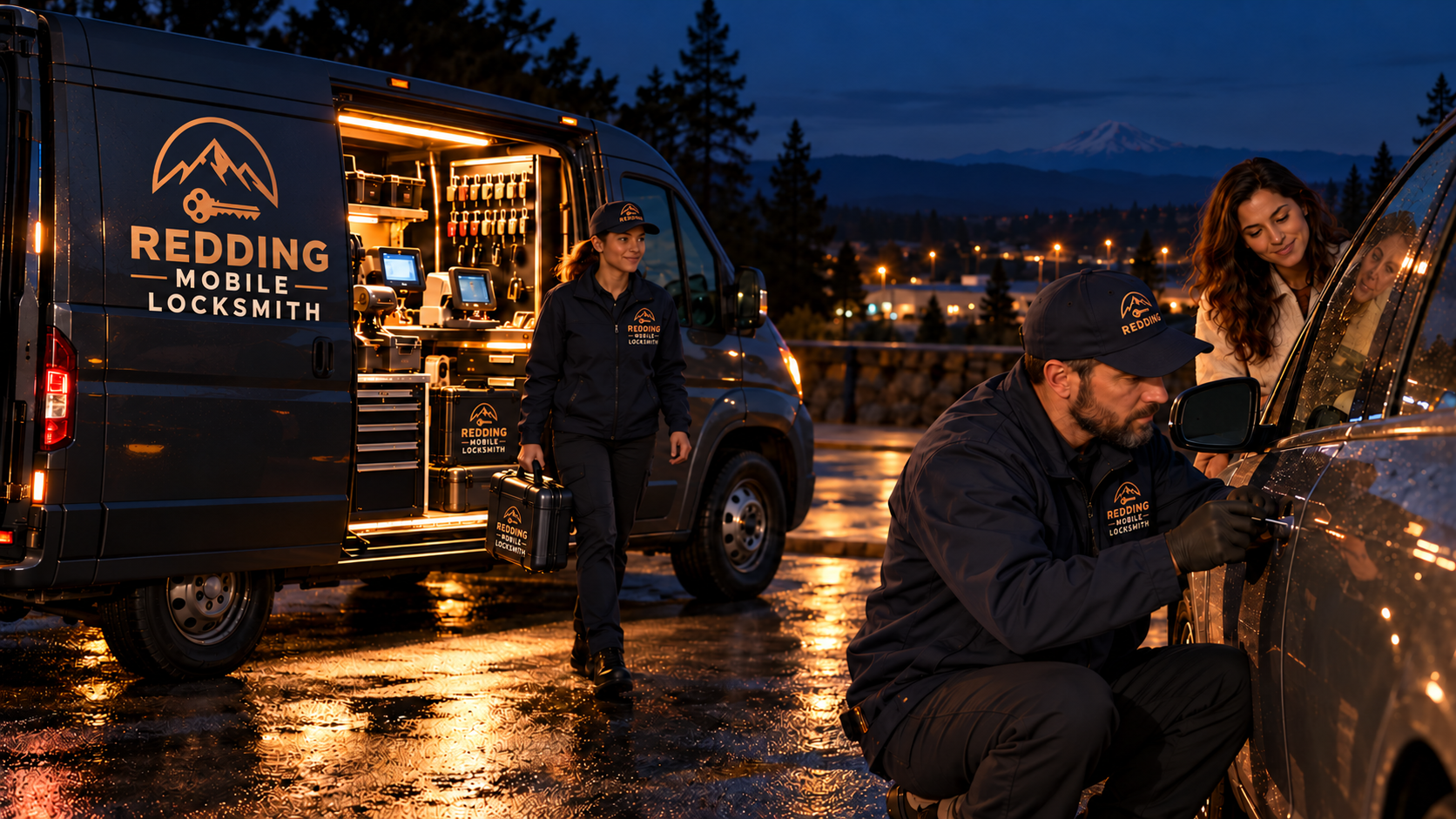
Our team arrives in a branded service van that carries key cutting and programming equipment, a range of blanks and common hardware. The work usually follows a clear sequence, and understanding it can help you stay calm while it happens.
First the technician confirms who you are and that the vehicle is yours. Second, the vehicle information is checked against the key type needed. Third, a blade is cut to fit the locks, either from a code or by taking information from the car itself. Fourth, the new chip or fob is programmed so the vehicle recognizes it. Fifth, everything is tested: door locks, ignition and remote buttons.
The details differ by vehicle. Some cars accept a new key in a short procedure, and others need a more involved process with the vehicle in a special mode. The technician will explain what applies to yours. Our vehicle key replacement service page and our transponder programming page go deeper into how this works.
Programming means teaching the car to accept a new key. The technician connects equipment to the vehicle, often through a diagnostic port under the dashboard, and starts a procedure that adds the new key to the vehicle's memory. This is routine work for a trained professional, but it needs the right tools and the right software for the vehicle.
While this happens, stay nearby but give the technician room. You may be asked to sit in the car, to turn the ignition on at a certain moment or to try each button on the new remote. If anything feels unusual, ask a question. A good technician explains what is happening in plain words.
What to gather before the van arrives
A little preparation makes the whole job smoother. Put these items together while you wait.
Proof of ownership matters. A responsible locksmith will not make a key for a vehicle without it. Our guide on proof of ownership for key replacement explains what counts and what to do if the registration is inside the car. If you are not sure about the vehicle details, our guide on preparing your vehicle information for the call helps you collect them.
Keep these items in a place you can reach, such as a wallet or phone case. If you rarely drive the vehicle, such as a seasonal truck or an older family car, check the paperwork before the night you need it. Many people discover on a lockout that the registration expired or sits in a drawer at home.
A photo of the registration and of the vehicle identification number on your phone is the simplest backup. Store the photos in a folder you can find in the dark. Do not send those images to anyone you do not trust, since they contain private details.
- Your driver license or other photo identification.
- The vehicle registration or title, or a photo of it on your phone.
- The make, model, year and color of the car.
- The vehicle identification number, found on the dashboard near the windshield or on the door jamb.
- Any key you still have, even if it is broken or does not start the car.
Lost key, broken key or worn key
These three situations feel alike but call for different handling. With a lost key, no working key exists, so the technician creates a new credential from the vehicle's data. With a broken key, there may be a piece to work from, such as a chip in the head or a blade still in the ignition. With a worn key, the original still works, but poorly, and a fresh copy can restore smooth operation.
If the key broke off in the ignition or a door lock, do not try to pull it out with pliers or glue. That can push the piece deeper and damage the cylinder. Tell the dispatcher about it. Our guides on a key broken off in the ignition and a key broken off in a door lock explain the steps.
A worn key often gives early warning. It sticks, it requires a jiggle or it works only at certain angles. If you notice this, copy it before it fails. Our guide on worn key symptoms describes what to look for.
When a key breaks, keep every piece. Even a cracked head may contain the chip, and the blade fragment can show the cuts. A technician can often rebuild a working key from these parts, which is sometimes simpler than starting from nothing.
For a worn key, bring the car and the key together. Copying a worn key can pass along the wear, so a technician may cut a fresh key from the code instead of tracing the old blade. That gives you a sharper, cleaner key that turns the ignition smoothly.
Adding a spare or replacing every key
After a loss, you face a choice: add one new key, or have the vehicle set so that only new keys work. Adding a key is simpler, and it leaves the old keys active. Replacing every key means the lost one will no longer start the car, which matters if you worry that it may be found by someone else.
Some vehicles let the technician erase old keys from the memory and program only the new ones. Others have limits. Ask what your car allows. If your key was lost in a place where someone could find it and also knows your vehicle, resetting the key list is a reasonable step.
Our guides on adding a spare or replacing every key and a lost key and vehicle security walk through both choices in plain terms. If your key was stolen, read stolen keys, steps to protect your vehicle as well.
There is no single right answer, and the choice depends on how the key was lost. If it fell out of your pocket in your own driveway, adding a spare is probably enough. If it vanished from a workplace locker or a public place, resetting may bring peace of mind.
Cost is a reasonable question, and a technician will explain the options before work begins. We do not quote figures on this page because they depend on the vehicle and the key type. Ask before you agree, and make sure you understand what the work includes.
Redding vehicles and the roads they travel
Redding sits where Interstate 5, Highway 299 and Highway 44 meet, so the vehicles here range widely. There are commuter sedans, work trucks, delivery vans, family SUVs and travelers' cars from far away. Hot dry summers, mild wet winters and long drives all put different stress on keys and batteries.
A work shift that ends at night means the key may be needed in a dim lot, and a worn key or a weak fob battery shows itself at the worst time. If you drive a work vehicle, ask your employer whether a spare is kept somewhere. Our guides on late shift workers and lockouts and keys for work vans cover those cases.
If the vehicle is a shared family car, keep a simple record of who holds each key. Our guide on managing keys for a shared family vehicle suggests a few habits.
Trucks that serve ranches, farms and job sites around the area often carry heavy key rings that wear ignitions sooner. A simpler ring with only the keys you need reduces strain. Keep a spare for each vehicle in a safe place at home, and note which key belongs to which truck.
For travelers, a lost key far from home is a different challenge. If you are passing through on the interstate, tell the dispatcher where you are headed and how long you can wait. A clear plan makes a hard evening much easier.
Staying safe while you wait
A dark parking lot is not where you want to spend an hour. If you can, wait inside an open business or in a lit area near other people. If you stay in the car, lock the doors and keep your phone charged. Let a friend or family member know where you are.
When you call, give your location in simple terms. Name the nearest cross road or the building closest to you, and describe the entrance you are near. Tell the dispatcher if you are alone, if it is raining or if the lot is poorly lit.
When the van arrives, check that it is branded and that the technician wears a uniform. Ask to see identification before any work starts. Our guide on confirming who is arriving gives a short checklist. Do not hand over your keys, registration or personal details until you are comfortable.
Avoid sharing personal details with strangers who approach offering help. If someone offers to open your car or to give you a ride, you can decline politely. Wait for the technician you contacted, and confirm identity when they arrive.
If you feel unsafe at any time, move to a populated place and call emergency services. A key can always be replaced, and nothing about a missing key is worth taking a risk.
Other Redding pages that may help
If you are locked out as well as missing a key, see night car lockout in Redding. If a house key went missing along with the car key, our page on rekeying locks in Redding explains how to make the old key useless. For a shop or office, see business security in Redding.
The Redding area page gathers these together. Nearby, the pages for Anderson and Cottonwood cover the small cities along Interstate 5. Our vehicle locksmith service page gives the full picture of automotive work.
How to start the request
The phone line is coming soon. For now, use the request form and include your location, the vehicle make, model and year, and whether you have any key at all. Add a callback number and mention if the car is locked, if the key broke in a lock or the ignition, or if you think someone may have taken it.
Once your request is received, a dispatcher will follow up to confirm details. Keep your phone with you, and keep the area around the vehicle in view. A clear message at the start prevents delays and helps the right equipment ride on the van.
When the work is done, ask for a spare. A second key made now is a gentle investment against the next problem. Keep it away from the car and away from the first key.
Common questions
Can a new car key be made if I have lost every key?
Generally yes. A technician can cut a new blade and program a chip or fob to the vehicle using equipment carried in the van. You will need identification and proof that the vehicle is yours. Have the make, model, year and vehicle identification number ready when you describe the problem.
What proof of ownership will I need?
Usually a driver license plus a registration or title that matches your name and the vehicle. A photo on your phone often works. If the paperwork is inside the car, tell the dispatcher, since there may be other ways to confirm. Responsible locksmiths do not skip this step.
Do I need to replace the key if only the plastic head is broken?
Not always. The chip or blade may be salvageable, and a technician can sometimes move them into a new shell. Bring every piece you have. If the chip is damaged or the blade is cracked, a new key will be needed, and the technician can say which applies.
Will my old lost key still start the car?
Possibly, unless the key list is reset. Some vehicles allow old keys to be erased from the memory when new keys are programmed. Ask the technician what your car allows, especially if the lost key could be found by someone who knows the vehicle.
Can the work be done where my car is parked?
In most cases, yes. The service van carries cutting and programming equipment, so the work happens at the vehicle. Tell the dispatcher exactly where you are and whether the car is locked. Some uncommon vehicles need extra steps, and the technician will explain them.
How do I contact you when the phone line is not live yet?
The phone line is coming soon. Use the request form on the contact page and share your location, vehicle details and a number where you can be reached. Keep your phone charged and answer calls from unknown numbers in case the dispatcher needs a detail.