
Home / Granada / Business Security in Granada
Granada business doors
Business Security in Granada, California
A small business runs on trust, and trust runs on who holds the keys. This page looks at Granada business security from the owner's side: staff changes, closing routines, door access and what to do when a lock fails after dark.
A small place with real things inside
Imagine a traveler passing through on the interstate, stopping for the night, and noticing a small shop with a single light on. To the traveler it is a stop on a long road. To the owner it is stock, tools, a till, records and years of work behind one door. That gap in how the same building looks is where business security begins.
Granada is a small community in the Shasta Valley area of Siskiyou County, near Montague. Businesses here are modest in size and often run by the owner. Many sit on rural parcels with a shop, a yard and a gate. A few are home based, which blurs the line between a house lock and a business lock.
Security for a place like this does not need to be complicated. It needs to be deliberate. The overview of the service sits at Business Security, and the hardware side at Business Door Hardware. This page applies them to a small Granada operation.
A shop in open country has its own risks. There may be no neighbor close enough to notice a light at the wrong hour. A business along a road with traffic only at certain times of day can sit unobserved for long stretches. That is not a reason for alarm. It is a reason to rely on good locks and good habits rather than on being watched.
The owner's view: who holds a key
The first question is simple and often unanswered: who holds a key to your business right now? Count them. Include current staff, former staff, family members, a landlord or property manager, a cleaner, a delivery contact, a bookkeeper and the person who opened the shop three owners ago.
Most small business owners find the count is higher than they expected. Keys accumulate over time because nobody wrote them down. A key that was handed to a seasonal helper two summers ago may still be on a hook in someone's kitchen. That is not a crisis. It is a list you can start to manage.
Write the list down, with a date, a name and a door for each key. Mark the keys that are unaccounted for. This single sheet of paper does more for security than any hardware, because it tells you where the exposure is. A technician can then work from it.
A second question follows the first. Who needs a key and who only thinks they do? A relative who helps on weekends may not need a master key. A supplier who delivers may do better with a drop box or a scheduled opening. Trim the list to the people who truly need access and give each of them the narrowest key that does the job.
- Name every person who holds a key, and the doors each key opens.
- Record any key that cannot be found or confirmed.
- Note which keys are duplicates and how many copies exist.
- List doors that share a key and doors that should not.
- Mark any lock that has never been changed since you took over the space.
Staff turnover and what it does to keys
People come and go. A seasonal employee leaves in autumn. A part time helper takes another job. A manager is let go. Each departure raises the same question: does this person still have a key, and does it matter?
In many cases it does not matter, because the person is trustworthy and the job ended on good terms. In some cases it does. The honest approach is to treat the key as a company asset, collect it when a person leaves, and note that you did. If a key does not come back, you need a plan.
That plan is usually rekeying. It changes the lock so the old key no longer works, without replacing the hardware. It is a clean, calm response that does not require an accusation, and it is covered for homes and shops at rekey locks in Granada. Rules around employment and keys vary, so ask the right advisor about your obligations, and use this page only for the lock side.
A useful middle path is a master key system or a set of keyed alike locks. A small shop can give staff a key to the front and a second key to the back room and keep the third for itself. Then a lost key only opens part of the building. A technician can help you design this.
Some owners prefer to hand a key to a staff member only after a trial period. Others issue keys on day one. Either approach works if it is consistent. What matters is that you can say, on any given day, who has a key and why.
Closing routines that protect the building
Closing is the moment a business is most exposed. The doors are open, the owner is tired, the cash is counted, and the last tasks stack up. Mistakes happen here. A back door is left unlatched. A key is left in a lock. A gate is not chained.
A written closing routine fixes this. It does not have to be elaborate. A short card by the door that lists each step in the same order every night works. Walk the building, check the back and side doors, lock the main door last, test it, and leave from a lit spot.
A second person, when possible, makes the routine more reliable. One person closes, the other confirms. If you work alone, say each step aloud. It sounds silly and it works. The aim is to make the final act of the day a habit rather than a thought.
Cold weather adds a closing hazard of its own. A frozen padlock, a stiff gate chain or a deadbolt that resists in the cold tempts people to leave a task half done. Warm your hands, take your time, and finish the routine. A lock that will not turn needs attention, not force.
- Walk the building and check each exterior door and window.
- Confirm the back and side doors are latched and the deadbolts are thrown.
- Gather your keys before you step out and keep them in one hand.
- Lock the main door last and test the handle.
- Check the gate and the yard before you leave from a lit spot.
Doors that fail: latches, strikes and closers
Most business door problems are hardware problems. A latch that does not catch because the door has sagged. A strike plate worn loose. A closer that no longer pulls the door fully shut. A deadbolt that sticks in cold weather. These are everyday failures, and they matter because a door that looks closed may not be locked.
Test your doors at closing. Pull the handle after you lock. Push the door against the frame to feel for play. If the door has to be lifted or pulled to make the bolt engage, the hardware needs attention. A technician can adjust or replace the parts before they fail.
Granada's weather asks something of doors. Hot dry summers can dry and shrink wood frames. Winter cold and damp can swell them. A door that closed smoothly in March may drag in August. Watch for it and ask for an adjustment.
If a door fails the test, tag it. Put a note on the list: which door, what the fault was, when you saw it. A technician can use that note to bring the right parts. A problem that is described well is a problem that gets fixed in one visit.
When a lock fails after dark
Eventually something fails at the wrong time. The key snaps in the cylinder. The lock turns freely and the bolt does not move. The door does not latch and you cannot leave the building secure. The after hours service exists for these nights.
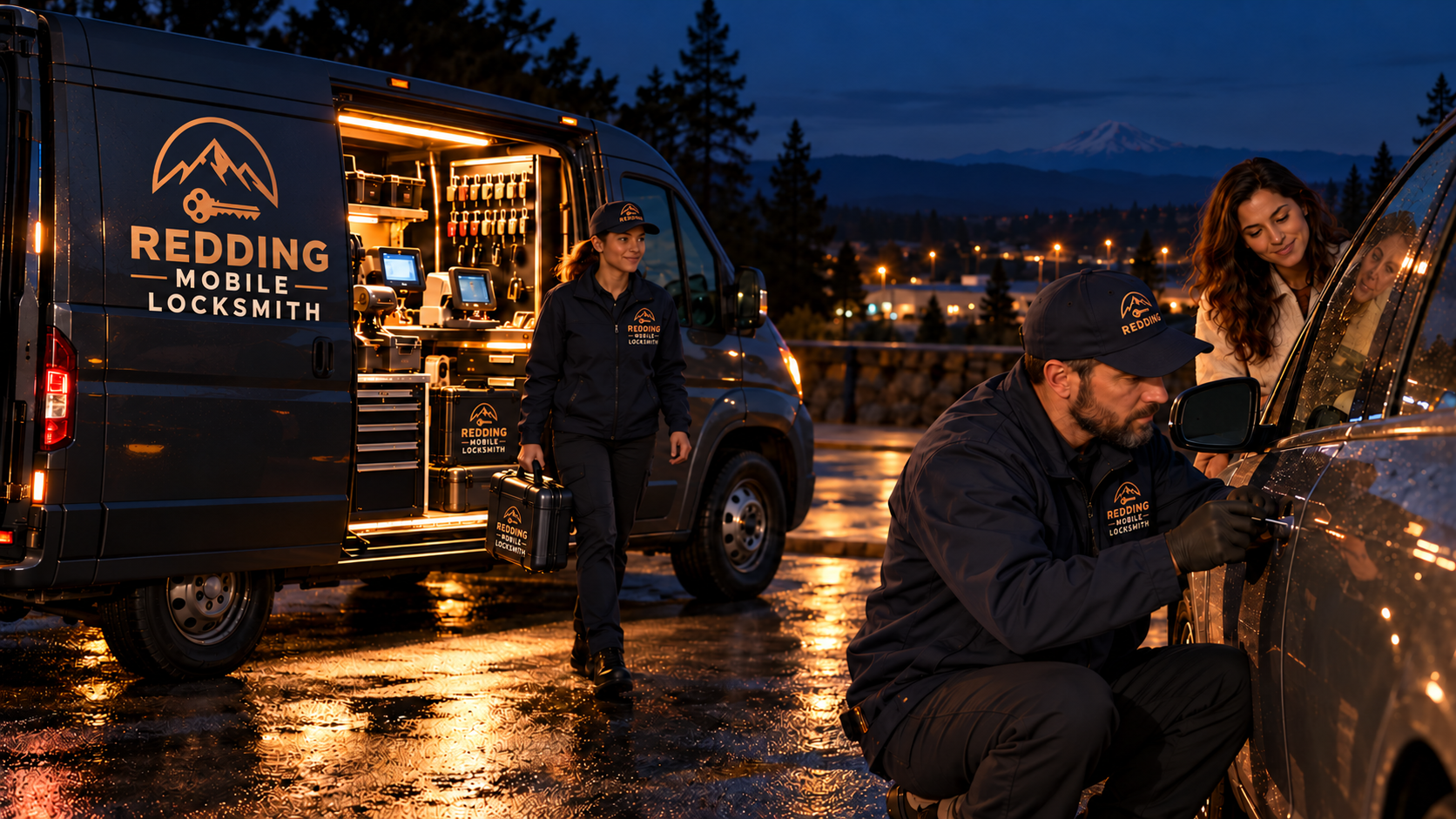
Redding Mobile Locksmith is a 24 hour mobile locksmith, and the van carries tools, key cutting and programming equipment and common hardware. For a small business, that means a problem can often be handled where it happened, at your door. Describe the lock, the door and the problem when you send the request.
If the building cannot be secured, plan for the wait. Stay if it is safe, or arrange for someone you trust to be there. Do not leave an open building alone with stock inside if you can avoid it. If you suspect a break in, call emergency services first and keep out of the building.
The cost of waiting is real, but so is the cost of a hurried decision. If a lock fails, secure the building as well as you can with the tools you have and describe the situation clearly. A technician can then advise whether a temporary fix is possible or whether the lock must be replaced before you can leave.
A lockout at the owner's own door
The embarrassing case is the owner locked out of their own business. It happens more often than anyone admits. A key is left inside, a lock fails, or the keys are in the wrong pocket.
A professional will ask for proof that you have authority over the premises. That might be a lease, a business license in your name, a utility bill for the address or a document from the landlord. If you rent, the landlord may be the one with the right to authorize work on certain locks. Rules vary, so ask early.
There is a safeguard here that works in your favor. The same checks that protect your business from a stranger also mean that a technician will not open your door for someone who claims to be you. Read more at a store owner locked out at closing time and a commercial building lockout after hours.
If you are the owner and the lock is yours, say so plainly. If you are an employee called to open a building, say that too and have the owner or manager reachable by phone. The technician may need a brief confirmation from the person who holds authority. That call is part of doing the job correctly.
Offices, shops and yards
Different business types use different hardware. A retail counter needs a front door that locks reliably and a back door that locks even more reliably. An office may use a keyed entry and an interior door to a records room. A yard or workshop may use gate locks, padlocks and a shop door.
Panic hardware, also called exit devices, is used in some commercial buildings. A bar on the inside lets people leave in an emergency without a key while the door stays locked from the outside. These devices are a code matter in many places, and rules vary, so ask the authority that applies to your building rather than assuming.
A locked out office is a close cousin of the shop lockout, and it is covered at locked out of an office after hours. The same questions apply: who you are, what the premises are, and what lock is involved.
When the building has more than one tenant, or shares a wall with another business, ask who controls which door. A shared hallway door may belong to the landlord. A lock on your suite may belong to you. Sorting that out before an emergency prevents a delay in the middle of one.
Access control without a big system
Access does not have to mean cards and readers. For a small Granada business, access can mean a few simple decisions. Who gets a front key? Who gets a back key? Who can open the gate? Who can lock up?
Some owners choose a keypad lock so that a code can be changed when staff change. Others stay with keyed locks and rekey as needed. Both are valid. A keypad needs power and attention, and a keyed lock needs a key list. Pick the one you will actually maintain.
The point is to know your system. A system that you understand is stronger than a complicated one that nobody can explain. A technician can help you match the equipment to the way you work and the risks you face.
Do not forget the small things: a mailbox, a cash drawer, a filing cabinet, a storage cage. Each has a lock and each has a key that wanders. A single list of all keys, kept current, solves most of these quietly. Add a line each time you cut a copy.
What the traveler on the interstate teaches
Return to the traveler in the first section. A person passing through sees a building with a light on. If the building looks cared for, with working locks, lit doors and a tidy yard, it tells a quiet story of attention. Poorly kept doors tell the opposite story.
Security is partly appearance. A secure door, a well lit entrance and a clear closing routine make a place a less attractive target. They do not make it immune. That is why the locks, the routine and the key list all matter together.
You do not need to turn a small shop into a fortress. You need to remove the easy openings. A rekeyed lock, a repaired latch and a short list of key holders do that.
Asking for help from Granada
The phone line is coming soon. For now, use the request form: send a request. Say that it is a business, describe the door and lock, and say what happened. Tell the team if you are the owner or a manager.
For the neighboring towns, see Montague and Yreka. For everything available in Granada, see the Granada page.
A calm, specific request leads to a calm, specific visit. If someone is in danger or a break in is under way, call emergency services before anything else.
One more thing before you send a request. Gather what you can: the type of door, whether it is wood, metal or glass, whether the lock is a knob, a lever or a deadbolt, and anything unusual such as an alarm or a chain. The more the technician knows, the better the van is stocked for your door.
Common questions
How do I know who has a key to my business?
Start a written list of every key holder and the doors each key opens. Include current and former staff, family, a landlord, cleaners and anyone who borrowed a key. Mark any key you cannot confirm. That list shows where the exposure is and what to rekey.
Should I change the locks when an employee leaves?
Only you can decide, but a simple approach is to collect the key and record it. If the key does not come back or you have any doubt, rekeying makes the old key useless without replacing hardware. Employment rules vary, so ask the right advisor about your duties.
What is the difference between a lockout and a failed lock at a shop?
In a lockout the lock works and you have no key or no access. In a failed lock the hardware itself is broken, such as a key that turns without moving the bolt. A failed lock may need repair or replacement as well as getting the door open.
What proof will a locksmith ask for at a business?
Expect to be asked for identification and for something showing you have authority over the premises, such as a lease, a utility bill or a document from the landlord. What counts can vary, so ask when you send the request and gather the papers before the visit.
Can doors and closers cause security problems?
Yes. A door that does not latch fully, a worn strike plate or a closer that no longer pulls the door shut can leave the building unlocked while it looks closed. Test the handle after locking. Ask a technician to adjust or replace worn hardware.
Is a keypad lock better than a keyed lock for a small business?
Neither is always better. A keypad lets you change a code when staff change but needs power and attention. A keyed lock needs a key list and rekeying. Choose the one you will maintain, and ask a technician which fits your door and routine.