
Home / Mount Shasta / Night House Lockout in Mount Shasta
Mount Shasta home lockouts
Night House Lockout Help in Mount Shasta
Being shut out of your own home after dark is stressful, especially when the weather is cold. This page explains what is happening at the door, what to do, and how to tell a lockout from a failed lock.
Two very different problems that look the same
From the porch, a lockout and a failed lock look identical. The door will not open and you are outside. But the cause is different, and so is the fix. In a simple lockout, the lock works perfectly and you just do not have the key. In a failed lock, something inside the lock or the door has stopped doing its job.
This matters because the fix for each one is different. A simple lockout needs entry without damage, and the lock is fine afterward. A failed lock needs entry and a repair or a replacement. If you know which one you have, you can describe it clearly and the technician arrives with the right parts.
Picture a retiree living alone in a house at the edge of Mount Shasta. It is late, the temperature has dropped, and the front door has latched behind a trip to the mailbox. Is the key in the kitchen? Or did the deadbolt just stop turning? The rest of this page helps you answer that question calmly.
Many people assume that any lockout means a broken lock. It rarely does. Most night calls involve a healthy lock and a missing key. Knowing that helps you stay calm, and it helps you avoid agreeing to work you do not need. Ask the technician to tell you what they find before they suggest anything beyond opening the door.
Start with safety and warmth
If you are outside in the cold, your first job is to stay warm and safe. Winters in this mountain city can be hard, and you should not stand on a porch for a long time in thin clothes. If a neighbor or a family member lives close by, go there. Ask to wait inside while help arrives.
If you feel unwell, confused or unsafe in any way, call emergency services. Do not wait for a locksmith. If someone inside the house needs help and cannot reach the door, tell the emergency dispatcher. They can arrange for entry and medical care at once.
If you are only locked out and otherwise fine, take a breath. Let a family member or a trusted friend know what is going on. Share your location by text if you have a phone. A short message like that is a good habit anytime you are alone and waiting for help.
Living alone adds one more thing to think about: who knows where you are. Make it a habit to tell one person when you step outside at night, even for a minute. If something goes wrong, that person knows to check on you. It is a small habit that costs nothing and gives real peace of mind.
The simple lockout: what it means
A simple lockout means the lock is healthy. The key turns, the bolt moves, and the door latches. You are out because the key is inside, lost, or somewhere you cannot reach. The door hardware itself is not the issue.
With a simple lockout, a trained technician can usually open the door without harming the lock. They look at the type of lock, choose a suitable method and open it. When the door opens, the lock still works the same way it did before. You can use it again immediately, with a key you still have.
The usual causes are ordinary. A spring latch closed on a door with no handle outside. A deadbolt that was thrown from the inside as you left. A key left on a table. A spare that was in a pocket of different pants. If that sounds like your night, say so in the call.
Some doors lock without a key in a way that surprises people. A handle set may have a push button that locks the knob from inside, and the door shuts behind you. A deadbolt with a thumb turn can be thrown by a gust or by a brush of a sleeve. These are ordinary mechanics, not defects, and they are the reason a spare matters.
The failed lock: signs to look for
A failed lock behaves differently. You have the key, but it will not turn. The key turns but the bolt does not move. The lock feels loose, gritty or stuck. The handle spins without engaging the latch. These are signs that something inside is worn, broken or jammed.
Weather can be part of it. Cold can stiffen old lubricant, and ice can build up in a keyway or in a gap around the latch. Moisture that seeps into a lock during a thaw can freeze again overnight. In a mountain climate like this one, a lock that worked last week may refuse on the first hard freeze.
Other signs include a broken key snapped off in the cylinder, a door that has shifted so the bolt no longer lines up with the strike plate, or a lock that was forced earlier and damaged. See our guide on a key broken off in a door lock if that is your situation.
A lock that fails in winter often fails again in the next cold snap. If your lock has stuck before, note it and mention it to the technician. Repeated trouble usually means the inside of the cylinder is worn or contaminated, and a replacement or a service visit may be a better answer than another emergency.
- The key goes in but will not turn at all.
- The key turns but the bolt stays where it is.
- The lock feels gritty, loose or stuck.
- The handle moves but nothing engages inside.
- The bolt does not line up with the strike plate on the frame.
How to tell which one you have
Ask yourself a few plain questions. Do you have the key in your hand? If yes, and the door will not open, it is probably a failed lock or a frozen mechanism. If no, and the lock worked fine when you left, it is probably a simple lockout.
Try the key gently. Do not force it. If it slides in smoothly but does not turn, stop. If it grinds, stop. A key that breaks off in the cylinder turns a small problem into a larger one.
Tell the dispatcher what you tried and what you felt. Words like stuck, loose, gritty, frozen and snapped are all useful. The technician can plan the right tools and parts before leaving, and that saves time at your door.
Learn what your own lock feels like on a normal day. A key that turns smoothly with a clear click is healthy. A key that drags or needs a jiggle is already warning you. If you pay attention to those small signals, you can fix a lock in daylight before it fails at midnight.
What to avoid on your own porch
Do not pry at the frame. Do not use a credit card, a knife or a screwdriver on the latch. Do not pour hot water on a frozen lock. Do not break a window to reach the lock, because broken glass is dangerous and the repair is far more costly than the lockout.
Do not remove the door knob or the lock body unless you know exactly what you are doing. Taking a lock apart outdoors at night is a good way to lose a spring, a pin or a screw in the snow. A lock in pieces is harder for a technician to repair than a lock that is whole.
Do not leave a window open to the cold and walk away. If you do gain entry some other way, such as through a spare key held by a neighbor, tell the dispatcher so the visit can be adjusted. If you are in doubt about any step, ask before you act.
Think about who else might be at the door. Do not open the door to anyone you did not call, and do not let a stranger in because they say they are from a service. If a neighbor offers to help, accept a warm room, not a tool. Wait for the person you called and check their identity.
What to have ready for the technician
Proof matters for a home. A photo identification with the address, a piece of mail, a utility bill or a lease all help to show that you live there. If you are a guest, a host or a property manager, have a way to show your connection to the place. Rules and expectations differ, so be prepared for a few questions.
Know the doors. Say which door is locked, whether it has a deadbolt, a handle set or both, and whether the lock is a keypad or a standard key type. If you have a screen door, a gate or a security door in front, mention that too.
Have your phone charged and the porch light on if you can reach it. If someone is inside the house, such as a family member or a caregiver, tell the dispatcher and ask whether they can open the door. Sometimes the simplest help is a person on the other side.
Have a small pack of facts in your phone: the address, the type of door, who holds a spare, and the number of the host or the landlord if that applies. If your phone is the only thing you have, those notes save you from guessing under stress. Keep them short and keep them current.
A cabin, a rental or a mountain home
Mount Shasta has vacation rentals, cabins and homes that sit on quiet roads. Access at night can be a challenge. Snow can narrow a driveway, and gates or private roads can hide a house number. When you call, give clear access details and note anything that could stop a van from reaching the door.
Many rentals use keypad or lockbox entry, and they depend on batteries or codes that the host manages. If a code does not work, the host may be able to reset it by phone. If not, a technician can look at the hardware. Tell the dispatcher what type of device is on the door.
If you are a host or a manager, think about how you would handle a guest lockout at midnight. Our guide on a short term rental guest lockout covers the planning side, including who to call and what information a guest should have.
Winter makes arrival harder. Plowed snow can block a driveway and ice can cover a step. Clear a safe path to the door if you can, and put a light on. If you have a dog, secure it before the technician arrives. These small preparations help the visit go more smoothly for everyone.
After the door opens
Once the door is open, the technician checks the lock. If it is healthy, you are done. If it is worn or damaged, you will get a plain explanation of the choices: a repair, a rekey, or a replacement lock. You decide, and you can ask questions at every step.
Ask what caused the problem and what you can do to prevent it. If the lock failed because of age, a replacement may be wise. If the lockout was about the key, a spare is the answer. A deadbolt that is thrown from the inside out of habit can be replaced with a model that has a different operation.
Look at related pages if you want more detail: night house lockout service, broken lock repair and installing new locks. Each explains how the work is done and what to ask.
If the lock needs a replacement, ask about the options in plain terms. A standard deadbolt, a handle set and a keypad lock each work differently and suit different homes. A technician can explain which fit your door and which will be simplest for you to use, especially if you live alone and want something easy.
Planning ahead so it does not happen again
A lockbox with a code, a spare key held by a trusted neighbor, and a habit of checking pockets at the door will cover most cases. Keep one spare away from the house. Avoid the doormat, the planter and the rock, since those are the first places anyone looks.
For someone who lives alone, a simple routine helps: keys on a hook by the door, a second set in a safe place with a family member, and a phone that is always within reach. Add a porch light with a motion sensor. It makes a night walk to the mailbox safer. See our notes on a bedtime lock check routine.
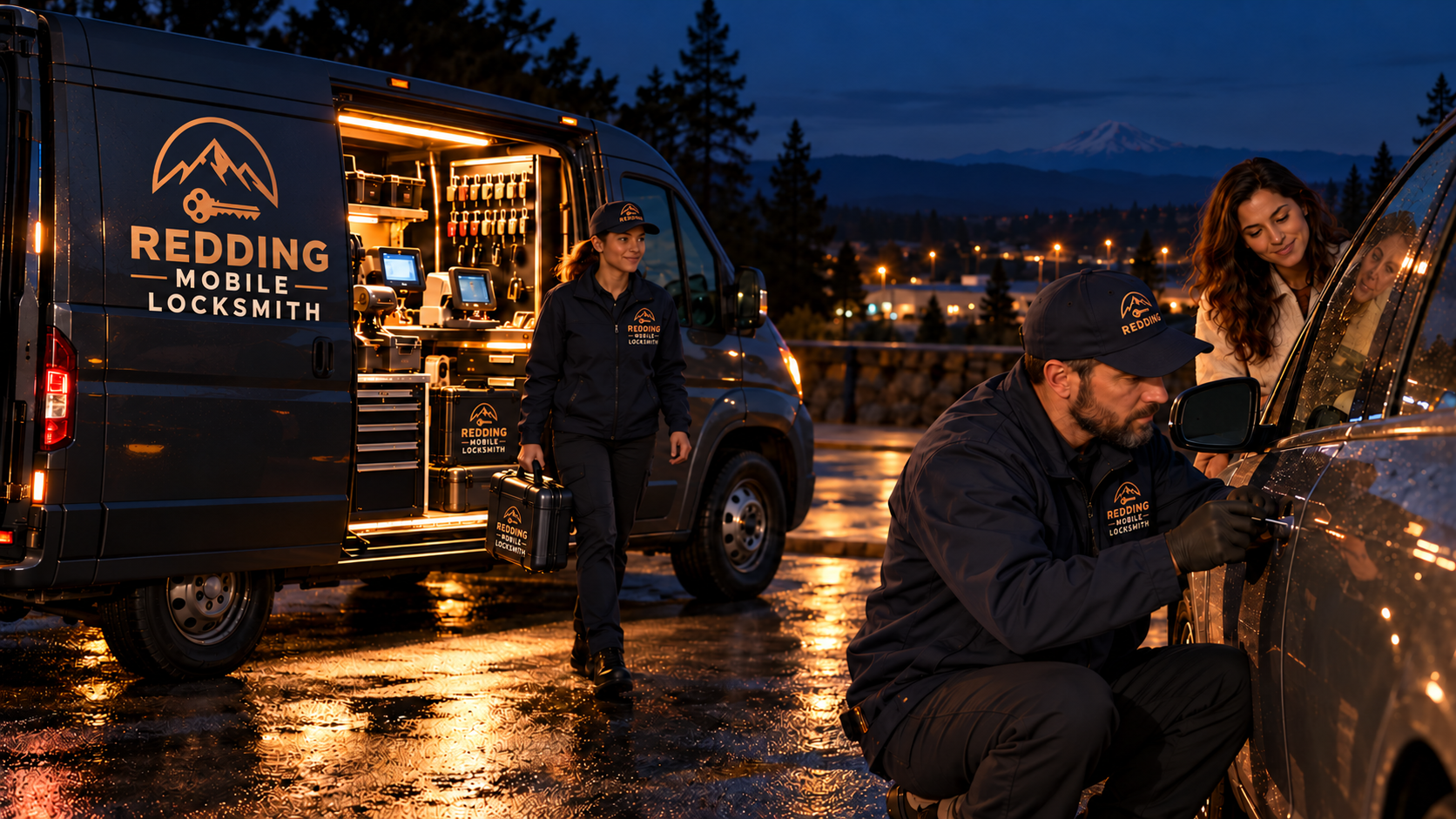
Redding Mobile Locksmith is a 24 hour mobile locksmith that serves Shasta County and Siskiyou County. Our uniformed team arrives in a branded service van. Read about Mount Shasta coverage, see the after hours emergency page, or use the request form. The phone line is coming soon.
If you are helping an older relative, set up the spare system with them rather than for them. Walk through where the key is, who has a copy, and what to do if the lock sticks. Write the steps on a card by the phone. See also an elderly relative locked out at night.
Common questions
How do I know if it is a lockout or a failed lock?
If the lock worked normally when you left and you simply lack the key, it is a lockout. If you hold the key and it will not turn, or the handle spins without engaging, the lock has probably failed. Describe what you tried and what you felt, and the technician will plan accordingly.
Will the technician damage my door when opening it?
A trained technician chooses a method that suits the lock and avoids harming the door or frame. In a simple lockout the lock usually works the same afterward. If the lock has failed or been forced earlier, entry may need a repair. The technician will explain the plan before beginning.
What proof of residence do I need to show?
Something that ties you to the address, such as a photo identification, mail, a utility bill or a lease. If you are a guest or a manager, bring whatever shows your connection to the place. Expectations vary, so have several options and expect a few questions.
Is it safe to wait outside in cold weather?
Not for long. If you can, go to a neighbor, a relative or a lit public place and wait there. If you feel unwell or unsafe, call emergency services. A lockout is a comfort problem in most cases, but the cold is a real concern in this mountain city.
Can I fix a frozen lock with hot water?
Please do not. Hot water can crack glass, damage finishes and refreeze into thicker ice inside the keyway. Tell the dispatcher the lock may be frozen. The technician has a method that suits the situation and will not make the freeze worse.
Should I replace my lock after a night lockout?
Only if the lock is damaged, worn or you lost a key. A simple lockout does not need new hardware. If a key is missing and you are unsure who has a copy, ask about rekeying. The technician can explain the choices and let you decide.