
Home / Yreka / Night House Lockout in Yreka
Yreka house lockouts
Night House Lockout in Yreka: Getting Back In Without Damage
Picture a shop owner who closes up downtown, drives home and finds the house keys still on the counter at work. This page walks through the calm, sensible order of options for a Yreka house lockout after dark.
What a night house lockout looks like in Yreka
Yreka is the Siskiyou County seat, set along Interstate 5 in the Shasta Valley area. The town mixes older downtown buildings, county and professional offices, established neighborhoods and rural edges where homes sit well back from the road. That mix matters for lockouts, because the doors, the lighting and the distance from help all change from one address to the next.
Imagine a small shop owner who spends the day on their feet, locks the storefront, and heads home with a head full of tomorrow's orders. At the front step the pockets come up empty. The house keys are on a hook at the shop, or in the pocket of a jacket left on a chair. It is dark, the evening has cooled off, and the plan for the night just changed.
This is a common kind of evening, and it is solvable. The goal on a night house lockout is simple: get you inside, keep the door and lock in working order, and leave the home as secure as it was before. The rest of this page lays out how that usually goes, so you can make good choices while you are standing on the porch.
The first five minutes: pause before you act
Start by stopping. Stand still, take a breath and look at your situation. A lockout feels urgent, but most of the damage people cause to their own doors happens in the first surge of frustration. Pulling on a handle, shoving a shoulder into a frame or prying at a window sash can turn a simple lockout into a repair bill and a door that no longer closes right.
Check the basics once, calmly. Try the door you are standing at, because it may simply have latched without the deadbolt thrown. Check your pockets, your bag and your vehicle seats. If you have a phone, look at it for a message from anyone who holds a spare. Make sure you have a safe place to wait, with light and shelter, and keep your own safety ahead of the lock.
If anyone inside the home needs help, such as a child, an older relative or someone who is unwell, call emergency services first. A locksmith is the right call for a locked door. It is not the right call for a medical emergency or a person in danger.
- Try each exterior door once, gently, without forcing anything.
- Check pockets, bags and the vehicle for the keys or a spare.
- Message anyone who holds a copy of your key.
- Move to a lit, sheltered spot while you wait.
- Call emergency services at once if a person inside is in danger.
The sensible order of options
There is a natural order to getting back into a house, and it runs from least invasive to most. First, check for a spare key held by someone you trust, a roommate, a relative or a neighbor. A key in a trusted hand beats any tool. Second, if the lock itself is fine and only the key is missing, a professional can open the lock without harming it, using tools made for the job.
Third, if the lock is damaged, frozen, or the door has shifted so the bolt will not move, the work changes from opening to repairing. That may mean a fresh lock or a small adjustment to the strike plate, which is the metal plate in the frame that the bolt slides into. Last of all, and only when nothing else works, comes forcing an entry, which costs the most damage and is rarely necessary.
When you request help through the request form, say which option you have already ruled out. If you know there is no spare, say so. If you suspect the deadbolt is thrown, say that too. The better the picture, the better the technician can plan the tools and hardware to bring.
How a locksmith opens a home door without damage
A locksmith does not guess at your door. The first step is to look at the hardware: what kind of lock, how many locks, and whether the deadbolt is engaged or only the latch. Most home entry doors use a pin tumbler cylinder, a small barrel with spring loaded pins that must line up before the plug will turn. Professionals have purpose built tools that work with the design of the cylinder instead of fighting it.
The method depends on what the door gives. A spring latch with no deadbolt thrown can often be opened without ever touching the cylinder. A thrown deadbolt calls for working the cylinder itself, and a good result is a lock that still works with your old key afterward. We keep the description general on purpose, since the details are a trade skill and not a how to guide, but the principle is the same everywhere: understand the lock, then work with it.
After the door is open, a careful technician checks that the lock still operates smoothly, that the latch retracts, and that the door closes and locks properly. If something looks worn, they will say so plainly and let you decide whether to repair it now or later.
Proof of residence, plainly explained
Before opening a home, a responsible locksmith wants to know the person asking belongs there. That is not suspicion aimed at you. It protects every resident of Yreka, including you on a night when someone else might claim your address. The technician may ask for photo identification and something that ties you to the address, such as mail, a lease or a utility bill, or a neighbor who can speak for you.
Requirements differ from one situation to the next, and rules vary between owners, renters and managed properties. A renter may be asked about the landlord or property manager. An owner may be asked for something showing ownership. If you are a guest or a family member rather than the resident, the person who lives there may need to confirm by phone. Ask what the technician needs when you make the request, and gather it while you wait.
If your identification is locked inside the house, do not panic. Say so up front. There are usually other ways to establish who you are, and the technician can explain which ones work for them. Our guide on why a locksmith may ask for identification covers this in more detail.
Doors you may find in older Yreka buildings
Yreka has older housing and older storefront conversions, and older doors have their own habits. You may find a mortise lock, which sits in a pocket cut into the edge of the door and combines a latch and a bolt in one body. You may find a rim latch on a back door, a simple surface mounted lock that sits on the inside face. Some older entries still carry a single worn knob lock that has outlived three owners.
Old doors also move with the seasons. Wood swells in damp weather and shrinks when it dries, so a door that closed cleanly in July can bind or sag by winter. A bolt that no longer lines up with the strike plate can look like a broken lock when it is really a door that has shifted. A technician who understands this will check the alignment before replacing anything.
If your home has an old lock that is clearly past its working life, a lockout can be a useful moment to update it. You do not have to decide on the doorstep, but it is worth asking what a replacement would involve. The install new locks page explains how that works.
Rural edges and homes set back from the road
Outside the downtown grid, Yreka's edges open into rural land where a driveway can be long, a gate may stand between the road and the house, and the nearest neighbor is not within shouting distance. A lockout here carries two extra problems. Finding the property in the dark is harder, and waiting outside can be colder and lonelier than waiting on a town street.
When you describe your location, give the plain facts: the nearest cross road, the color of the gate or mailbox, whether the driveway is paved or gravel, and any landmark a driver can see from the road. Turn on an exterior light if you can reach a switch, or leave your vehicle's headlights aimed at the house so the entrance is easy to spot. Our location checklist for the dispatcher gives a fuller list.
If the property has more than one door, say which one you prefer to be opened. A back or side door with a simple latch can sometimes be a gentler option than a heavy front deadbolt. Tell the technician about dogs, gates and any step or path that is hard to see at night.
- Name the nearest cross road and any visible landmark.
- Describe the gate, mailbox or driveway so it is easy to spot.
- Switch on an exterior light, or aim vehicle headlights at the entrance.
- Mention dogs, steep steps or uneven ground.
- Say which door you would like opened.
What to prepare while you wait
Waiting is easier when you have a short list. Get your photo identification out if you have it on you. Think about the evidence that connects you to the address, such as a piece of mail in your vehicle or a message on your phone with the address in it. If a neighbor knows you, ask whether they would be willing to confirm who you are.
Make yourself comfortable and safe. Yreka nights can turn cool in the shoulder seasons and cold in winter, so wait in your vehicle with the engine off and doors locked if there is no other shelter. Keep your phone charged, keep the line open for a call, and stay somewhere visible if you are alone.
One more thing to prepare is a short answer to a hard question: will you want the lock changed? If your keys are lost rather than simply left behind, you may want the cylinder rekeyed so the missing keys stop working. Think about that now, so the decision is not made in a hurry later. The page on rekey locks explains how that works.
Lost keys versus left keys: why it changes the next step
The cause of your lockout shapes what happens after the door opens. If the keys are sitting on your shop counter, you know where they are, and you can collect them in the morning. The lock never left your control, and you can simply carry on. In that case, the job is to get you in, confirm the lock works, and send you into your evening.
If the keys are truly lost, the picture is different. A key that fell out of a pocket in a parking lot, or that was taken, could be used by someone else if they connect it to your address. That is a reason to think about rekeying the lock so the old key no longer works. Rekeying changes the internal pins of the cylinder to match a new key, without replacing the lock itself.
Be honest with the technician about which situation you are in. It does not change whether they will help you. It changes the advice they can give about keeping your home secure afterward, which is the part that matters most once the door is open.
Aftercare: making the house secure again
When the door swings open, the job is not quite finished. Walk through the entry with the technician and test the lock with a working key, if you have one, or ask what to do about getting new keys cut. Check that the deadbolt throws fully into the strike plate and that the door latches without needing a shove.
Look at the weak points in the doorway while the tools are out. A strike plate held by short screws can be strengthened with longer ones that reach into the framing. A deadbolt that barely clears the frame may want a better fit. These are small, practical improvements, and they matter more than any fancy hardware. Read about deadbolts and door frames at night for more.
Finally, think about your habit loop. A spare key with a trusted person, a second key kept somewhere you will remember, and a brief glance at your pockets before you pull the door shut can prevent the next lockout. A calm routine does more than any single lock.
Help close to Yreka and across the county
The service covers 17 communities across Shasta and Siskiyou Counties, so if you are near Yreka but not in it, help is still available. Neighbors along Interstate 5 and Highway 3 will find pages for Montague, Fort Jones and Etna, and to the south there are pages for Weed and Mount Shasta.
For other Yreka needs, the same community has pages for a Yreka after hours emergency, a car lockout in Yreka and rekeying in Yreka. The general night house lockout page describes the service in full, and the overview of Yreka shows everything available in town.
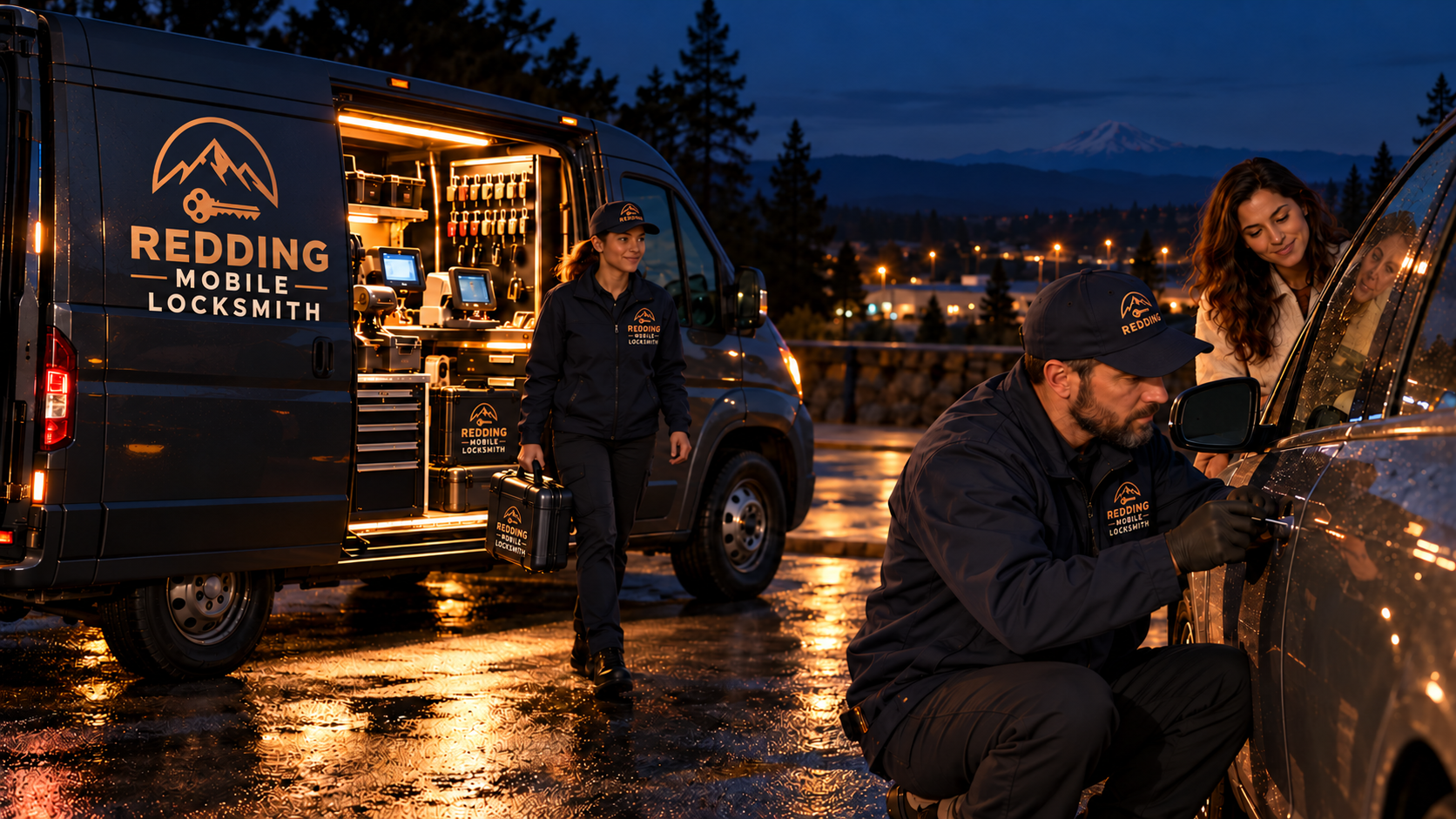
Redding Mobile Locksmith operates a branded service van that carries the tools, key cutting equipment and common hardware for home work. The phone line is coming soon, so for now the way to ask is the request form on the contact page.
Common questions
What should I do first when I am locked out of my Yreka home at night?
Stay calm and try each exterior door gently, without forcing anything. Check your pockets, bag and vehicle, and message anyone who holds a spare. Move to a lit, sheltered spot. If anyone inside is in danger, call emergency services before anything else. Then send your request through the contact page with the details of your door and location.
Will opening the door damage my lock?
A trained technician aims to open the door without harming it. They look at the hardware first, choose the least invasive method, and test the lock afterward. Forcing an entry is a last resort, used only when the lock is damaged or the door has shifted so the bolt will not move. You will be told if anything needs repair.
Why would a locksmith need proof that I live at the address?
Opening a home for the wrong person would put every resident at risk, including you. A technician may ask for photo identification and something tying you to the address, such as mail or a lease. Requirements vary between owners, renters and managed properties, so ask what is needed when you send your request.
My keys are lost, not just locked inside. What then?
If the keys may be in someone else's hands, consider rekeying the lock. Rekeying changes the internal pins so the old keys stop working while the lock itself stays in place. Tell the technician which situation you are in, and they can explain your options once the door is open.
Can the technician find my house in the dark if I live outside town?
Help is much easier when you describe your location clearly. Give the nearest cross road, the gate or mailbox color, the driveway surface and any visible landmark. Switch on an exterior light or aim your headlights at the entrance. Mention gates, dogs and steps so the visit goes smoothly.
How do I ask for help if the phone line is not listed?
The phone line is coming soon, so for now use the request form on the contact page. Tell us your location, the type of door, whether the deadbolt is thrown and what you already tried. The more detail you give, the better the technician can plan the tools and hardware to bring.