
Home / Mount Shasta / Vehicle Key Replacement in Mount Shasta
Mount Shasta car keys
Vehicle Key Replacement in Mount Shasta
Losing a car key far from home is a stressful event, but it is a solvable one. This page explains how replacement works with and without a spare, and what to prepare before the technician arrives.
Why a lost key is different from a lockout
A lockout means the key exists but is out of reach. A lost key means it may not exist at all. That changes the job. A technician cannot copy something you do not have, so the work starts from the vehicle itself rather than from an old key.
Picture a traveler passing through on the interstate. They stopped in Mount Shasta for a meal, a view of the mountain and a walk, and now the key is gone. The vehicle is loaded, the next stop is hours away, and there is no spare in the glove box. Where does that person begin?
They begin with facts. What is the vehicle? What type of key does it use? Can the owner show the vehicle is theirs? Those three answers decide almost everything that happens next, and this page walks through them in the order a calm dispatcher would ask.
It also helps to separate what you can control from what you cannot. You cannot control that the key is gone. You can control how clearly you describe the situation, how well you protect your belongings while you wait, and whether you make a good decision about where to stand and who to trust. Put your energy into those three things.
Take a moment to write down what you know about the missing key. When did you last see it? Where were you? Did you hand it to anyone? If a valet, a friend or a lodge desk had it, a phone call may solve the whole thing. Check that before you pay for a new key, and then decide with a clear head.
The three kinds of vehicle key
Older vehicles use a plain metal key. The key is cut to match the lock, and nothing inside it talks to the vehicle. These are the simplest to replace, because a technician can cut a new key to the lock code or by reading the lock itself.
Many vehicles from the last couple of decades use a transponder key. The head of the key holds a tiny chip that sends a coded signal to the engine computer. Without the right signal the engine will not run, even if the blade turns the ignition. A replacement needs both a cut blade and a programmed chip.
Newer vehicles often use a smart key or a fob for push button start. The fob talks to the vehicle by radio. A replacement must be paired with the vehicle, and sometimes the older fobs must be removed from the system. Our guide on smart key replacement in plain words explains it step by step.
A key blade is more than a piece of metal. Some blades are cut on the edge, with ridges along one or both sides. Others are cut in a groove in the middle of the blade, called a laser or high security cut. These need special cutting machines, and that is one reason a service van with the right equipment matters on the road.
When you have no spare
With no spare, the technician has to create a key from nothing. For a transponder or smart key vehicle, that means connecting equipment to the vehicle, programming a new key, and often erasing the lost one so it can no longer start the car. Each step takes care.
The van carries key cutting and programming equipment, so many of these jobs are completed at your location. That is the benefit of a mobile service. You do not need to tow the vehicle somewhere. You stay with it, and the work comes to you.
Some vehicles have extra security that slows the process. Certain systems require a waiting period inside the computer or a special code from the manufacturer. The technician can tell you if your vehicle falls in that group. Ask before work starts so you know what to expect, and see our vehicle key replacement service page.
A transponder chip is a small electronic part sealed inside the key head. When you turn the key, the vehicle sends out a small field of energy that wakes the chip, and the chip answers with a code. If the code matches the one stored in the engine computer, the engine is allowed to start. If not, the engine may crank and then stop.
Programming is how the vehicle learns to accept a new key. The technician connects a tool to the vehicle, enters the required information, and teaches the computer the new chip. For vehicles that allow it, the same tool can remove lost keys from the list. This is why programming equipment and training are central to the job.
When you do have a spare
A spare changes the work for the better. With a working key in hand, a technician can often clone or copy it, or add another key to the vehicle without erasing anything. The job becomes simpler, and the cost of time goes down.
Having a spare does not always mean you can skip programming. A copied blade may open the door but not start the engine if the chip is missing. A fob that is a copy still needs to be paired. The technician will test the new key in the ignition and in the doors before calling it finished.
If you have one key and want a second, do it before you lose the first. Adding a key to a vehicle that has a working key is generally easier than creating the first one from scratch. Our guide on adding a spare or replacing every key explains the tradeoffs.
A spare also helps with the proof side. If you hold a working key and the registration, there is little doubt about who you are. The technician can focus on the mechanical work. For this reason, people who plan ahead often find the visit shorter and calmer than people who start from nothing.
Be honest with the dispatcher about what you do not know. If you are unsure whether the spare at home works, say so. If you do not know the key type, describe the key head or the dash button. A guess can send the wrong tools to the wrong place, while an honest answer lets the team prepare for two outcomes.
Proof of ownership comes first
A responsible locksmith asks you to show that the vehicle is yours. A registration or title and a photo identification are the usual pair. The name on the document should match the identification, or you should be able to explain the difference.
This step is not an insult. A key is the most powerful tool for a vehicle, and a locksmith who hands one to anyone is a risk to the public. A traveler far from home might feel awkward being asked, but the requirement protects every owner, including you.
If the vehicle is a rental, a company car or a borrowed vehicle, the process is different. You may need the owner or the rental company to approve the work. Read more in our guides on proof of ownership for key replacement and rental car lockout steps.
Keep copies of your documents in more than one place. A photo of the registration on your phone, a copy in a travel folder and a record at home are all useful. When the original is locked inside the vehicle, a photo may help you describe the vehicle correctly, even if the technician needs to see the paper before final work.
What to tell the dispatcher
Start with the vehicle: make, model, year and color. Then the key type if you know it. If the vehicle has a button on the dash to start, say so. If you have a fob, say whether it works. If the key is cut with a laser track along the blade, mention that.
Describe where you are, whether the vehicle can be moved, and whether it is safe to wait. If the vehicle is parked on a public street, in a lot, at a lodge or at a trailhead, tell the dispatcher. The details help the team plan the route and the right equipment.
Tell the dispatcher what happened to the key. Lost, stolen, broken, or left somewhere? A stolen key leads to a different plan from a lost one. See our page on lost key and vehicle security reprogramming questions.
Finally, tell the dispatcher about modifications. A remote start, an aftermarket alarm or a tracker can change how the vehicle accepts a new key. These parts are not always obvious from the outside. If you know about one, say so, and the team can plan accordingly.
The job at the roadside
When the technician arrives, they confirm your identity and the vehicle. They check the existing lock, the ignition and the key type. They explain what they plan to do and what it involves. You can ask questions at any time.
If the vehicle is locked, they open it first. If it is already open, they go straight to the key. The process may include cutting a blade, connecting a programming device, adding the new key to the vehicle and removing a lost key from memory.
They test the new key in the door, the ignition and the remote functions. Only when everything works do they hand it over. Ask for a second test if you are unsure. Ask also about a spare, so that the same problem does not repeat on the next trip.
The technician may also check the other keys, the door locks and the trunk. If the ignition is worn, a new key may feel stiff. If a door lock is worn, the key may not turn smoothly. These are separate problems from the lost key, and you can decide whether to deal with them now or later.
Cold weather and the mountain setting
A cold night in Mount Shasta can affect a key job. Cold fingers drop things. A fob battery can fail. An engine that has been sitting may not start even with a correct key if the vehicle battery is weak. Tell the dispatcher about the weather and the state of the vehicle.
Snow can cover the lock and the door seals. A technician may need a clear spot to set up equipment near the cabin. If you can, move the vehicle to a safe, flat place that is not on a slope or a snow bank. If you cannot, tell the team.
If the engine does not crank after the key is programmed, the problem may be the battery, not the key. Our page on a dead car battery and door locks explains how to tell the difference.
Visitors to Mount Shasta often come for the outdoors. Gear bags, jackets and trail packs are easy places for a key to vanish. If you think the key is in one of them, search carefully before you call, and retrace your steps in a safe way. If you are far from the vehicle, make sure you have a way back.
If the lost key was a fob with a mechanical blade hidden inside, the door may still open with a spare blade. The engine is a different matter. Say which part you need first: a way into the vehicle, a way to start it, or both. The technician will handle them in the proper order.
A traveler's checklist
Before you call, have the registration and identification ready, the vehicle details written down, and your exact location. Keep your phone charged. Decide whether you can wait where you are or need a nearby warm place.
While you wait, resist the urge to try workarounds. Do not buy a key blank online or from a stranger. Do not let someone else tow the vehicle before you know the plan. Wait for the technician and get the facts first.
After the job, keep the new key safe and ask for a spare to be made. When you travel, keep the spare somewhere that is not in the vehicle. A traveler with two keys in different places is much harder to strand.
One more caution for travelers: if you are tempted to leave the vehicle to find help elsewhere, let the dispatcher know. Leaving the scene changes the job. The technician needs the vehicle in front of them to program a key, and the proof has to be in the hands of the owner. Stay or arrange for a trusted person to meet the team.
Serving Mount Shasta and the area
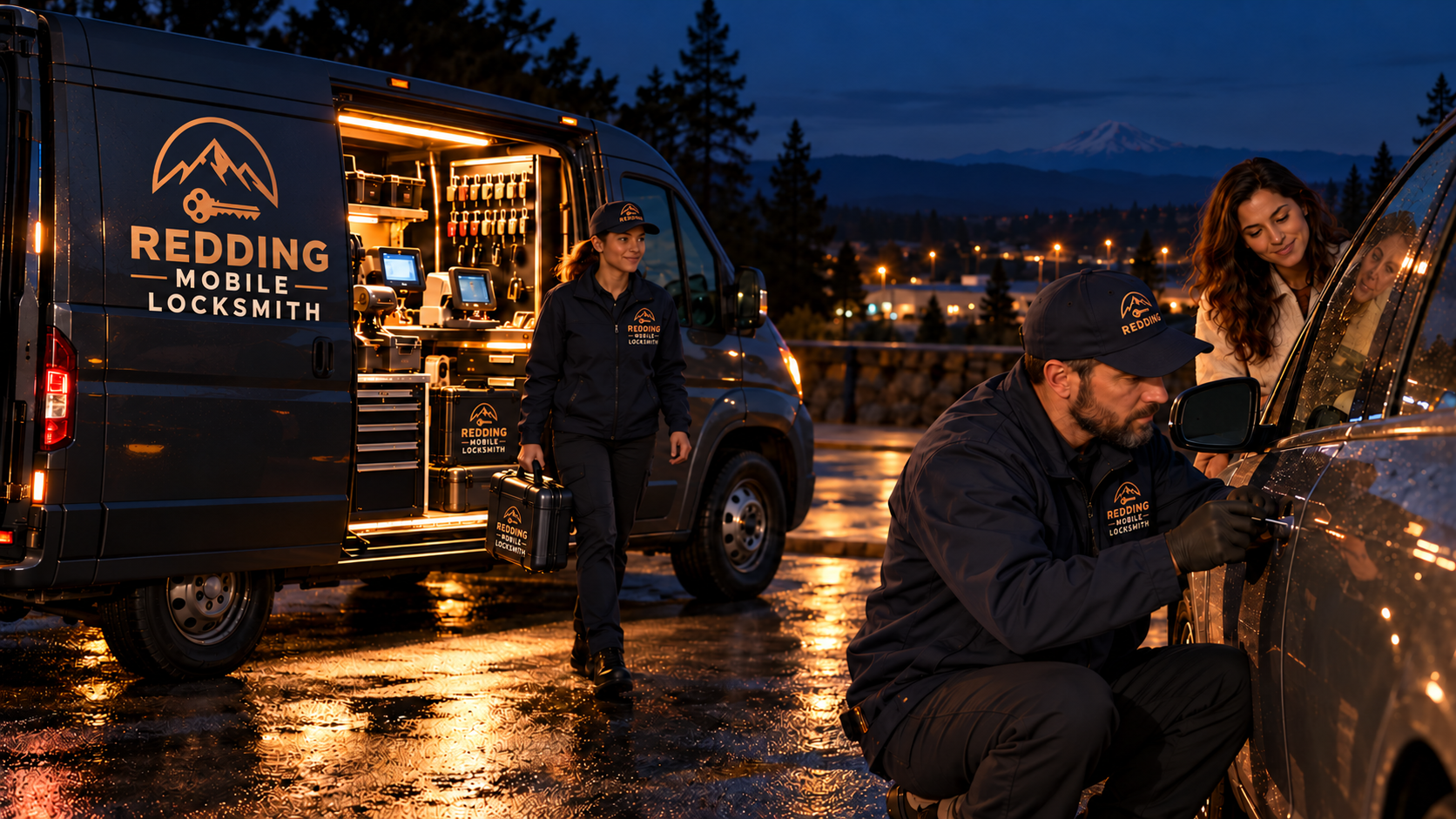
Redding Mobile Locksmith is a 24 hour mobile locksmith based in Redding, California, serving Shasta County and Siskiyou County. Our team wears uniforms and arrives in a branded service van with professional tools, key cutting and programming equipment.
See the Mount Shasta coverage page for the full picture of the area, or read about nearby Weed and Dunsmuir. If the situation began as a lockout, start with night car lockout in Mount Shasta.
The phone line is coming soon. Use the request form on the contact page to share your vehicle details and your location. Keep it short and clear, and keep your phone with you.
Think about the longer trip ahead. A new key in the pocket is good, and a second key in a different bag is better. If you travel with a group, give each driver their own key. It removes a single point of failure from the whole journey.
If your vehicle has special features, such as a locked glove box or a trunk with a separate key, mention that. A technician can often cut or program those too, so you end the visit with every lock matched. See also why a spare key matters before you need it.
Common questions
Can a locksmith make a new car key if I lost every key?
In most cases yes. The technician creates a key from the vehicle itself, cuts the blade and programs the chip or fob to match. Some vehicles have extra security that adds steps. Give the dispatcher the make, model and year so the team arrives with the right equipment.
Do I need my registration to get a new key?
You will need proof that the vehicle is yours, usually a registration or title and a photo identification. If the paperwork is inside the locked vehicle, tell the dispatcher. Other proof may be accepted, but a responsible locksmith will not skip this step.
Is programming always needed?
For transponder keys and smart keys, yes. The chip or the fob must be recognized by the vehicle before the engine will run. Older vehicles with plain metal keys need only a cut blade. The technician will tell you which applies to your vehicle.
What happens to the old lost key?
The technician can often erase a lost key from the vehicle memory so it can no longer start the car. This matters if the key was stolen or you are worried someone might find it. Ask about it when you describe the situation.
Can the work be done where my vehicle is parked?
Usually yes. The service van carries cutting and programming equipment, so many jobs are completed on site. Some vehicles need a certain setup or a longer procedure. Tell the dispatcher where the vehicle is so the team can plan.
Should I make a spare after replacement?
It is a good idea. A spare costs less effort when the technician is already there and the equipment is set up. Keep the spare in a different place from the main key, and not inside the vehicle.