
Home / Palo Cedro / Vehicle Key Replacement in Palo Cedro
Palo Cedro Car Keys
Vehicle Key Replacement for Palo Cedro Drivers
Replacing a car key depends entirely on what kind of key the vehicle uses. This page explains the types, from a plain metal blade to a smart fob, and how replacement differs for each one in and around Palo Cedro.
A cabin owner arrives after weeks away
Imagine a seasonal cabin owner who spends the winter elsewhere and returns to the Palo Cedro area in spring. The truck has sat for weeks. They walk out to it, reach into a pocket for the key and find nothing, because the key stayed in a coat in another city. Or the key is there, but the truck will not start and the fob does nothing when pressed.
That kind of situation is common in country where a second vehicle, a trailer or a work truck is used only some of the year. A battery goes flat, a fob battery weakens, a key blade bends, and a spare was never made. When you need the vehicle most, the key is the weak link.
The good news is that most key problems have a clear path. The first question is not how soon, but what kind of key. Once that is known, the options become plain. The rest of this page walks through each kind in order, from the simplest to the most complex.
Metal keys with no chip
Older vehicles often use a plain metal key with no electronics. The blade is cut to match the pattern of pins or wafers in the ignition and door locks. If the vehicle predates transponder systems, a copy or a new key can often be cut from a code or by working from the lock itself, without any programming.
This is the simplest and most forgiving case. A technician with key cutting equipment in a service van can produce a working key on the spot, test it in the door and the ignition, and hand over spares if you want them. Wear matters, though. A key copied from a badly worn key carries the wear forward, and a fresh cut from the vehicle's code is usually cleaner.
If your vehicle falls in this group, read our page on keys for older vehicles from before transponder chips. It explains why these keys are easier to replace, and why that same simplicity is a reason to lock the vehicle carefully.
Transponder keys with a hidden chip
From the late 1990s onward, many vehicles added a small chip inside the plastic head of the key. The chip carries a coded signal. When you turn the key, the vehicle reads the signal through a ring around the ignition. If the code matches, the engine can start. If it does not, the engine may turn over briefly and then stop.
That is why a cut blade alone is not enough. A copy that fits the lock will turn the ignition but will not start the engine until the chip is programmed to the vehicle. Programming involves connecting equipment to the vehicle's diagnostic port, or using a procedure the vehicle itself allows, and teaching it to accept the new key.
This work is part of our transponder programming service. Bring any working key if you have one, because adding a key is generally simpler than starting from nothing. If all keys are lost, the process is longer but still possible for most vehicles.
Remote head keys and flip keys
A remote head key combines a transponder key and a remote in one piece. The blade is part of the same plastic body that holds the lock, unlock and trunk buttons. A flip key folds the blade into the body like a pocketknife. Both give you a key you can use in the door and the ignition, plus convenience from the remote.
Replacing one means three tasks: cut the blade, program the chip so the vehicle will start, and program the remote functions so the buttons work. Sometimes the blade, the remote and the chip are all new. Sometimes you can reuse the shell of an older key. A technician can tell you what makes sense once they see what you have.
Remote batteries in these keys are small and easy to replace. If your remote has simply stopped working, the battery may be the whole story, and a replacement key would be an expensive answer to a small question. Our guide on key fob battery failure at night explains how to tell.
Smart keys and push button start
Many newer vehicles use a smart key or proximity fob. You keep it in a pocket or bag, the vehicle detects it when you are near, and you start the engine with a button. The fob contains a transponder, a radio, a battery and often a hidden mechanical key for emergencies. The vehicle checks the fob using short range signals, and it can tell when the fob is inside the cabin.
Replacing a smart key is the most involved case. The new fob must be matched to the vehicle's security system, and the vehicle must be told to accept it. Equipment, software access and skill all matter, and the work must be done with the vehicle present. If the original is lost, extra steps may be needed to ensure the lost fob can no longer start the vehicle.
Read smart key replacement in plain words and push to start vehicles and lockouts for a longer explanation. If you drive such a vehicle, a spare is worth far more than it appears to be.
What happens when every key is lost
Losing the only key is the hardest version of the problem, but it is solvable. The technician first confirms your ownership and identity. Next they identify the vehicle, including the make, model, year and, where needed, the vehicle identification number, which lets them determine the correct key blank and code.
If the vehicle is at home, a mobile visit usually suffices. If it is at a trailhead or on a back road, tell the team, since access matters. Some vehicles must be towed to a place where the work can be done safely. A technician will say so honestly rather than promise something that may not work in the field.
After a new key is made, ask about the old one. A lost key could be in a stranger's hands. Where the vehicle allows, the old key can be erased from its memory so that only the new keys start the engine. Our page on a lost key and vehicle security reprogramming covers the questions to ask.
What to prepare before the visit
Proof of ownership comes into every replacement, because a key opens and starts a vehicle. Expect to show identification and something that ties you to it, such as a registration or title, and bring a note from the owner if the vehicle is not yours. The exact items can vary. Our guide on proof of ownership for key replacement explains the thinking, and a photo of the documents on your phone helps a cabin owner whose papers sit in a drawer elsewhere.
Preparation shortens the visit. Write down the make, model and year of the vehicle. Note the color if more than one similar vehicle is on the property. Find the registration or title. If you have any working key, even a damaged one, set it aside. If you have a spare at a relative's house, ask them to bring it.
Think about the place. For rural Palo Cedro, a clear note on the road, the driveway and the spot where the vehicle sits helps. If the vehicle is inside a shed or a barn, make sure the door can be opened and the area is lit. If it is parked among tall grass or on soft ground, say so.
Decide how many keys you want. Many people ask for one key to get moving and regret it later. A second key made at the same time is simpler than a second visit. Send your details through the request form, since the phone line is coming soon.
- Make, model, year and key type if you know it.
- Registration, title or other proof of ownership.
- Any working key, a damaged key or a spare from a relative.
- The road, driveway and exact spot where the vehicle sits.
- How many keys you want made during the visit.
Work trucks, trailers and rural vehicles
Country life uses vehicles hard. Work trucks carry tools, trailers sit unused for months, and old pickups run long past their expected life. Each brings its own key issues. A work truck may have a worn key that is one use away from breaking. A trailer may use a simple lock that has rusted. An old pickup may use an ignition so worn that any key feels loose.
If your key is worn, replace it before it fails. A worn key forces the pins to ride unevenly, wears the ignition further and breaks without warning. Our guide on worn key symptoms lists the signs. A new key cut cleanly from the vehicle's code is often the cure, and sometimes the ignition needs attention too.
For ranch and farm pickups, see keys for pickup trucks on ranches. For commercial vehicles that several people drive, see keys for work vans, which discusses sharing and tracking keys.
Heat, cold and idle weeks: why keys and fobs fail
Seasonal use is hard on keys. A fob left in a hot parked vehicle through a valley summer can warp its case and weaken its battery. A fob left in an unheated cabin through a winter cold snap may lose enough charge that the buttons stop responding. Neither is a defect in you. They are the normal results of small batteries and plastic exposed to weather.
The vehicle has its own battery, too. A truck that sits for weeks can go flat, and a flat vehicle battery can make a perfectly good key look dead. Door locks may not respond, the dash may stay dark, and a smart key may not be recognized. Before you decide the key is the problem, think about whether the vehicle has power. A jump start or a charge may solve what looked like a key failure.
When both the key and the vehicle battery are suspect, say so to the dispatcher. The answer changes which tools come on the visit. It also saves you from paying for a key you did not need. Our guide on a dead car battery and door locks explains how a weak battery behaves.
How the vehicle decides whether to trust a key
It helps to know what is happening when you press start. A transponder or smart key holds a code, and the vehicle holds a list of codes it accepts. When you turn the key or press the button, the vehicle sends a short challenge and the key answers. If the answer is on the list, the engine control unit allows fuel and spark. If not, it refuses, and the dash may flash a security light.
Programming a new key adds its code to that list. In some vehicles the list is stored in the engine controller, in others in a separate immobilizer module or the body computer. This is why the work needs the vehicle itself, and why a key bought from a stranger and cut at home often fails. The key must be introduced to the car, not just shaped to the lock.
A well run job ends with a clean list. Unwanted keys, including the lost one, are removed where the vehicle allows it, and only the keys you hold can start the engine. Ask whether this was done. A direct question gets a direct answer, and the answer should be plain.
After the new key works
When the new key is ready, test it properly. Use it in the driver's door, in the other doors if the vehicle has locks on them, in the trunk or tailgate, and in the ignition. Start the engine, let it run, shut it off and start it again. Press every button on the remote. Do this while the technician is still there.
Pay attention to small details as well. Does the key slide in smoothly, or does it catch? Does the dash light for the security system go out as it should? Do the door locks answer the remote from a normal distance, and do the panic and trunk buttons behave? Any oddity is easiest to fix during the visit, when the equipment is still out and the technician has the vehicle open in front of them.
Then think about the bigger picture. If you had a single key, make a spare and store it away from the vehicle. If you replaced a lost key, ask whether the old one has been disabled. If a key broke in the lock or the ignition, consider whether the cylinder is damaged. The vehicle key replacement service page outlines the full range of work.
Palo Cedro is one of several communities along Highway 44 and the foothills east of Redding. If you travel to Redding or the surrounding area, you may find the Redding key page and the Millville key page helpful. The Palo Cedro coverage page lists every local service.
Common questions
What types of car keys are there?
Plain metal keys with no chip, transponder keys with a hidden chip, remote head keys that combine a key and remote, flip keys that fold the blade, and smart keys or fobs for push button start. Each needs a different process for cutting, programming or both, so knowing which you have is the first step.
Can a new key be made if I lost every key?
For most vehicles, yes. The technician confirms your identity and ownership, identifies the vehicle, and cuts and programs a new key. The work can take longer than adding a key when you still have one, and some vehicles have extra requirements. The team will explain what applies to yours.
Why does my new key turn but not start the engine?
If the vehicle has a transponder system, the key also needs a chip that the vehicle recognizes. A cut blade without programming will turn the ignition but the engine will not stay running. Programming teaches the vehicle to accept the new key's code.
Do I need to bring my vehicle somewhere?
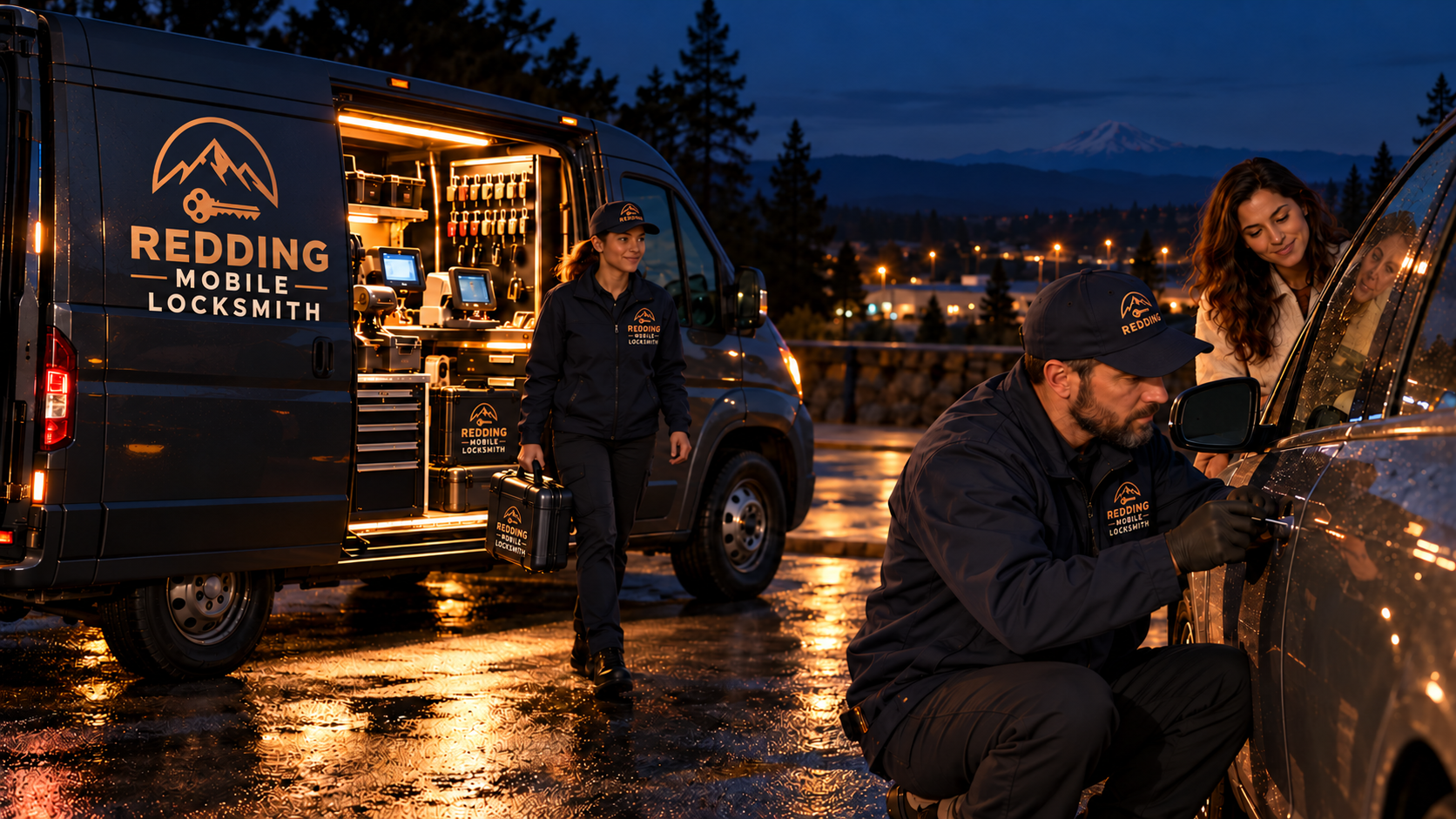
In most cases the work comes to you, since the team uses a service van with cutting and programming equipment. Tell the team where the vehicle is and what the ground is like. If a particular vehicle cannot be done on site, the team will say so plainly.
What proof will I need to show?
Identification and something that ties you to the vehicle, such as a registration or title. If the vehicle belongs to someone else, you may need their permission. Exact requirements can vary, and the team can tell you what it will accept when you send your request.
Should I replace a worn key before it breaks?
Yes, if you can. A worn key damages the ignition, grows less reliable and can snap in the lock. Making a fresh key while the old one still works is simpler than a rescue after it fails, and it gives you a clean spare.