
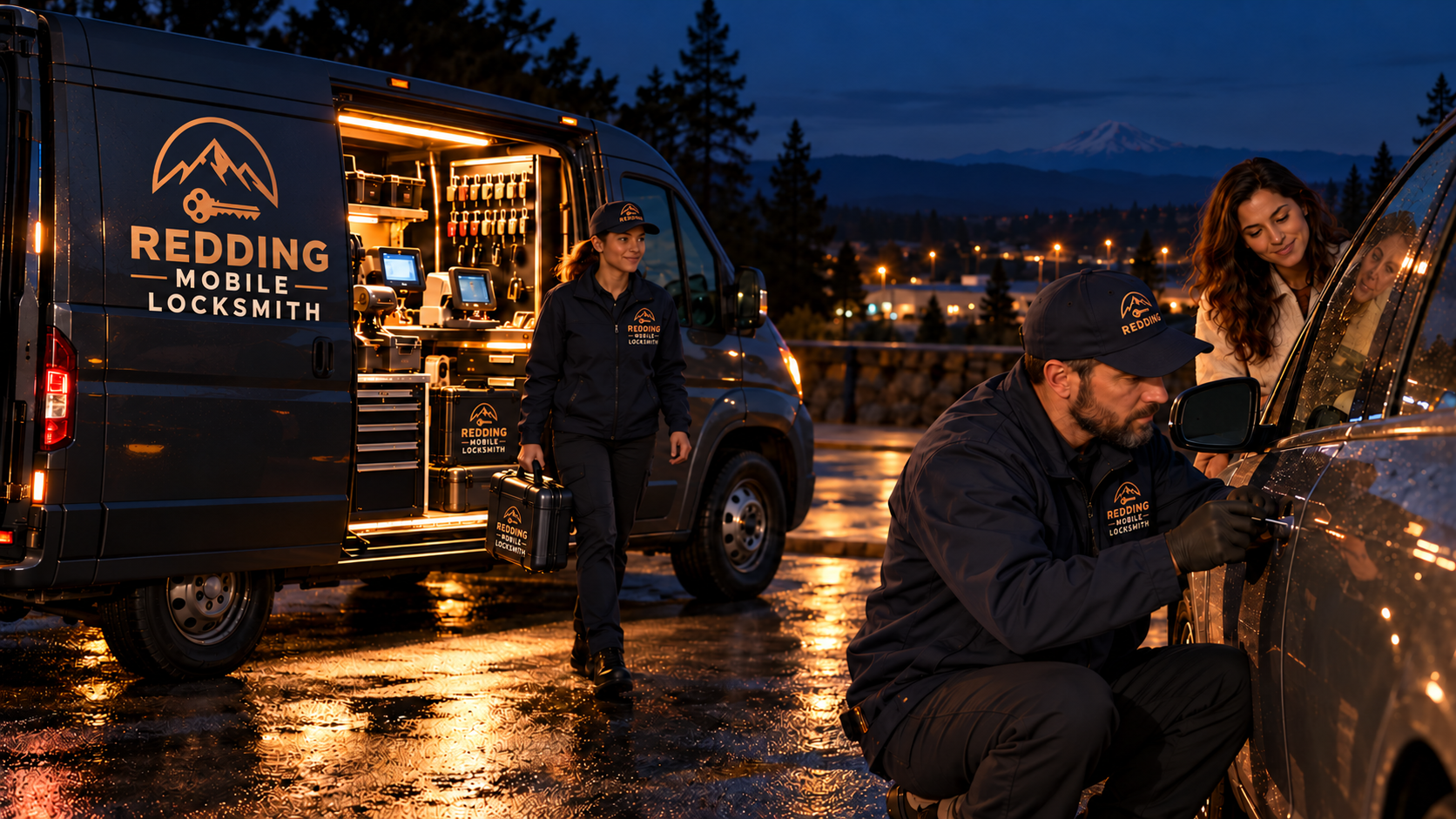
Picture a trailhead as the light fades
Imagine a hiker or an angler walking back to a pickup as the sun drops behind the foothills. The creek was loud all afternoon. The keys were in a jacket pocket, and somewhere along the way the pocket emptied. Now there is a vehicle, a dark sky, and no way to start the engine.
This kind of evening is easy to picture around Millville, ZIP 96062, a small rural community east of Redding in the Shasta County foothills. People here spend time on country properties, on long private roads, and at the edges of wild land. A key lost out there is not simply misplaced. It may be on a trail, in a stream, or in a field you will not walk again before morning.
The good news is that a lost car key is a solvable problem. A mobile locksmith can come to the vehicle rather than asking you to tow it anywhere. This page explains the difference between having a spare and not having one, what to gather, and how vehicle key replacement usually works.
If you still have a spare
A working spare is the simplest path by far. Someone can bring it to you, or you can get to wherever it is kept. If it is a mechanical key or a standard transponder key, it will start the vehicle exactly as the lost one did. The first decision is whether that is enough or whether you should also deal with the missing key.
A lost key is not harmless just because a spare exists. On many vehicles the missing key can still start the engine if someone finds it. If it was lost near a road, a parking area, or a trailhead where other people pass, think about whether that matters to you. Some vehicles allow lost keys to be removed from the system so they no longer start the car, and a locksmith can explain whether yours does.
Use the spare to get home safely, then plan the next step in daylight. Making a copy from a working key is usually a simpler job than making one from nothing, so the spare gives you a good starting point for a replacement.
If you have no spare at all
With no key in hand, the locksmith works from the vehicle itself. A new key must be cut and, for most modern vehicles, programmed to communicate with the car. The technician needs to confirm the exact vehicle, identify the lock and the key type, and create a key that the engine control system will accept.
That sounds like a lot, but it is routine for a van that carries cutting and programming equipment. The vehicle stays where it is. You wait with it, and the work is done at the curb, in the driveway, or at the trailhead if the location is safe enough. Some places are not safe or practical at night, and the technician will say so.
Because the work happens beside the vehicle, you can watch each step. Ask questions as they come up. A technician who explains the key type, the cutting and the pairing is showing you that the process is sound, and you will understand your own vehicle a little better afterward.
What you need to supply is proof that the vehicle is yours and information that identifies it. We cover those items in proof of ownership for key replacement and preparing your vehicle information for the call. Having them ready turns a long conversation into a short one.
Write the details in your phone notes before the next outing, not after the keys are gone. A hiker who has a photo of the registration and the dashboard number can describe the vehicle in one breath. Someone who relies on memory at the end of a long day may stumble over the year or the trim.
Why the key type matters
Not every car key is the same object. Older vehicles use a plain metal key with cuts that match the lock. Many later vehicles use a key with a small chip inside the head, called a transponder. The chip carries a code. When you turn the key, the car reads the code and decides whether to allow the engine to start.
Some vehicles use a remote with buttons, a fob that sits in a pocket, or a push button start with no key blade you ever turn. Each design has its own process. A plain metal key can be cut with the right machine. A transponder key must be cut and also paired. A smart key must be paired to the vehicle with specific equipment.
You do not need to be an expert. You only need to tell the dispatcher what your key looked like. Did it have a plastic head? Buttons? Did you push a button to start the engine? Those answers narrow the job down. Our guide to transponder keys explained for night emergencies fills in the rest.
What to gather before the technician arrives
Gather what you can while you wait. Note the make, model and year of the vehicle. Find the vehicle identification number, which usually appears on the dashboard near the windshield or on a label inside the driver door frame. Have a photo ID ready, and anything that links you to the vehicle, such as registration or a title document.
If you cannot reach those papers, think about what else shows ownership. A rental agreement, a letter from the registered owner, or an insurance card may help. Requirements differ by situation, so ask the dispatcher what is acceptable rather than assuming.
If the vehicle is not yours, say so at the start. A friend lending you a pickup for a fishing trip is a common case. The owner may need to confirm by phone or provide documents. Plan for that call before it is dark and before anyone's phone battery gets low.
- Make, model and year of the vehicle.
- The vehicle identification number if you can reach it.
- Photo ID and any document that shows ownership.
- A description of the lost key, including buttons or a plastic head.
- A clear description of where the vehicle is parked.
Mobile service on country roads
Millville properties often sit well off the paved road. A technician arriving at night needs to know where to turn, which gate to use, and whether the last stretch is gravel. Describe landmarks that stay visible in the dark, such as a mailbox, a reflector, a barn with a light on, or a distinctive fence.
If you are at a trailhead rather than a driveway, say what the parking area looks like and whether other vehicles are nearby. Stay near your vehicle with the doors locked if you have another way in, and keep your phone on. If you feel unsafe where you are, move to a place you trust and tell the dispatcher where the vehicle is instead.
Our trailhead lockouts guide and rural road lockouts after dark go through the practical details of waiting well. They apply just as much to a replacement key as to a plain lockout.
A lockout and a lost key are different jobs
People often combine two situations. In a lockout, the key exists but is inside the vehicle. A technician opens the door and you retrieve the key. In a lost key situation, there is no key anywhere you can reach, so a new one must be made. The tools and the time involved are not the same.
If you are standing at the vehicle and the keys might be inside, look through the windows first. A glimpse of keys on a seat or in the ignition changes the whole call. Ask for night car lockout service in Millville instead, which is usually a simpler job.
If the keys are definitely gone, say so clearly. The dispatcher can then plan for key cutting and programming equipment, not only door opening. Telling the truth early avoids a second trip and keeps the whole process steady.
A third case sits between the two: the key is broken, not lost. If the blade snapped off in the lock or the ignition, a piece of it may still be stuck. Do not try to dig it out with a knife or a pin. Describe what you see and let the technician plan for extraction as well as replacement.
What happens during the replacement
The technician first confirms who you are and what vehicle this is. They identify the lock and the key type, then cut a blade if one is needed. The key is tested in the door and the ignition, and the technician checks that it turns smoothly without catching. If the vehicle uses a transponder or a smart key, the new key is paired with the car so the engine control unit accepts it.
You should be shown that every key works before the technician leaves. Try the door lock, the ignition or push button, and any remote buttons. If you want a second key made at the same time, ask. Cutting two keys while the equipment is already set up is often easier than calling someone out again.
The details differ for each vehicle, so expect the technician to explain the steps in their own words. We do not publish prices or time promises, because they depend on the vehicle and the situation. Ask the technician to describe what is involved before they begin.
If you carry more than one vehicle on your property, such as a pickup, a utility vehicle and a trailer, tell the dispatcher which one needs the key. Each vehicle can use a different lock and key, and mixing them up is an easy mistake at the end of a long day.
Protect the vehicle after a lost key
Once you are home, think about what a stranger could do with the lost key. If it fell off a trail in an empty area, the risk is low. If it was lost in a parking lot with your registration inside the glove box, the risk is different. Decide how comfortable you are, and ask whether the old key can be removed from the vehicle system.
Keep your registration somewhere other than a spot where a key and the paperwork can be found together. This is a general safety habit, not a rule. Talk with your insurance provider if you want to know how they treat lost keys.
Our guides on a lost key and vehicle security and why a spare key matters before you need it lay out the questions to ask. They are calm, practical, and written for people who would rather prepare than panic.
One more habit helps. When you come home from an outing, put the key in the same place every time: a hook by the door, a bowl, a pocket you always check. Most lost keys are not stolen or dropped on a trail. They are set down in a place the owner forgot to think about.
Make a spare before the next outing
The most useful thing you can do after a night like this is to get a second key made. It is much simpler to copy a working key in daylight than to build a key from nothing at dusk. A spare should live in a place the vehicle owner can reach, but not on the vehicle itself.
Think about how your household uses the car. If two people share it, each one should carry a key. If you often head into rough country, consider keeping a spare at home with someone who can bring it. Do not hide a key in a magnetic box under the bumper where every thief checks. Label nothing with the address or the plate number. A key ring with a tag that says where the vehicle lives gives a finder everything. Keep the spare plain and keep the information about it in your own head or with a person you trust.
You can read about adding a spare or replacing every key to decide which path suits your vehicle. If your key uses a chip, the page on transponder programming explains what is involved in pairing a new one.
Serving Millville and the communities nearby
Redding Mobile Locksmith works with a branded team in uniforms and a branded service van that carries professional tools, key cutting and programming equipment, and common hardware. We serve Millville along with Palo Cedro, Anderson, Redding and many other places across Shasta and Siskiyou counties.
Our general vehicle locksmith page explains the whole range of car work. The Millville coverage page describes the area and the other local pages. If you would rather see what a home emergency looks like, read about night house lockouts in Millville.
The phone line is coming soon. For now, send the details through the request form on the contact page. Include the vehicle, the key situation, and a clear description of where you are.
Common questions
Can a locksmith make a car key with no spare at all?
In many cases, yes. The technician identifies the vehicle, cuts a key if needed, and pairs it with the car if it uses a chip or a smart system. Requirements depend on the vehicle, so tell the dispatcher the make, model and year and describe the lost key.
Do I need to tow the vehicle for a new key?
Usually not. A mobile service brings equipment to the vehicle, so the car stays where it is parked. Some locations are not practical or safe at night, and the technician will tell you if the work should happen somewhere else.
What proof will I need that the car is mine?
Expect to show a photo ID and something that links you to the vehicle, such as registration or a title document. Rules vary, so ask the dispatcher what is acceptable. If you borrow the vehicle, the owner may need to confirm by phone.
Is a lost key a security risk?
It can be. If the key was lost somewhere other people pass, it may still start your vehicle. Some vehicles allow lost keys to be removed from the system. Ask the technician whether yours does and what the steps involve.
Is a copy of a working key easier than a new key from nothing?
Generally, yes. With a working key in hand, a copy is a simpler job, and the technician can match the original. When no key exists, the technician must build one from the vehicle information and pair it with the car. Expect to show proof of ownership, and have the vehicle number ready if you can reach it. A calm, complete description makes the first conversation much shorter.
How do I ask for help while the phone line is coming soon?
Use the request form on the contact page. Describe the vehicle, what happened to the key, and exactly where the car is parked. If you are on a private road or trailhead, add landmarks that are easy to see at night. A technician finds a vehicle far more smoothly when your description sounds like what a stranger would see from a vehicle, not like what a local already knows.