
Home / Yreka / Vehicle Key Replacement in Yreka
Yreka car keys
Vehicle Key Replacement in Yreka: What It Involves and What to Gather
Imagine a caregiver visiting a relative in Yreka who loses the only car key on a dark evening. Here is how replacing a lost or broken car key works, and what to have ready when you ask for help.
When a car key goes missing in the county seat
Yreka is the Siskiyou County seat, sitting along Interstate 5 in the Shasta Valley area. People come and go all day: residents, workers at county and professional offices, travelers on the highway and visitors who drive in for a few days to help family. Many of them rely on a single key to get anywhere, and a key can vanish at any point in that routine.
Picture a caregiver who has driven up to look after a relative for a week. They park outside the house, carry in groceries, and set the key down somewhere in an unfamiliar kitchen. By evening it is gone. The vehicle is the only way home, and the next appointment is early. No one in the house knows the car, and the spare is at home in a drawer.
A situation like this is stressful, but it has a clear path. Replacing a lost or broken car key is a defined job with defined steps, and understanding them ahead of time lets you stay calm and prepare the right things. This page walks through what is involved, what to gather and what to ask.
Why one lost key can be more than a copy job
Most modern cars do not use a plain metal key. Inside the plastic head of many keys sits a small chip, called a transponder, that talks to the vehicle. When you turn the key, the car sends a low power signal, the chip answers with a coded reply, and only then will the engine run. A blank cut to the right shape will turn the ignition and still fail to start the car, because the chip was never introduced to the vehicle.
That is why a replacement key is two jobs in one. First, the metal blade must be cut to match the locks. Second, the electronic part must be programmed so the car accepts it. Some cars use a smart key, a fob that lets you unlock and start the car without inserting anything, which adds a third layer: the fob must be paired to the vehicle's computer.
When all keys are lost, the process is more involved than when you have one working key to copy from. With a working key, a technician can often clone or add to what is already known. With none, the vehicle's own system has to be accessed to enroll a new key. A professional van that carries cutting and programming equipment makes this possible at the roadside.
The types of keys, from simple to smart
It helps to know which kind of key you have, because it shapes what the job takes. At the simple end is the plain mechanical key, common on older vehicles. It has no chip, and it can be cut to match the door and ignition alone. Next is the transponder key, which looks like a regular key with a thick plastic head and needs programming to start the car.
Further along is the remote head key, a transponder key with lock and unlock buttons built into the head. Then comes the switchblade or flip key, which folds a blade into a fob. At the top is the smart key or proximity fob, used with push to start ignition. It does not need to be put in a slot at all, as long as it is inside the vehicle.
Each type costs different effort to replace, and the amount of equipment and time needed changes with it. If you are not sure which type you have, look at the key in a photograph, at a spare, or at the push button on the dash. Describing it plainly in your request is enough for a technician to plan ahead.
- Plain mechanical key: cut to shape, no chip to program.
- Transponder key: cut to shape and programmed to the vehicle.
- Remote head key: transponder plus lock and unlock buttons.
- Flip key: a folding blade built into a remote.
- Smart key: a proximity fob for push to start vehicles.
What to gather before you ask for a key
A short list makes everything go smoother. You will need to show that the vehicle is yours or that you have the right to use it. That usually means photo identification and either the registration or the title, or a rental or lease agreement if the car is not owned by you. Rules differ between situations, so ask what applies to yours.
Note the vehicle's make, model and year, and find the vehicle identification number, a long code printed at the base of the windshield on the driver's side and on the door jamb. The number helps a technician look up the correct key and programming information. If you can read it from outside the car, write it down or photograph it.
For our caregiver visiting a relative, the car may belong to someone else or be registered at another address. If so, say that plainly. Any proof of the right to use the vehicle helps, and the owner may be asked to confirm by phone. Our guide to proof of ownership for key replacement explains what is typically useful.
Preparing your vehicle information for the call
The more precisely you can describe the car, the better the technician can prepare. Say how many keys you have left, if any. Say whether the vehicle has a push button start or an ignition slot. Mention whether the doors are locked or open, and whether the vehicle is parked at a house, a lot or the roadside.
Tell the technician the symptom too. A key that is lost needs a different approach than a key that is broken in the ignition, one that is cracked at the head, or one whose remote buttons have stopped working. A key that turns but will not start the car is often a programming problem, not a cutting problem.
The guide on preparing your vehicle information for the call gives a fuller checklist. To keep the process smooth, send your request with these details in one message through the request form.
How the replacement actually happens
The technician starts by confirming who you are and that you can have a key made for this vehicle. Then they identify the key type and gather the code or blank needed. A blank is an uncut key made to fit the vehicle. A key cutting machine in the van shapes the blade to the correct pattern, which may be an edge cut along the side or a sidewinder cut into the face of the blade.
Once the key is cut, the chip is programmed. A diagnostic tool connects to the vehicle's port under the dashboard, and the technician walks the car's computer through the process of learning the new key. With some vehicles this takes a few steps, and with others it involves a security sequence that must be entered in order. Afterward, each function is tested: the door lock, the ignition, the engine starting and, if present, the remote buttons.
The last step is the one people forget. Test every key you own with the vehicle, including any old spares. If one of them no longer works, that is useful to know now, not on a dark road later.
Lost keys, broken keys and worn keys are different jobs
A fully lost key means a vehicle with nothing to copy from, and the job begins with programming a brand new key into the system. A broken key may leave part of itself in the ignition or door lock. In that case, the first task is to remove the broken piece without harming the lock, and then replace the key. A technician can often use the broken half to help match the cut.
A worn key is a more quiet problem. After years of use the cuts round off and the key begins to stick, feel loose or work only when jiggled. Replacing a worn key before it fails is easier than doing so after, and it protects the ignition cylinder from damage. If you notice the key feels odd, mention it.
If one key works and the other does not, that may be a chip or battery issue rather than a cutting one. The page on when one key works and the other does not explains what to look for.
Questions worth asking before the work begins
A calm customer asks a few plain questions, and a good technician answers them without fuss. Ask what type of key your vehicle uses and whether anything about it is unusual. Ask whether the new key will need programming, and whether the old keys will keep working afterward. Ask what you should do if the key is later lost again.
It is also fair to ask what happens to any old key. If the lost key could be found by someone else, you may want it removed from the car's memory so it can never start the engine. Not every vehicle allows that, and the technician can tell you what yours supports. Knowing the answer lets you decide if the extra step is worth it.
Finally, ask for a test of every function before the technician leaves. Lock and unlock from the remote, open the trunk or tailgate if the key controls it, start the engine, shut it off and start it again. A thorough test at the curb costs a minute and avoids a second call in the dark.
Do you need a spare too?
When a technician has your vehicle and programming equipment in front of them, adding another key at the same visit is usually simpler than making a separate trip later. Programming a second key while the first is being made is a modest extra step. After a loss, a spare is the thing that keeps the next loss from becoming a crisis.
Consider who else drives the car. A caregiver who borrows a relative's vehicle, or a family that shares one, may benefit from a key that stays with the owner and another that travels with the driver. Think also about keeping one key in a safe place away from the car, not in the glove box or under the seat.
If a key has been lost rather than simply misplaced, ask whether the old key can be removed from the vehicle's memory. Some systems allow a lost key to be erased so it will no longer start the car. Our page on adding a spare or replacing every key describes the choice.
Doing this in Yreka after dark
The mountains of Siskiyou County cool off sharply after sunset, and Yreka evenings can turn cold in the shoulder seasons and sharp in winter. If you are stuck outside with a lost key, wait somewhere warm and lit rather than in an unlit lot. Keep your phone charged and keep your vehicle's information handy.
If you are a visitor, make sure the person you are helping knows where you are. A relative who knows the plan can help confirm identity or ownership by phone, and a neighbor may offer a light and a seat. Do not accept help from strangers who offer to cut a key on the spot, and stay with people you know.
The service for night calls is described on the vehicle key replacement page, and the related transponder programming page explains the electronic side in more depth. Nearby, the Yreka overview lists everything available in town.
Keeping the key you end up with in good shape
A new key is only useful if it lasts, so a few habits are worth building. Keep the key away from heavy bunches of other keys, since the weight hangs on the ignition and wears the cylinder over the years. A light ring with only what you need is easier on the lock and on your pocket. Avoid chewing, bending or prying with the blade, which loosens the cut and can crack the plastic head.
For fobs and remote heads, remember that the battery is a small but important part. A weak battery can make the remote buttons fail or make a smart key hard for the car to detect. Replace the coin cell when the range seems to shrink, before it quits. If the car shows a warning about the key, treat it as a reminder, not a mystery.
Finally, keep a note of where each key lives. For our caregiver, that might mean one key on the person using the car and one with a trusted relative. A simple plan like that turns a lost key from an emergency into an inconvenience. The guide on why a spare key matters before you need it puts the idea in plain words.
If your problem is a locked car and not a missing key, the night car lockout page for Yreka is the better starting point. For a missing house key, see the house lockout page. Business owners can look at business security in Yreka.
People in the surrounding valley also have pages: Montague, Fort Jones, Etna and Weed each describe what is available nearby.
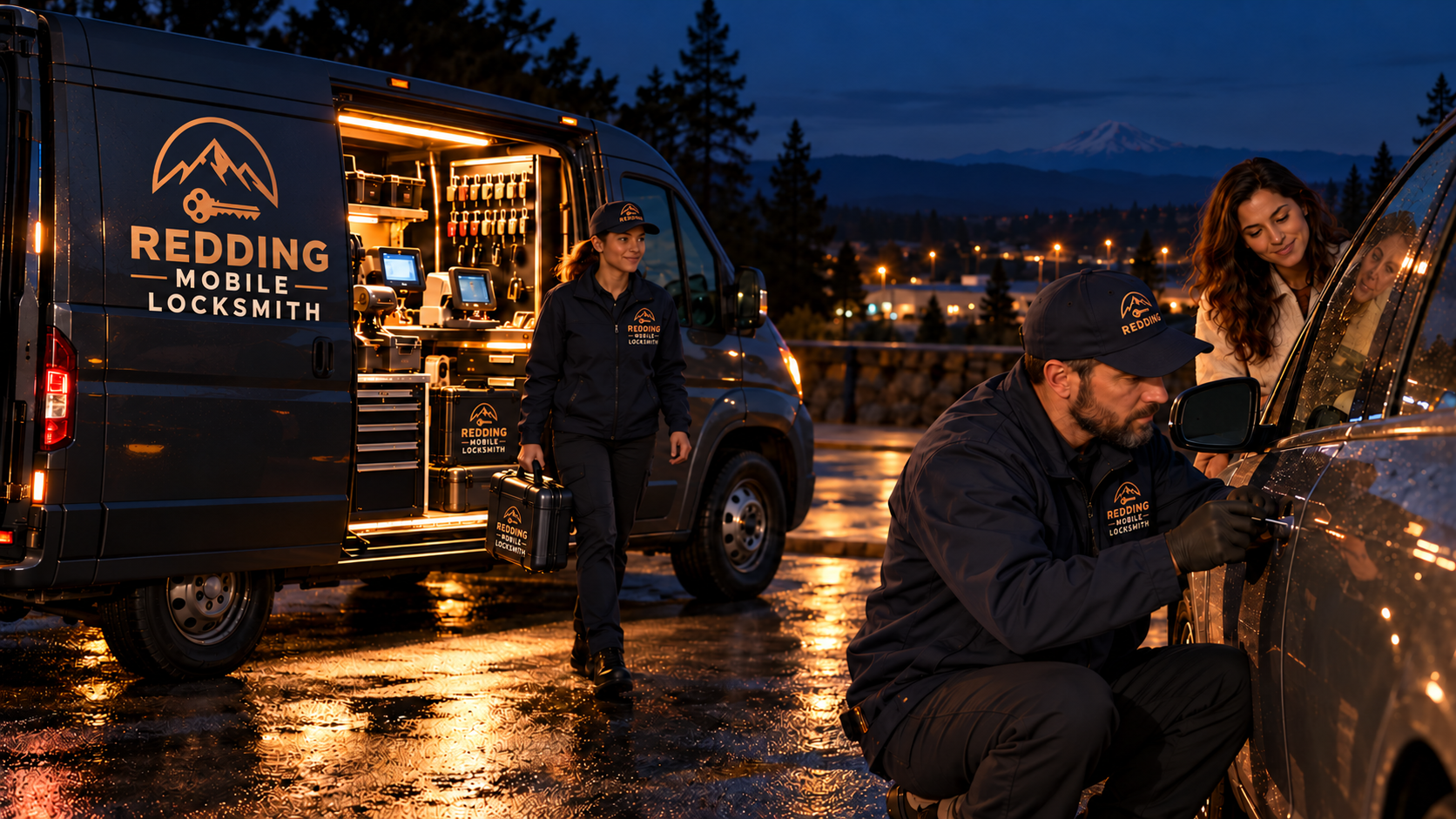
Redding Mobile Locksmith runs a branded van with key cutting and programming equipment. The phone line is coming soon, so for now the way to ask is the form on the contact page.
Common questions
Can a car key be replaced if I have lost every key?
Yes. With no working key to copy from, the technician accesses the vehicle's system to enroll a new key. The blade is cut to match, then the chip is programmed so the car accepts it. You will need to show you have the right to the vehicle, so have identification and registration or title ready.
What proof will I need for a replacement key?
Expect to show photo identification and either registration, title or a rental or lease agreement. The aim is to make sure a key goes only to someone with the right to the car. Rules vary between situations, so ask when you send your request what applies to yours.
Why does my new key turn the ignition but not start the car?
Many keys contain a transponder chip. If the chip has not been programmed to the vehicle, the engine control system will refuse to run even when the blade turns the lock. A programming step with a diagnostic tool introduces the key to the car and fixes the problem.
How is a smart key different from a regular key?
A smart key is a proximity fob that lets you unlock and start a push button car without inserting anything. It communicates by radio with the vehicle. Replacing one involves pairing the fob to the car's computer, which needs specialist equipment, in addition to any mechanical emergency blade inside.
Should I get a spare made at the same visit?
Adding a second key while the equipment is already connected is usually simpler than arranging another visit later. It also protects you from another loss. Ask about the option when you make your request, and consider whether you want a lost key removed from the vehicle's memory.
How do I ask for help if there is no phone number yet?
The phone line is coming soon, so for now use the request form on the contact page. Include your location in Yreka, the vehicle make, model and year, how many keys you have, the type of key and what happened. Details help the technician bring the right blanks and tools.