
Home / After dark / Adding a spare or replacing every key
Key decision guide
Adding a spare or replacing every key: how to decide
Some key problems need one more key. Others need a clean slate. Ask who may hold a copy, how worn your keys are and whether a key could be in the wrong hands, then choose.
Two different jobs with a similar name
People often say they need a new key, and they mean one of two quite different things. The first is adding a key: you have at least one working key, and you want another that behaves the same way. The second is replacing every key: you want the old keys to stop working and a new set to take their place.
The difference matters because the two jobs protect you in different ways. A spare protects you against inconvenience. A full replacement protects you against the possibility that someone else holds a working key. If you mix them up, you can end up with a second key that still works for anyone who has the first.
This page helps you choose calmly, in daylight or at night. It covers cars and homes, explains what a locksmith does in each case and lists what to prepare. It follows the page on why a spare key matters before you need it, so read that first if you have no spare at all.
When adding a spare is enough
Adding a key makes sense when the situation is ordinary and the existing keys are under your control. You have one key and want a backup. A family member needs their own key. A key is worn and you want a fresh one before it fails. A child is old enough to be trusted with access.
In these cases, nobody has lost or stolen anything. The old keys remain valid and safe. A new key simply joins them. For a house, a locksmith cuts a key to match the lock, ideally from the lock's code or a clean original. For a car, a locksmith cuts the blade and programs the chip or remote so the vehicle accepts it.
Adding a key also suits a household that wants to retire a worn key. You can cut a fresh one, keep the old one in a drawer for a short time, and then discard it once the new one proves itself. Our guide on worn key symptoms explains how to see when that is wise.
Consider a short example. Picture a couple who have lived in a house for years with three keys among them. Their daughter moves out and takes one. Nobody worries, because she is family. Then a second key goes missing after a move. Now two of three keys are unaccounted for, and the couple cannot say who has them. A spare adds a fourth key to a list they cannot track. A rekey resets the list to the keys they actually hold.
When replacing every key is the better choice
Replacing every key is the careful path when you cannot be sure who might hold a working copy. Consider it in situations like these.
In each case, the worry is not the key you can see. It is the key you cannot. A spare does nothing about that. Only changing the lock, or removing old keys from the car's memory, closes the gap.
Our guides on stolen keys, steps to protect your vehicle and a lost key and vehicle security reprogramming questions explain how this works on a vehicle.
Business and fleet situations follow the same logic. A shop that adds an employee may only need one more key. A shop that loses a key during a staff change may need to change the lock. Where several people share vehicles, the car's list of trusted keys matters as much as the metal. Our guide on fleet vehicle night lockouts and the page on business security look at the commercial side.
- A key was lost, and you do not know where.
- A key was stolen, or a bag, wallet or car was broken into.
- A former partner, tenant, employee or contractor still has a copy.
- You moved into a home and do not know who held keys before you.
- You gave a key to someone you no longer trust.
- Keys have been copied many times and nobody keeps a list.
How a house is reset
For a home, the standard way to replace every key is rekeying. The locksmith opens the cylinder, changes the small pins inside to a new pattern and cuts new keys to match. The lock itself stays in the door. The old keys no longer lift the pins correctly and stop working. The new keys do.
Rekeying is often more practical than replacing the whole lock, because the hardware stays in place and the doors keep their finish. It can be done for every lock in a house, so that a single key opens the front, back and garage entry. Our page on rekey locks describes the work.
Sometimes the lock itself is the problem. If it is damaged, loose or old, replacing it may be wiser than rekeying it. A locksmith can explain which applies. The pages on home locksmith work and install new locks show the options.
Rules about changing locks vary by lease, by building and by community. If you rent, ask the owner or manager first. If a building has shared rules, check them. This page does not state any rule as a fact, only that you should ask before you change a lock that is not yours to change.
There is also a middle path for homes: rekey the locks that matter most, such as the front and any door that opens straight to a bedroom hallway, and add a spare for the rest. The locksmith can suggest an order. The aim is to reduce the number of keys that could open the places you care about, without redoing every door at once.
How a car is reset
A car key is different, because the car remembers the keys it knows. Many vehicles store the identity of each chip or fob in the vehicle's computer. When a locksmith programs a new key, the car adds it to that list. Depending on the vehicle, the locksmith may also be able to remove old keys from the list, so a lost or stolen key can no longer start the car.
That is the car version of rekeying. It does not always change the physical lock. Instead, it changes which electronic keys the car trusts. Whether it can be done, and how, depends on the model and year. This is why the first question a locksmith asks is for the year, make, model and trim. Read preparing your vehicle information for the call.
On some vehicles, the door and ignition cylinders can also be rekeyed or replaced, for example if a key was stolen and the thief might use the blade. Other vehicles rely mainly on the electronics. A locksmith can tell you which approach suits your car. Our pages on vehicle key replacement and transponder programming describe what is involved.
Some people ask whether they must be present for a car reset, and whether the vehicle needs to be moved. Usually the car stays where it is, and the mobile locksmith works there. You should be present with your identification and documents. If the car sits in a spot that is unsafe at night, such as a dark shoulder, think about moving yourself first and tell the dispatcher where you are. The plan for waiting for help in a parking lot is a useful reference.
Questions to ask yourself
A few honest questions point you to the right choice.
If the answers are comfortable, a spare is probably enough. If any answer is uneasy, a full replacement deserves a serious look. You do not have to decide alone. A locksmith can discuss the situation and explain the options, though the choice is yours.
Remember that doing nothing is also a decision. A lost key left active is a standing opening. If you are unsure, it is safer to assume the key could be found and act accordingly, particularly for a home where people sleep or a vehicle that holds valuables.
Keys for a shared family vehicle need special thought. If several people drive the same car, count each driver and decide who holds which key. A lost key in a shared setup is more likely, because keys change hands. Our guide on managing keys for a shared family vehicle gives ideas for keeping track without fuss.
- Do I know every person who holds a copy of this key?
- Could any key be lost, stolen or in the car of someone I would not trust?
- Is the key I have in good shape, or is it worn and cracked?
- Is the vehicle or home likely to be targeted, for example after a theft?
- Do I need extra keys for people, or a clean reset for safety?
What to prepare for the visit
A smooth visit starts with preparation. Gather these items before the locksmith arrives or before you send a request.
Our page on proof of ownership for key replacement explains why these matter, and why a locksmith may ask for identification describes the reasoning. Having these ready keeps the visit calm and the work accurate.
You can send details through the request form while the phone line is coming soon. If you want the work done at night, say so, since Redding Mobile Locksmith operates around the clock.
- Photo identification.
- Proof that the vehicle or property is yours, such as a registration, an insurance card or a document with your name and the address.
- The year, make, model and trim of the vehicle, and what keys you already have.
- Every key you still hold, including broken or worn ones.
- A list of people who currently have copies, if you know.
- For a rental or shared building, permission from the owner or manager.
What the locksmith does on site
After confirming identity and ownership, the locksmith looks over what you have. They check the keys for wear, read the lock or the vehicle details, and talk through the plan. For a spare, they cut and test the new key, program it if needed and check it in every lock.
For a full reset, they do more. At a home, they rekey each cylinder, cut new keys, test them and make sure the old ones no longer work. At a car, they program the new keys and, where the vehicle allows, remove the old ones. They then test the new keys everywhere: doors, trunk, ignition and remote.
A good locksmith narrates the work in plain words and answers questions. They also tell you honestly what cannot be done on site. Some vehicle systems need dealer equipment, and an honest professional says so rather than guessing. You should leave knowing exactly how many keys work, and where they are.
Doing it at night, doing it by day
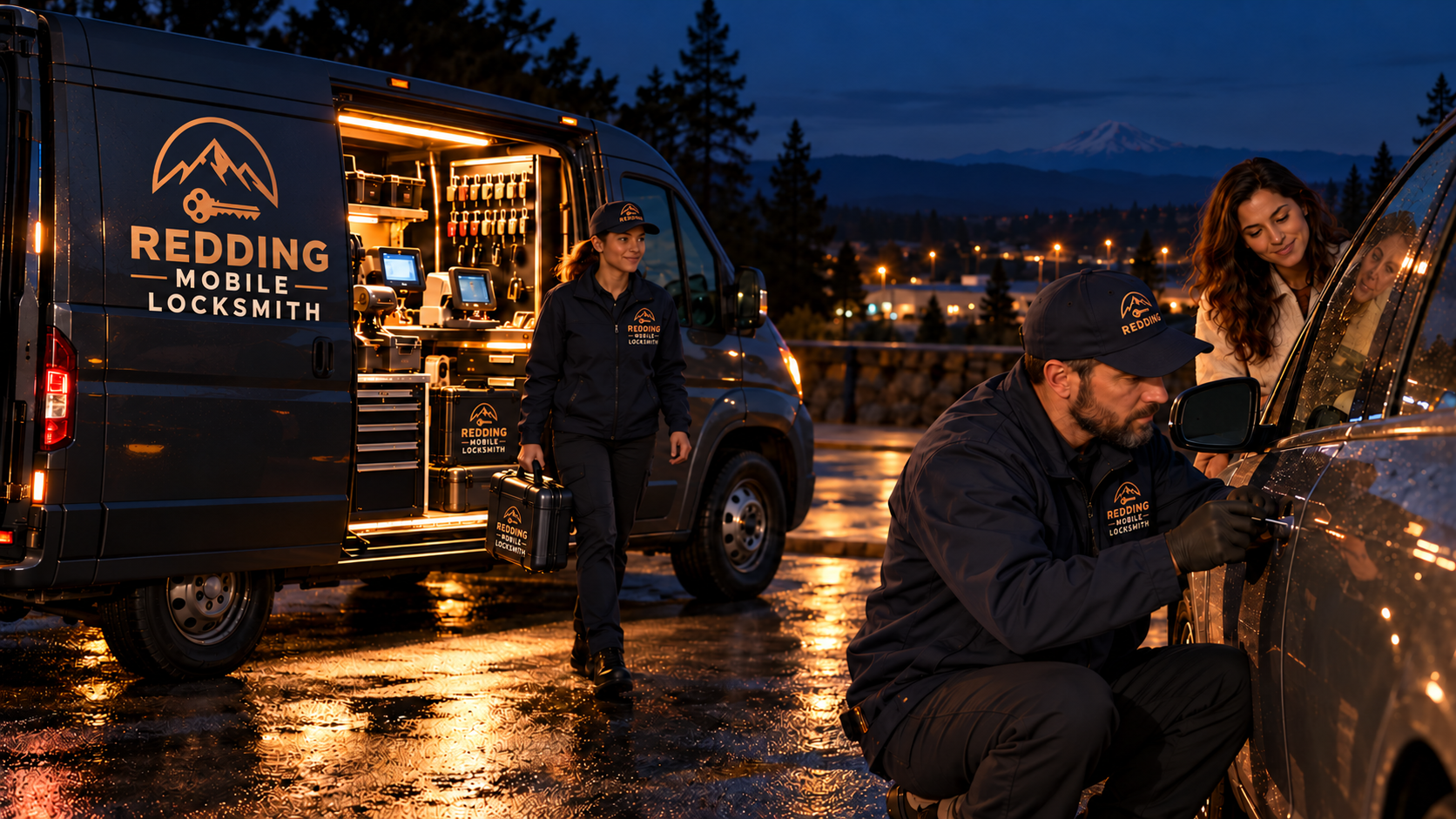
A night call is for emergencies, but a reset does not have to happen in the dark. If you have lost a key but can wait safely, a daytime visit may allow a calmer process. If your safety is at stake, for example after a theft or at a property you cannot secure, a night visit makes sense. A mobile team with a branded service van can come to the place where the vehicle or door is.
The tradeoff is simple. A night visit solves the urgent safety problem. A daytime visit gives you time to think about the whole set of keys. In many cases, the sensible path is both: secure the opening tonight, then plan the full reset when you are rested. See locked out at night, a safety first plan for the first part.
Whichever you choose, your safety comes first. Wait in a lit place. Verify who is arriving before you open the door, as our page on confirming who is arriving at your door explains.
Ask about key control too. Some keys are cut on blanks that are harder to copy without the right equipment, and some cars use fobs that cannot be duplicated casually. A locksmith can tell you what applies to your lock or vehicle and what that means for who can make copies. It is a good question to ask when the aim is a tighter list of who holds access.
After the work is done
When the job is complete, take a few minutes to close the loop. Count the keys you were given and note where each one goes. Test every key in every lock yourself, while the locksmith is still there. Write down who holds which key, and store the spare in a safe place.
If you did a full replacement, destroy or hand over the old keys. A key that no longer works is harmless, but a drawer of mystery keys is a source of confusion. If you rekeyed a house, tell the people who need new keys, and remove any old ones from the key rings in circulation.
Finally, set a reminder to test the spare once a season. Fobs need battery changes, blades can bend in storage and locks change over time. A short routine keeps the system working. Redding Mobile Locksmith serves Shasta and Siskiyou counties, so help for keys is available in Redding, along Interstate 5 and in the mountain towns. See the vehicle locksmith and after hours emergency pages for more.
Common questions
What is the difference between adding a spare and replacing every key?
Adding a spare gives you another working key and leaves the old ones valid. Replacing every key changes the lock or the car's list of trusted keys so that old keys stop working. A spare helps with convenience. A full replacement helps when a key may be in the wrong hands.
Should I replace every key after losing one?
Often it is wise, especially if you do not know where the key went or the loss happened near your home or car. If you are confident the key is in your house and will be found, a spare may be enough for now. When in doubt, treat the missing key as live.
Can a locksmith remove an old key from my car?
On many vehicles, yes. The locksmith programs the new keys and clears the stored list so a lost key no longer starts the car. It depends on the model and year, so have the year, make, model and trim ready. Some vehicles need extra steps, and the locksmith will explain what applies.
How is a house reset if I replace every key?
Usually by rekeying. The locksmith changes the pins inside each cylinder and cuts new keys to match, so the old keys stop working while the lock stays in the door. If a lock is damaged or old, replacing it may be better. The locksmith can explain which suits your doors.
What proof will I need to show?
Expect to show photo identification and something that ties you to the vehicle or home, such as a registration, an insurance card or a document with your name and address. A responsible locksmith asks because a key grants access. For a rental, bring permission from the owner or manager.
Can I do this at night?
Yes, if the situation calls for it, such as a stolen key or a door you cannot secure. If you can wait safely, a daytime visit may be calmer. Either way, wait in a lit place, confirm who is arriving, and send your vehicle details and location through the request form.