
Home / Millville / Business Security in Millville
Millville business access
Business Security and Door Access in Millville
Business security is mostly about control: who can open which door, and when. On a rural property with several doors, tenants and shifting schedules, a clear access plan matters more than any single lock.
Picture the end of a long shift
Imagine someone finishing a long work shift at a small business near Millville. The last customer left a while ago. There is a till to count, a back room to straighten, and a line of lights to switch off. The person is tired and wants to go home. Standing at the door with a ring of unlabeled keys, they realize one of them is missing.
This is how most business security problems actually begin. They do not start with a break in. They start with a tired person, a crowded key ring, and a door that does not behave. Millville, ZIP 96062, sits in the Shasta County foothills east of Redding, where businesses are often small, spread out, and run by a few people who wear many hats.
When the building is far from the next one, a lockout or a failed lock after dark has real weight. This page covers how to think about access across several doors, tenants and schedules, and how business security service fits into daily operations.
Start with a map of every door
Walk the property and list every door. Front entrance, rear entrance, loading door, side door, storage room, office, restroom, gate, fence door, equipment cage. Note which ones lock, which hardware each uses, and who needs to pass through them. Do this once, on paper, and it will pay back many times over.
Rural properties often have more doors than a town business of the same size. A shop might share a lot with a storage building. A small complex might have three tenants and a shared yard. Each door has a different use pattern, and each needs a different level of control.
Group doors by purpose. Doors the public uses should open easily during business hours. Doors only staff use should close firmly and lock. Doors that should never be used at night should be treated as part of the perimeter. This simple sort lets you assign the right hardware and the right keys.
Take the walk at night once, with a flashlight, and look at each door the way a stranger would. Which entrance is dark? Which one is hidden from the road? Which one has a lock that you would not trust? The answers tell you where to spend effort first, and they cost nothing but an evening.
Who holds which key
A key list is the next document to create. For each person, write down which keys they hold and why. Owners, managers, staff, cleaners, delivery partners, maintenance workers, and tenants all have different needs. Few of them need access to everything.
The principle is old but still sound: give each person the smallest set of keys that lets them do their work. A cleaner needs the front door and the supply closet. A tenant needs their own suite and the shared entrance. A manager might need the whole building.
Check the list on a regular schedule. People change jobs, tenants leave, vendors rotate. Each change is a chance for a stray key to stay in circulation. When a key goes missing or a person leaves, the safe answer is usually to change the lock so the old key stops working. Our page on rekeying explains how that works.
- Write down every person who holds a key and what it opens.
- Give each person only the keys their work requires.
- Collect keys when someone leaves, and note the date.
- Rekey when a key is lost or its holder is unknown.
- Keep a master list in a secure place, not on the door.
Tenants and shared spaces
If you own or manage a building with more than one tenant, access gets more delicate. Each tenant wants privacy for their space. Everyone needs the shared entrance. You, as the owner, may need an emergency way in. Balancing these needs without handing out too many keys takes some planning.
Separate locks for each suite are the starting point. A shared door may use a separate key from the suites, so a tenant does not need access to anything beyond their own area. When a tenant leaves, only their suite lock needs to change, which limits the work and the cost of turnover.
Lease terms, local rules and landlord obligations vary, and we do not give legal advice. What we can say is that clear records help. If a tenant changes a lock without telling you, the whole system starts to break down. Agree early on who may change locks, who must be given a key, and how changes are documented.
Common areas like a shared yard, a gate or a mailroom deserve their own rule. If several tenants use one gate, a single key for everyone is simple but weak. A smaller key group, managed by one person, keeps responsibility clear. When something goes wrong, you will know who to ask.
Schedules, shifts and late hours
A business that runs on shifts has special needs. The opening person arrives alone, perhaps in the dark. The closing person leaves alone, perhaps after the street has emptied. Both need doors that work reliably and lights that make the entrance visible. A lock that sticks in the cold on an early morning is not an inconvenience, it is a risk.
Think about handoffs. When one shift ends and another begins, how do keys change hands? Do people take them home? Are they stored on site? A tidy answer reduces both losses and arguments, and it gives you a clear person to ask when a key does not turn up at the start of a shift. Many small operations choose one named holder for each key rather than a shared hook.
The person in our picture would have been fine with one habit: a closing checklist that includes the keys. Lights off, till counted, back door checked, keys in hand, front door locked and tested by pulling on it. A short routine said aloud catches the mistakes that tiredness invites.
If your hours extend into the night, plan for what happens when something goes wrong. The person closing may find a door that will not lock, a latch that sticks, or a key that refuses to turn. Read late shift workers and lockouts and a store owner locked out at closing time for steady, practical advice.
Hardware that matches the door
The right lock depends on the door. A glass storefront door needs a different approach than a steel back door or a wooden office door. Some doors need a deadbolt, some need a panic bar so people can leave easily in an emergency, and some need a closer so the door shuts and latches every time it is used.
Building and fire rules affect which hardware is allowed on exit doors. These rules vary, so ask the authority that applies to your building rather than guessing. A locksmith can explain how a particular piece of hardware works, but you should confirm requirements with the people who set them.
Closers, strikes and frames matter as much as the lock. A strong deadbolt in a weak frame is only as secure as the frame. Check that the door hangs true, the latch lines up with the strike, and the closer pulls the door fully shut every time. A door that stops an inch short of the frame is not locked at all, however good the lock. For a closer look at the parts that make up commercial doors, see business door hardware and new lock installation.
Lockouts at a business after hours
A lockout at a business is different from a lockout at a house. The building may hold stock, cash, records or equipment. The person locked out may not be the owner. There may be an alarm on the system that will sound if a door is opened the wrong way.
Before you call, check whether you are allowed to authorize entry. If you are an employee, the owner may need to confirm by phone. If you are the owner, have an ID and something that links you to the property. These steps protect your business from the very risks that locksmith work could create if done carelessly.
If an alarm is present, tell the technician before any work starts. Do not guess at the code or try several times, because repeated wrong entries can trigger a response you do not want. Have the alarm company's details ready, and let the technician know who should be called if the system activates.
When the technician arrives, expect questions. They will ask what the door is, what the lock is, and whether anyone inside could be hurt. They will confirm who you are. The same patient approach described for homes applies here, and our guide on a commercial building lockout after hours shows the sequence.
Keeping the rural setting in mind
Millville businesses and rural properties share conditions that town businesses do not. Roads are long and often dark. Help takes planning to reach. Neighbors may be too far away to notice trouble. A property can stand empty overnight with no one passing by.
Hot dry summers and cold winter mornings both strain hardware. Dust enters locks, metal expands, and moisture can freeze a latch. Lubricating the right parts at the right time, and checking that doors close fully, are small habits with real benefit. A technician can explain what suits a particular lock.
Lighting, visibility and reporting also help, though they sit beside the lock rather than inside it. See well lit entries and motion lights for the ideas that complement good hardware. Good locks, good lighting and good habits work together.
Remember also that rural properties have more to watch than the main door. Fuel tanks, equipment sheds, feed rooms and tool cages sit away from the building and are easy to forget. Treat them as part of the same plan, with their own locks and their own place on the key list.
What a mobile business visit looks like
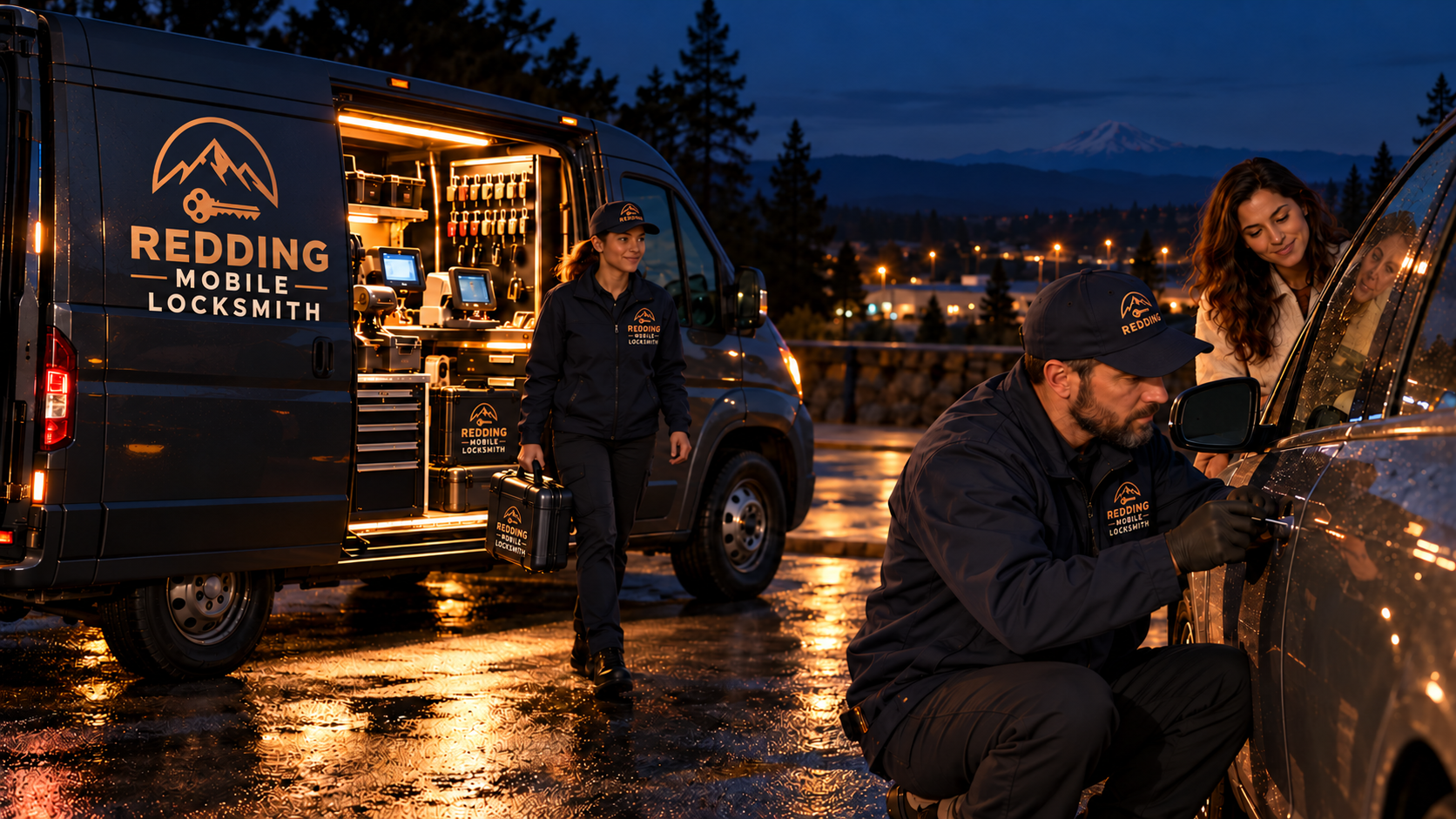
For a planned job, a technician from the branded team comes to the property in the service van. The van carries professional tools, key cutting and programming equipment, and common hardware. They walk the doors with you, test each lock, and note which ones need repair, rekeying or replacement.
You get a plain description of what each door needs and why. You choose what to do now and what to leave for later. Not every door needs the same attention, and a technician who explains this honestly helps you spend effort where it matters.
Expect the technician to test their own work in front of you. A lock that has been repaired or installed should turn smoothly, latch firmly and release without sticking. If something feels off, say so before the van leaves, not the next morning when the shift starts.
For an urgent problem at night, such as a lock that will not secure a building, the same team handles it. See after hours emergency service for how that works. Right now the phone line is coming soon, so use the request form on the contact page to describe the job.
Building a simple access plan
A good access plan fits on one page. List the doors, the hardware on each, the people who need access, and the rules for changing locks. Add the steps you will follow when a key is lost, when an employee leaves, and when a tenant moves out.
Keep the plan where the right people can find it and the wrong people cannot. Look it over every season. Update it when something changes. A plan that sits in a drawer and never changes will slowly stop matching reality.
You do not need to do this alone. A locksmith can help you think through the doors and suggest sensible groupings. For homes and small properties, the Millville rekey page shows how planning a key set works, and the ideas carry over to a business directly.
Finally, decide who is the single point of contact for locks. When one person owns the decision, requests do not collide and records stay tidy. When everyone feels able to change a lock, nobody can say who holds a key to what, and the whole system slowly drifts away from the plan.
Serving Millville and the area around it
Redding Mobile Locksmith serves Millville along with sixteen other communities in Shasta and Siskiyou counties. Nearby places include Palo Cedro, Anderson and Redding.
The Millville coverage page lists every local page for the community. If a night problem involves a house or a vehicle, those are covered there too, including night house lockouts.
Business owners often ask where to begin. Start with the walk, the door list and the key list, then keep them current. Then call for help with the parts that need a professional. That sequence is calm, organized, and protects your business without drama.
Common questions
Where should a small business start with access control?
Start on paper. List every door, the lock on it, and who holds a key. That one page shows where keys are shared too widely, where old keys remain in circulation, and which doors need attention first. Then ask a locksmith to help with the weak points. Doing the paperwork first means the visit is spent on real work instead of guessing.
Should every employee have a key to every door?
Usually not. Give each person only the keys their work requires. A cleaner may need the front door and a supply closet, while a manager might need more. Fewer keys in fewer hands reduces losses and makes it easier to know what to do when a key goes missing.
What happens when a tenant moves out?
The lock on that suite should change so the old key stops working. If the tenant held a key to a shared door, think about that one too. Rules about lock changes and tenant rights vary, so check your agreement and ask a qualified person if you are unsure.
Do I need proof of authority to unlock a business?
Yes, expect to be asked. A technician will want to know that you own the business or are allowed to enter. An employee may need the owner to confirm by phone. This step protects the building and everything inside it. Have an ID ready and, if you can, something that links you to the business, such as a document with the name on it.
Who decides which exit hardware is allowed on a door?
Rules for exit doors and related hardware vary by building and use, and they are set by the authorities that apply to your property. A locksmith can explain how hardware works, but you should confirm requirements with the proper office before you change anything.
How do I request business help while the phone line is coming soon?
Use the request form on the contact page. Describe the doors, the problem, and how the property is laid out. If it is after hours, say whether the building is currently secure and whether anyone is waiting on site.