
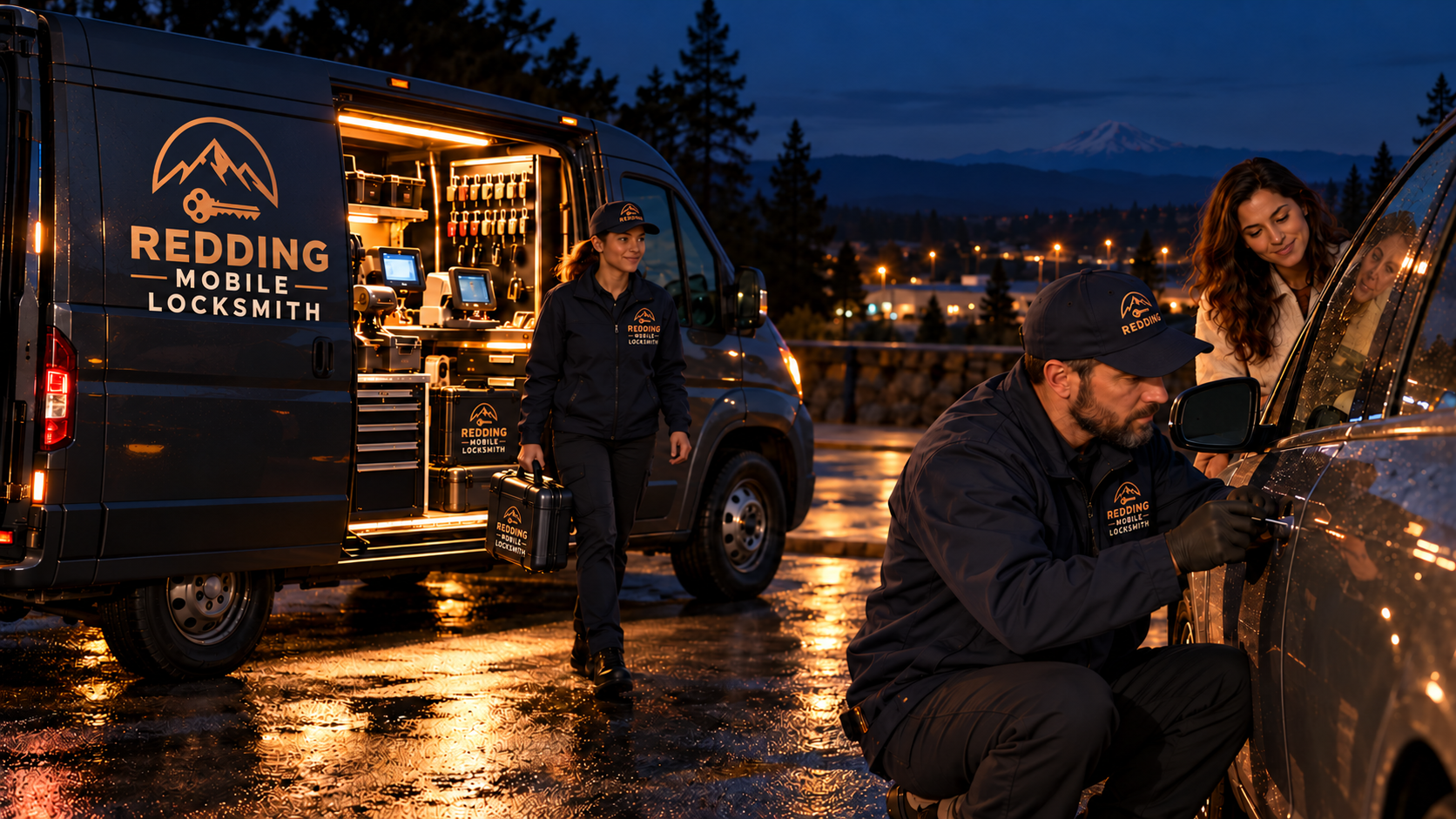
Home / Montague / Night Car Lockout in Montague
Montague car lockouts
Night Car Lockout in Montague, California
Dusk comes early on the edge of the valley, and a locked vehicle is a bigger problem when the light is gone. This page covers car lockouts around Montague for every kind of vehicle, and how to wait safely.
Back at the vehicle as the light fades
Imagine a hiker or an angler walking out of the brush at dusk, boots wet, pack heavy, thinking only of the heater and the road home. The vehicle is where it was left. The door handle is cold. The keys are on the driver's seat, or the console, or in the ignition with the engine off.
It is a small mistake with an outsized effect. The vehicle is a warm, safe place, and it has become a closed box with the means to open it inside. Nothing is broken. Everything is simply on the wrong side of the glass.
A night car lockout is one of the most common reasons people call a locksmith. The service overview is at Night Car Lockout. The wider vehicle picture is at Vehicle Locksmith. This page is about Montague and its surroundings.
The calm response is the same whether the vehicle is a compact car or a work truck. Stop, think, and sort the situation into what is safe and what is not. A cold, tired person makes poor choices, so the first rule is to make yourself comfortable enough to think.
Where lockouts happen around Montague
Montague sits in the Shasta Valley of Siskiyou County, near Yreka. People here park in front of older homes, behind small main street businesses, at field gates, at the edges of farm roads and at pullouts along the routes that lead toward rivers and lakes. Each of these places has its own risks after dark.
In town, a lockout is usually inconvenient. In the agricultural surroundings, it can be isolating. Pullouts and gravel lots have no one nearby and little light. The same lockout can feel completely different depending on where the vehicle sits.
That is why location matters in the request. A vehicle parked at the end of a farm road needs different directions than one on the town street. Name the nearest road, the direction you came from and anything lit that you can see.
Older homes in town often have narrow driveways and street parking. Small shops have a few spaces in front. In both, the lit areas tend to be near buildings, so staying close to a door or a window is sensible. A locked vehicle in town is usually a short wait compared with one far out.
First, make sure the situation is safe
Before anything else, ask whether anyone is inside the vehicle who cannot get out. A child or a pet locked in a vehicle is an emergency. Call emergency services first. Do not wait for a locksmith, do not wait for a better moment, and do not try to solve the problem yourself first. The pages a child inside a locked car and a pet inside a locked vehicle explain why.
If the vehicle is running with keys inside, the engine may keep going. That raises concerns about fuel, exhaust and theft. Read keys locked inside a running car for what to watch. Stay away from the exhaust if the vehicle is in an enclosed space.
If no one is inside and the vehicle is parked in a safe place, you have time to plan. That is the usual case. Treat it calmly.
There is one more reason to be careful. A vehicle left running with the keys inside is a target for theft in any town. If you can see the vehicle from a safe spot, keep it in sight. If you cannot, tell the team that it is unattended, and they will plan accordingly.
A sedan, a truck, a van and an SUV
Vehicles are not all alike when it comes to getting in. A sedan has a low roofline, a flat trunk and four doors that open into a compact cabin. A pickup truck sits higher and often has a sliding rear window, a bed cover and a locking tailgate. A van has side and rear doors and sometimes a sliding door. An SUV has a rear hatch and a taller body.
The lock hardware inside the door varies as well. Some vehicles use rods and levers connected to the door handle. Others use cables. Some doors have thick weather stripping and some have extra shielding. A professional knows how these systems work and what the door will tolerate.
For you, this means a few simple things. Tell the technician what kind of vehicle you have and which door is easiest to reach. Say whether the doors have power locks, whether there is a keypad on the door, and whether a window is cracked open. Do not try to improvise a tool.
Cargo vans and work trucks deserve special mention. They may carry tools, materials or equipment that matter more than the vehicle itself. Tell the team what is inside, since it affects how you feel about a delay and how carefully the vehicle should be watched. Never leave valuables in plain sight, even in a rural place.
Some vehicles have a second lock for a rear cargo area, a bed cover or a topper. A lockout may involve one lock, two, or all of them. Describe which parts are locked and which are not. If the tailgate is open but the cab is locked, that detail may be useful to the technician.
- A sedan is usually opened at a front door with the key left on a seat or console.
- A truck may involve a cab with a rear seat, a sliding window or a tonneau cover over the bed.
- A van can have separate cargo doors, which may lock differently from the cab.
- An SUV can have a rear hatch that locks independently of the doors.
What a professional does in general terms
The technician will first confirm that the vehicle belongs to you. Expect to be asked for your identification and a registration, a title or some other paper that links you to the vehicle. If you have none, say so, and ask what else may be accepted.
Then they look at the door and the lock. A professional uses tools designed for each vehicle type and aims to open the vehicle without scratching paint, bending the door or damaging weather seals. The details of the method are not something this page describes, and a good technician explains the plan before starting.
Once the door is open, they check that the lock and the window still work. They may offer to make a spare if one key is all you have. Then you drive away with your keys in your hand.
Expect a professional to protect the vehicle from harm as part of the job. They use padding, protective covers and careful tools where needed. They avoid shortcuts that could mark the door. They also keep your vehicle's electronics in mind, since many modern vehicles have sensors in the doors.
Why you should not use a hanger or a wedge
Many people have seen a video of a coat hanger opening a door. The truth is less simple. Modern doors have side impact beams, airbags, wiring and electronics in the door panel. A tool pushed in the wrong place can scrape the paint, tear the seal, damage the wiring or trigger a fault.
A forced window is another problem. Tempered glass shatters. Replacing a window costs far more than a lockout call. It also leaves the vehicle open to weather and theft until it is repaired, which is a serious matter on a cold night.
There is a rule of thumb that has served many people: if you would not do it to a vehicle you plan to sell, do not do it to your own in the dark. Wait for a professional.
If a lockout has already involved an attempt with a tool, tell the technician. A bent seal or a dislodged rod changes how the job is done. It is better to say so than to hide it, since the technician can then work around the damage instead of finding it unexpectedly.
Waiting safely at dusk and after
A lockout means waiting. The waiting is where the real risk lies. Pick a safe, lit place. If the vehicle is at a trailhead or a pullout with no light, consider moving to a nearby lit location on foot only if the distance is short and the route is safe. Otherwise, stay and stay visible.
Dress for the weather. In the valley, summer evenings can still be warm, and heat inside a closed vehicle is dangerous. Winter nights are cold, and the wind off open ground cuts through light clothes. Keep a layer on and carry water in summer.
Stay off the road. Do not sit on the pavement or walk along a dark highway. If a stranger stops and offers help, thank them and say help is on the way. See trailhead lockouts for the specific points that apply to remote parking.
If you are alone, consider telling a friend or family member where you are and when you expect to be home. A short message is enough. If you are with a group, keep everyone together and stay in a warm, lit spot. Keep the engine of any running vehicle off in an enclosed space.
Information that makes the visit work
The request should be clear and short. Give the vehicle year, make, model and color if you can. Give your location in plain terms. Say which door or entry you think is easiest. Say whether keys are inside, whether the engine is running and whether anyone else is inside.
Also say whether you have a second key at home. If a family member can bring it, that may end the problem without any tool at all, as long as the trip is practical. Do not assume. Mention it in the request and let the team help you decide.
Be reachable. Keep your phone on and charged. If the signal is weak where you are, say so in the request, and give an alternate way to reach you. A good dispatcher will plan around it.
Mention anything that might change how the technician approaches the vehicle: a dog in the back seat, a trailer hitched on, a cover over the bed, a locked gate in front of a farm road. Small details can save time and trouble when the van arrives in the dark.
- Vehicle year, make, model and color.
- Where the vehicle is, in plain words, with the nearest road.
- Whether keys are inside, and whether the engine is running.
- Whether anyone or any animal is inside.
- Whether you have a spare key and who has it.
When the key is lost, not just locked in
Not every lockout is a locked in key. Sometimes the key is missing altogether. Then the problem is two problems: getting in and getting a way to start the vehicle. The second one is the key replacement job, covered at Vehicle Key Replacement in Montague.
Tell the dispatcher at the start. The technician will plan for both tasks and bring what is needed for each. This avoids a second visit and a second night.
If you have a spare at home but not with you, say that too. It changes the plan, and sometimes the right answer is to open the vehicle first and deal with the spare later.
If the key is lost in a place where someone else could find it, tell the team. The lost key may be able to be removed from the vehicle's memory once a new one is made, so that it can no longer start the vehicle. That step is a decision to make with the technician, not alone in the dark.
After you are back in the vehicle
Check that everything works. Lock and unlock each door. Open and close the windows you touched. Start the vehicle. If the technician opened it in a particular way, ask whether anything needs to be watched in the next few days.
Then address the cause. If you locked the keys inside once, you may do it again. Move a spare to a safe place, like a wallet or a bag you carry with you, not inside the vehicle. A magnet box hidden under the bumper is a poor choice because thieves know to look there.
Consider a habit: pat your pocket for the keys before every door closes. It sounds like a joke and it prevents more lockouts than any gadget.
Think about keys in general. Do you have a spare at home? Do you have a second one for work trucks? Should the farm vehicles share a key system? These questions are easier to answer in daylight, and the team can help you plan once the lockout is behind you.
Asking for help near Montague
The phone line is coming soon. For now, use the request form: send a request. Include the vehicle, the place and what happened. If the situation is also a house or business problem, see After Hours Emergency in Montague.
For the surrounding area, see the Montague page, Yreka and Granada. These neighbors are served by the same 24 hour mobile service.
If anyone is in danger or in a vehicle that is overheating or freezing, call emergency services first. That rule does not change.
Common questions
What do I do first if my keys are locked in my vehicle near Montague?
Make sure no child, pet or person is inside. If there is, call emergency services first. If not, move to a safe lit place, gather your registration and identification, and send a request with the vehicle details, your location and whether the engine is running.
Does the type of vehicle change how a lockout is handled?
Yes. Sedans, trucks, vans and SUVs have different doors, locks, windows and rear access. Tell the team what you drive and which door is easiest to reach. A professional uses tools and methods suited to the vehicle to avoid damage.
Can I use a hanger or a wedge to open my own door?
It is not a good idea. Modern doors contain wiring, airbags, beams and seals that can be damaged by a tool pushed in the wrong place. A forced window can shatter. A professional lockout is usually far less costly than the repairs that follow a failed attempt.
What proof will I need to show for a car lockout?
Expect to show identification and something that links you to the vehicle, such as a registration, title or insurance paper. What is accepted can vary. If you have nothing with you, say so in your request and ask what else may work.
What if my engine is still running with the keys inside?
Stay out of any enclosed space where exhaust can collect, and tell the team the engine is running. Fuel use and security are both concerns. If anyone is inside or ill, call emergency services first and do not wait for a locksmith.
I lost my key completely. Is that the same service?
It is two jobs: opening the vehicle and making a new key. Tell the team at the start so the right equipment arrives. Key replacement involves cutting and programming, and you will be asked to prove the vehicle is yours before work begins.