
What rekeying really means
Rekeying is a change on the inside of a lock. The lock stays on the door, the bolt stays in the frame and the hardware looks the same. What changes is the arrangement of small parts inside the cylinder, so that a different key turns it. The old key still goes in, but it no longer turns.
Imagine a caregiver visiting a relative in Redding. The relative has lived in the house for decades, and over that time the keys have been handed to neighbors, helpers, nurses, a former housekeeper and a family friend. No one is sure how many copies exist. This is a hypothetical picture, but it is one of the most common reasons to rekey. The question is not whether anyone is untrustworthy. It is whether anyone should still have access.
Rekeying answers that question without replacing hardware. For many households, it is the simplest way to reset who can come and go.
Think of it as changing the secret without changing the door. A house in Redding may have a solid front door, a rear slider, a garage entry and a side gate. If you replaced every lock, you would face a pile of hardware, fresh holes and mismatched finishes. If you rekey, the finishes stay, the handles stay and only the secret changes.
This matters most for people who are not at home all the time. A caregiver who splits days between two households does not want to learn a new set of locks on each visit. Rekeying keeps the feel of the door the same while making it safer.
How a pin tumbler lock is built
Most house locks and many car and padlock cylinders are pin tumbler locks. Inside the cylinder is a row of small spring loaded pin stacks. Each stack has a bottom pin that touches the key and a top pin that is pushed down by a spring. When the right key goes in, its cuts lift each stack to exactly the height where the split between the pins lines up with the edge of the cylinder.
When every split is lined up, the cylinder can turn. That turning motion retracts the bolt or latch. If one pin sits too high or too low, the cylinder is blocked.
To rekey, a technician removes the cylinder, takes out the pins and replaces them with pins of different sizes that match a new key. The cylinder goes back into the lock, and the new key works. Nothing else about the door changes. This is why the process is gentle on your home and tidy to carry out.
Why do the pins have different sizes? Because the key's cuts have different depths. A deep cut lets a pin drop lower, and a shallow cut holds it higher. A technician picks pins that fit the pattern of the new key, much as a tailor cuts cloth to a pattern.
The pins are small, and the springs are delicate, so this is work for a trained person with the right tools. A cylinder taken apart on a kitchen table often loses a pin in the carpet. A professional works on a clean mat with a tray, and keeps each part in order. That care is part of what you pay for.
When rekeying is the right choice
Rekeying fits many situations. Here are the most common ones.
In each of these cases, the lock itself is fine. The risk is the unknown key. Rekeying costs less in time and disruption than replacing every lock, and it works with the hardware you already have. Our service page on rekey locks gives the wider view of the process.
If the lock is damaged, loose or worn out, rekeying may not be enough. A technician can look at the hardware and say whether it is worth keeping.
There is another reason that people rarely mention: peace of mind. Even if no one has misused a key, not knowing who holds a copy can make you uneasy. Rekeying turns that unknown into a clear number. You know how many keys exist because you received them.
A caregiver, an elderly relative or a family that has been through a hard season often feels that relief most. If you are making arrangements for someone else, such as a parent who lives alone, tell the dispatcher so that the technician can explain the changes clearly to the person who lives there.
- You bought or rented a home and do not know who holds keys.
- A key was lost and you cannot tell where it ended up.
- A roommate, tenant, employee or caregiver no longer needs access.
- You want several locks on the property to use one key.
- A relationship ended and the former partner still has a key.
When replacement makes more sense
Sometimes a lock should be replaced. If the cylinder is badly worn, if parts are bent or missing, or if the lock does not meet the level of security you want, replacing it is the sensible step. A technician will tell you honestly which situation you face.
Replacement also makes sense when you want a different style, a keypad, or a smart feature. It makes sense when a lock has been forced and cannot be trusted. It may make sense on an older door whose latch no longer lines up with the strike.
Our page about installing new locks describes how that work goes, and the page on broken lock repair covers cases where a lock is damaged. Ask the technician to explain both paths, so that you can decide with full information.
Think about the door as a whole. A lock is only as strong as the frame and the strike that hold it. A short strike screw, a split jamb or a loose hinge can defeat a strong cylinder. A technician who looks at the door may point out small improvements that cost little and add strength.
If you are considering a smart lock or keypad, ask about battery life, backup keys and how codes are managed. These locks suit many households, but they trade a mechanical secret for an electronic one. Make sure you understand the difference before you commit.
What the visit looks like
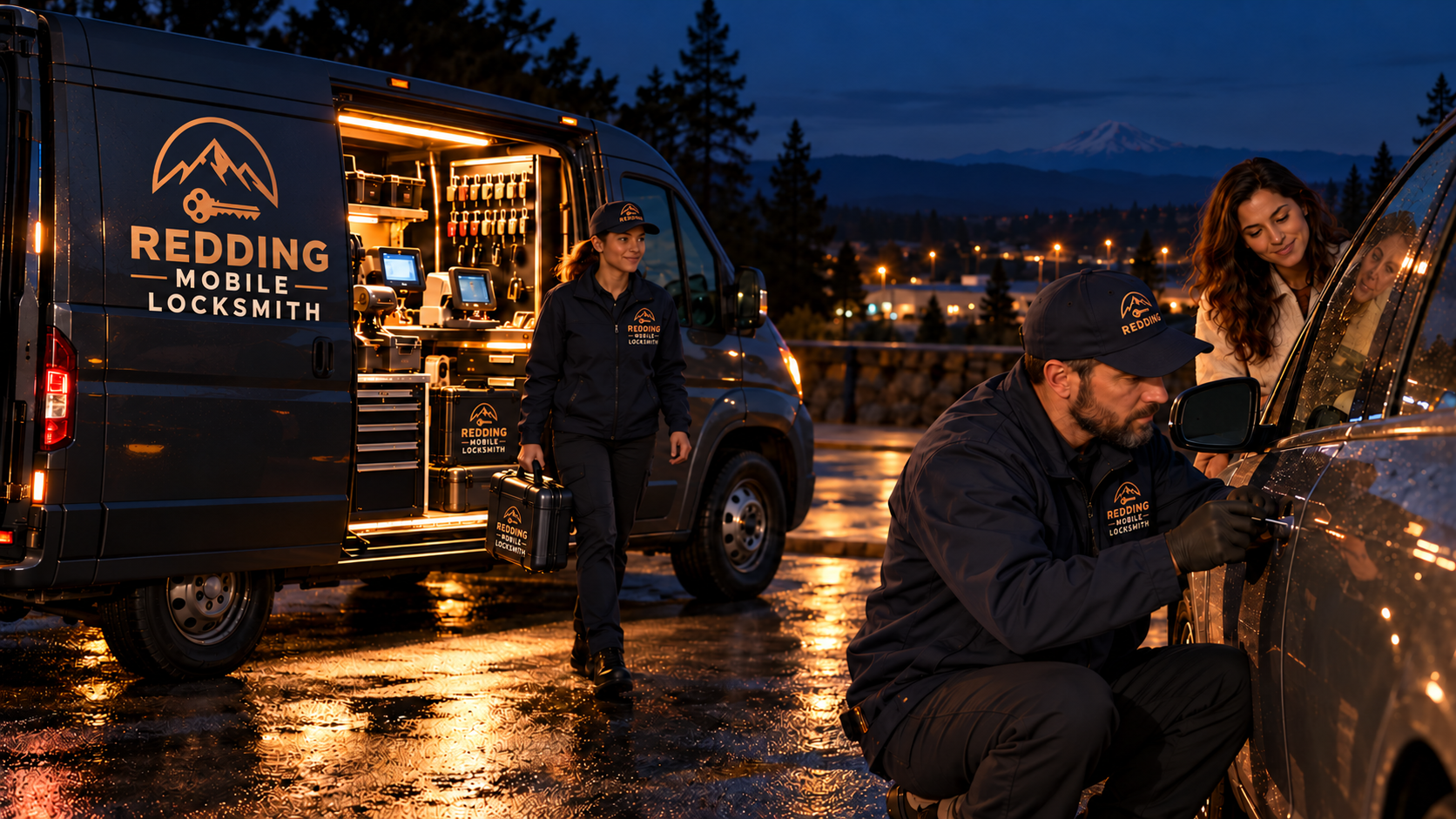
A mobile technician arrives in a branded service van with a uniform and tools. After confirming who you are and that you have the right to change the locks, the technician looks at each lock you want rekeyed. They note the brand type in generic terms, such as a deadbolt or a knob set, and check that the cylinders can be rekeyed.
Then the work begins. Each cylinder is taken out of its lock, the pins are changed, and the cylinder is tested with the new key before it is put back. When every lock is done, the technician tests each one again from outside and inside. You receive new keys, and the old keys are now useless for those locks.
Expect to be asked a few questions. How many locks? Which doors? How many keys do you want? Would you like all locks to work with one key? Think about these ahead of time to make the visit smooth.
Plan to be present, with all doors accessible. Move furniture that blocks a door, and let pets and family know that a stranger is working at the entrances. Keep the old keys together so the technician can test them after the work and show that they no longer turn.
After the visit, label the new keys in a way that does not reveal the address. Give the extra keys to the people who need them, and write down who received each one. If a copy leaves your control, you will know where to start looking.
One key for many doors
Carrying six keys for six doors is a nuisance. Rekeying lets a technician set all locks on a property to use a single key. That is called keying alike. It makes daily life easier, and it makes it easier to track who has access.
Keep in mind the tradeoff. If one key opens everything, losing that key exposes everything. For a home, this is usually acceptable. For a property with a separate rental unit or a workshop, you might prefer to keep some locks on a separate key.
Our guide on managing keys for a shared family vehicle shows a similar idea for cars. For homes, the habit is the same: keep a simple list of who has which key.
Another option is a master key system, in which a master key opens several locks that each have their own key. This is more common in buildings with many units or many staff, and it needs careful planning. For a household, it is rarely necessary.
If you have an outbuilding, a shed or a workshop, think about whether it should share the same key as the house. A shared key is convenient, but it also means a tool borrowed by a contractor could expose the house. Separate keys for separate risks is a sensible habit.
Rekeying after a move, a loss or a change of people
The moment right after you take possession of a home is the ideal moment to rekey. You do not know who holds old keys, and you have not yet settled into the space. A same visit rekey gives you a clean start.
A lost key is the second most common trigger. If the key was found in your own driveway, you may not need to do anything. If it vanished somewhere unknown and had an address or a clue attached, rekey. Our guide on stolen keys, steps to protect your vehicle lists steps that also apply at home.
Landlords and property managers rekey between tenants as a matter of routine. Rules vary on who must pay and who must be notified, so ask what applies in your situation. A tenant should talk to the landlord before changing any lock.
When people move out of a shared home, the same logic applies. Roommates leave, partners separate and adult children move away. Each of them may keep a key out of habit. A rekey does not accuse anyone. It simply returns control of the home to the people who live there now.
Redding has many rentals and many homes that change hands. Hot dry summers and mild wet winters tend to bring waves of moving, and many people take the chance to refresh their locks. If you are among them, plan the rekey for the day you take possession.
Safety, honesty and what a technician will ask
Rekeying a lock is a security matter, so the technician will ask for proof that you live at the property or have the right to change the locks. Expect to show identification and some connection to the address. This protects you, and it protects the previous occupant or owner.
A good technician also explains what is being done. They show you the old pins, describe the new setup and make sure every key you receive works. They do not pressure you into extra work. If an upgrade makes sense, they explain why and let you decide.
Our guide on why a locksmith may ask for identification covers the reasoning in more depth. If you want to check who is at your door, see confirming who is arriving at your door.
Be wary of anyone who offers to rekey a lock without asking a single question. A professional who cares about security asks who you are, what you own or rent and why you want the work done. Those questions may seem like a delay, but they reflect the same care that will protect your home.
When the work is finished, test each lock yourself. Turn the key several times in each lock, from the outside, with the door open and then closed. Check that the bolt extends and retracts smoothly. If something feels wrong, say so before the technician leaves.
Other Redding pages and nearby cities
If a lockout is your problem tonight, see a night house lockout in Redding. For vehicles, read vehicle key replacement in Redding. For a shop or office, see business security in Redding.
The Redding area page gathers all of these, and the pages for Anderson and Shasta Lake cover nearby places. Our home locksmith page describes the full range of residential work.
You may also want to read the guide on a bedtime lock check routine, which describes a simple way to notice loose or worn locks before they cause a problem. Our guide on rear and side doors explains why the doors people forget are often the ones that matter.
How to ask for rekeying
The phone line is coming soon, so use the request form. Tell us how many locks you want rekeyed, whether they are deadbolts, knob sets or lever handles, and whether you want them keyed alike. Mention any lock that sticks or feels loose.
If the work is not an emergency, say so. A planned rekey can be scheduled with less strain than a night call. If it is an emergency, such as a key stolen or a former partner with access, say that too. The dispatcher will treat the safety side as the priority.
Have your identification ready, and decide how many new keys you want. A spare for a trusted person, a spare in a safe place and a main key are a good starting count.
Think about timing and flexibility. If you are available in the evening, say so. If you can be flexible about the day, that may help the dispatcher fit the visit into the schedule. A calm message with the right details is easier to act on than a hurried one.
After the visit, keep a short record: the date, which locks were rekeyed and who holds the keys. Store it somewhere private. If you ever sell the house or hand it to a new tenant, that record will be useful.
Common questions
What is the difference between rekeying and changing locks?
Rekeying changes the inside of the existing lock so a new key works and old keys do not. Changing the lock replaces the hardware. Rekeying keeps the same lock on the door, usually with less disruption. Replacement suits damaged, worn or outdated locks, or when you want a different style.
Will my old keys still work after rekeying?
No. The old keys will still fit into the keyway but will no longer turn the cylinder. That is the purpose of rekeying. Collect any old keys you do not need and keep them separate, so they do not get mixed up with the new ones.
Can all my locks be set to one key?
Often yes. Rekeying can set several locks to the same key, which is called keying alike. It makes a ring lighter and a key list shorter. Some locks, such as certain padlocks or specialty hardware, may not be compatible, and the technician will tell you.
Do I have to prove I live there?
Yes, expect to. A responsible locksmith will ask for identification and a link to the address, such as a lease or utility bill. This protects both you and the former occupants. If you have nothing handy, tell the dispatcher and ask what alternatives exist.
How long do I have to wait after calling?
We do not make time promises, because they depend on location, traffic and other calls. The dispatcher will give you a realistic plan when you describe where you are and what you need. For a planned rekey, you can choose a time that suits you.
Can a lock that is stuck or broken still be rekeyed?
Sometimes. A technician checks the cylinder first. If the lock is damaged or the cylinder will not come out, repair or replacement may be needed instead. The technician will explain the reason and let you choose before any work begins.