
Home / Redding / Night House Lockout in Redding
Redding, house lockout
Night House Lockout in Redding Without Damage
Getting back into a house at night is mostly about doing things in a sensible order. This page lays out that order for Redding homes, from the first calm check to the moment a technician starts work on the door.
Stop and take stock before you touch the door
Standing outside a locked house at night makes people want to act. Resist that for one minute. Look at the door, look at the lights and look at your phone. Ask yourself a short list of questions. Is anyone inside? Is the lock turning but not catching? Did the key work yesterday? Is the problem the door or the key?
Picture a seasonal cabin owner arriving after weeks away. It is late, the drive was long and the porch is dark. The key goes in, but the deadbolt will not turn. This is a hypothetical picture, but it matches what happens when a lock sits unused. Dust, a dry cylinder, a swollen door frame or a worn key can all mimic a lockout.
In Redding, the range of homes is wide. There are older houses with original hardware, newer subdivisions with modern deadbolts and smart locks, and everything in between. The right approach depends on the door in front of you, which is why the first look matters.
Look closely at the lock before you decide anything. Is the deadbolt thrown, or is only the latch holding the door? Can you see light inside, or hear a television or a pet? If someone is inside and does not answer, that is a different situation, and it may call for emergency services rather than a locksmith. When you suspect someone is hurt or in danger, call emergency services first.
If you are alone and nothing seems wrong inside, move on to the next step with a clear head. Write down the address, the door you are at and any detail that stands out, such as a porch light that is out or a gate that is shut. These notes make the call to a dispatcher smooth.
The sensible order of options
Here is the order we recommend. It starts with the least costly and least risky choice and moves toward professional help.
Notice what is not on that list. Credit cards, screwdrivers and kicking the door are not good options. They damage frames, strike plates and doors, and they turn a lockout into a repair. A professional visit costs less in effort than a broken jamb on a cold night.
Why this order? Because each step is reversible until the last one. Checking other doors changes nothing. Asking a neighbor changes nothing. Trying the key again changes nothing if you use gentle pressure. Calling a locksmith is the first step that brings in specialized tools, and it is still gentle on the door.
Forced entry, by contrast, cannot be undone. A kicked door can crack a frame that cannot be repaired without a carpenter. Broken glass leaves an open hole in a house at night, in the dark, where you may be hunting for tape and cardboard. For most people, the sensible order saves both money and a cold hour.
- Check every other door, including a side door, garage entry and sliding door, in case one was left unlocked.
- Ask a household member, a neighbor or a trusted person with a spare key whether they can reach you.
- Check the key itself: look for bends, wear and the right orientation.
- Try the lock gently once more with steady pressure, without forcing it.
- Call a locksmith before you consider breaking glass, prying a frame or removing hinges.
What entry without damage means
When we say entry without damage, we mean the door, the frame, the strike and the lock all work the same afterward. A trained technician uses purpose built tools and an understanding of how the lock is made. We will not describe methods here, because that information can help a burglar more than a homeowner.
What we can say is that most residential locks are designed around a latch, a deadbolt and a cylinder. The latch holds the door closed in its frame. The deadbolt slides a solid bar into the frame for extra strength. The cylinder is the part that your key turns. A professional works with those parts rather than against them.
Sometimes a door cannot be opened without replacing a lock, for example when the lock is already broken or the key snapped inside. In that case the technician will explain the reason and show you the options. Our page on a night house lockout describes the general process, and the home locksmith service page covers the wider work done at houses.
Doors differ in construction. A solid wood door in an older Redding home responds differently from a hollow door in a newer subdivision or a steel door on a garage entry. Frames also vary: some are thick hardwood and some are thin finger jointed strips. A technician reads these details and chooses an approach that fits.
If a lock must be removed or replaced, the technician can often match the hole pattern on the door, so no new drilling is needed. That keeps the door looking the same. You can ask for the old lock back if you want it, and you can ask what the replacement hardware is made of.
Proving that the house is yours
A responsible locksmith will ask you to show that you live at the address or have the right to enter. This is not a hassle. It protects you and your neighbors from someone who might try to get into a home that is not theirs.
Typical items include a driver license with the address, a utility bill, a lease, a piece of mail or a photo of you with the property. If you have none of these in hand, say so, and the dispatcher can talk through other ways to confirm. For a seasonal cabin, a property tax document or a rental agreement on your phone can serve.
Our guide on why a locksmith may ask for identification explains the reasoning. Rules for rentals and shared properties vary, so ask your landlord or property manager what applies. For a late night apartment problem, read our guide on a late night apartment lockout, which puts management first.
Do not be offended if the technician checks identification more than once. It shows that the company takes security seriously. If you are a tenant, the landlord or property manager may need to approve work on the lock, and rules vary. Ask what applies to your lease before work begins.
If you are at a house you do not own, such as a friend's home or a relative's property, call the owner and ask them to confirm by phone. Owners can also share a photo of a document. It is far better to wait a little for proper confirmation than to open a door for the wrong person.
Weather and the Redding climate
Redding has hot dry summers and mild wet winters. In summer, a locked house at night can still be a warm place to wait, and the heat of the day may linger. In winter, rain turns a porch into a cold, damp spot. Neither is a reason to hurry a bad decision, but both are reasons to find shelter if you will be waiting.
A car, a covered porch or a nearby open business are all fine places to wait. If you have children or an elderly relative with you, make shelter the first priority. Our guides on being locked out with children and an elderly relative locked out at night cover those cases.
Keep your phone charged and your battery saver on. If the signal is weak at your door, step to a spot where it is stronger. A dispatcher will often ask for a callback number, so confirm that yours is reachable.
Rain on a porch also affects the tools and the lock itself. Moisture can swell a wooden door and make a latch stiff. Heat can make metal expand slightly and make a key feel snug. These small effects are often the reason a key that worked yesterday feels wrong today.
Let the technician know about weather related symptoms. If the door sticks in the frame during damp weeks, a plane or an adjustment to the hinges may help over time. A locksmith can point out when the issue is the door rather than the lock, even if the fix belongs to a carpenter.
Seasonal cabins and houses left empty
Houses that sit empty for weeks are more likely to produce lockouts. Locks stiffen, door frames shift with the seasons and keys wear. A seasonal property in the hills near Redding may also have a gate, a long driveway or a storage building with its own lock. Tell the dispatcher about every barrier between the road and the door.
Before you leave an empty house, consider making a spare and leaving it with someone you trust. Test the lock from outside, with the door open and then closed. If the key feels rough or the bolt seems stiff, mention it to a technician before the next trip. A small repair now prevents a lockout later.
Our guides on a bedtime lock check routine and deadbolts and door frames at night explain what a healthy lock feels like and how to notice problems early.
Think about what an empty house needs before the next visit. A lock that is gently cleaned and tested keeps working far longer than one that is ignored. Avoid oily lubricants in a cylinder, since they can gather dust and gum up the pins. A dry graphite based product is more common advice, and a technician can tell you what suits your lock.
If you hold several keys on one ring and the ring is heavy, consider removing keys you do not need. A heavy ring wears the ignition and door cylinders sooner. Label keys, but never write the address on a tag, since a lost ring becomes much more dangerous when it carries an address.
Smart locks, keypads and dead batteries
Many Redding homes now use keypad deadbolts or smart locks. These are convenient, but they bring a few new failure points. A keypad lock can run out of battery. A smart lock can lose its connection to your phone. A code can be forgotten or changed by someone else in the household.
Most electronic locks include a backup, such as a mechanical key cylinder or a way to power the lock from outside for a moment. If you know where yours is, try it. If the backup was never used or the key is lost, call for help and describe the lock as clearly as you can. A photo of the lock on your phone can help a dispatcher understand what you have.
Our service page on installing new locks explains how electronic and mechanical locks compare, in case you decide to change what you have after a lockout.
Change batteries on a regular schedule, not only when the lock complains. Keep a spare set in a place you can reach. If your lock sends alerts to a phone, make sure those alerts go to someone who will see them.
Be careful about sharing codes. A code given to a friend for one visit can stay active for years if no one removes it. After any lockout, a good habit is to go over who has access and to remove anyone who does not need it.
After you are back inside
Once the door is open, take a few more minutes. Test the lock several times with the key. Check that the deadbolt extends fully and retracts smoothly. If anything feels wrong, say so before the technician leaves.
Ask yourself whether the lockout revealed a larger problem. If a key was lost, consider rekeying so the old key stops working. Our page on rekeying locks in Redding explains how that works. If the lock was damaged, a repair or replacement may be sensible, and the technician can tell you which.
Make a spare key and leave it with someone you trust, or place it where it is hard to find. Update any codes on electronic locks. A short note about what happened and what you changed makes the next problem easier.
Take one more step that most people skip: look at the door frame and the strike plate. A loose strike or short screws can weaken the whole door. A technician can often tighten or replace these parts while the van is there. Longer screws in the strike reach the framing behind the jamb and add real strength.
Think about lighting too. A well lit entry helps you see the keyhole, and it helps neighbors notice anything unusual. Our guide on well lit entries and motion lights explains how lighting supports the lock.
Other Redding pages and nearby towns
If your problem is actually your vehicle, the page on a night car lockout in Redding covers it. For a lost key, see vehicle key replacement in Redding. If you run a shop or office, see business security in Redding.
The main Redding area page brings all of these together. If you live to the south or toward the lake, you may find the pages for Anderson and Shasta Lake useful as well. Our guide on being locked out of your home late at night adds a general plan for any house.
You can also read the broader after hours emergency service page to understand how a night call is organized. Our page for an after hours emergency in Redding covers the situation when you are not sure what kind of help you need.
How to ask for help tonight
Phone contact is coming soon, so use the request form for now. Give your address or the closest cross street, the type of door, the type of lock and whether anyone is inside. Mention children, elderly relatives or pets, and say if you are waiting somewhere safe.
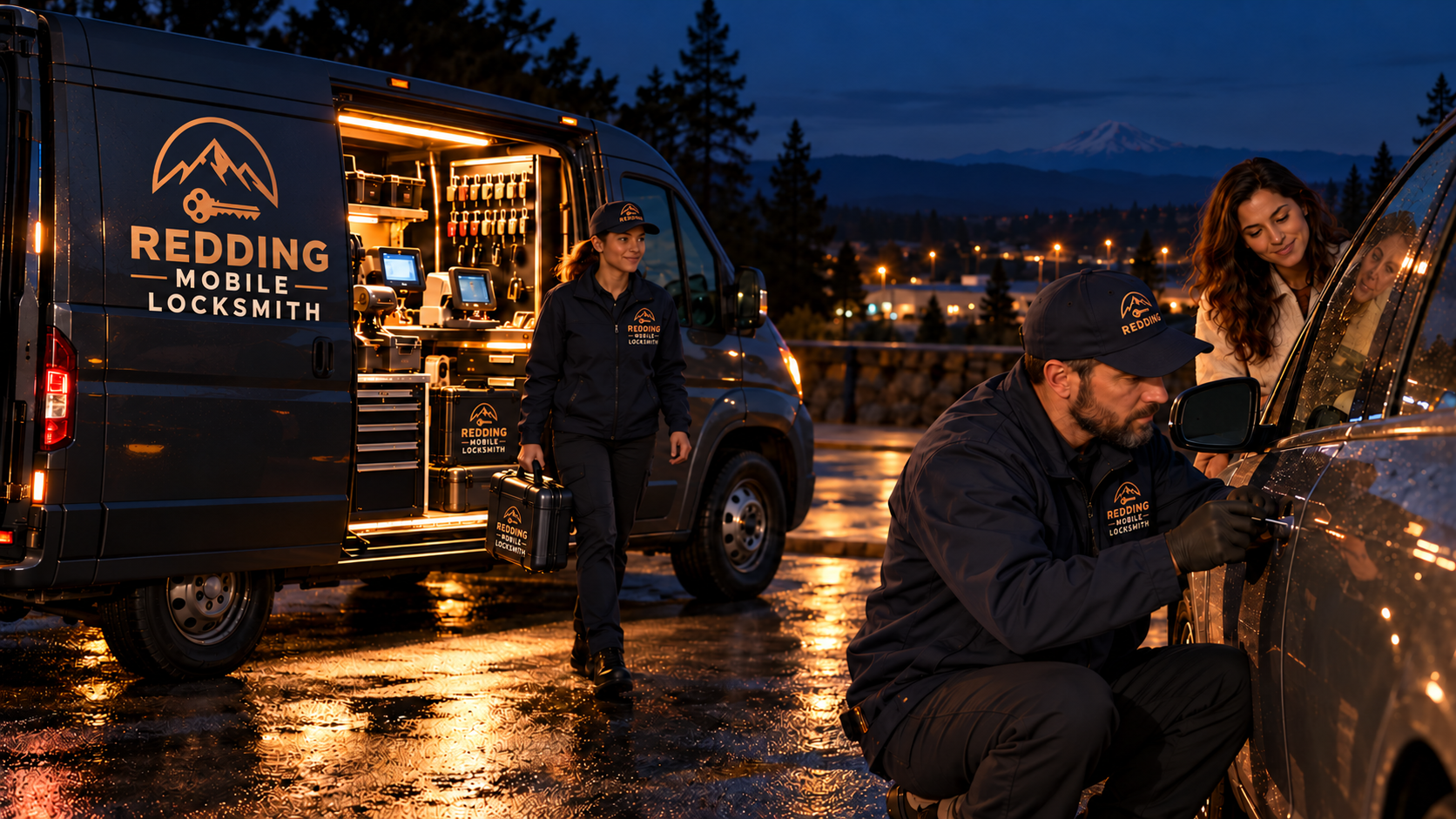
When the van arrives, expect a uniformed team member and a branded vehicle. Ask to see identification, and check that the person matches what the dispatcher described. Our guide on confirming who is arriving at your door gives you a short list of things to check.
Stay calm, stay warm and stay in a place where you can be reached. The goal tonight is a door that opens, a lock that works and a house you can sleep in.
Common questions
What is the first thing to do if I am locked out of my house in Redding?
Pause and check for another unlocked door, such as a side door, garage entry or slider. Ask whether anyone with a spare key can reach you. Do not break glass or force the frame. If those steps fail, call a locksmith and describe the door and lock.
Will a locksmith damage my door when opening it?
The aim is to open the door so that the frame, strike and lock work the same afterward. A trained technician uses purpose built tools and works with the lock rather than against it. Damage comes mostly from prying, kicking or breaking glass, which we advise against.
What proof will I need to show that I live there?
Usually a driver license with the address, a utility bill, a lease or other mail will do. For a seasonal cabin, a property document or rental agreement can serve. If you have nothing in hand, tell the dispatcher and ask what other options exist.
Can you help if my keypad or smart lock has stopped working?
Often yes. Many electronic locks have a mechanical key or a backup power point. If you do not know where yours is, send a photo of the lock and describe what it does when you touch it. The technician can then decide what to bring.
Should I rekey the locks after I lose a house key?
Rekeying is a sensible step when a key is lost and you cannot be sure where it went. It changes the inside of the lock so the old key stops working, while the lock stays on the door. A technician can advise whether rekeying or replacement fits.
How do I reach you if the phone line is not live?
The phone line is coming soon. Use the request form on the contact page and give your address, door type, lock type and a callback number. Keep your phone charged, and answer calls from unknown numbers in case the dispatcher needs a detail.