
Home / Shasta Lake / After Hours Emergency in Shasta Lake
Emergency, Shasta Lake
The First Ten Minutes of a Night Lockout in Shasta Lake
The first ten minutes decide how a lockout ends. This page gives Shasta Lake residents and visitors a calm sequence: what to check, what to avoid and what to prepare before the technician reaches you.
Minute one: stop and look around
Stand still for a moment. Your first job is to notice your surroundings, not to solve the lock. Look at where you are, who is near you and whether the place is safe to wait. A lit entrance is better than a dark side yard. A car with the doors locked is better than the roadside.
Picture a caregiver who drives to Shasta Lake in the evening to visit a relative. The relative is resting, the porch light is off, and the caregiver steps out to the car for something and hears the door click behind them. Their phone, their keys and the spare are all inside. It is a quiet street and the caregiver feels the old pull to do something right now.
That pull is understandable. A locked door at night feels like a deadline, and the mind reaches for a hand on the handle, a push on the window, a call to anyone at all. Most of those moves make the evening longer. The sequence below slows the first ten minutes down on purpose, so that each step is one you chose.
Resist that pull. A calm start is the most useful tool you have. Say to yourself what is true: the door is locked, the people inside are either safe or need help, and a trained person can open the lock. Everything after this line depends on that clear head.
Minute two: ask who is inside
The most important question is whether anyone inside is in danger. A baby, a young child, a person who has fallen, a person who is ill or a pet in a hot room all change the call. If anyone inside cannot manage alone, call emergency services first and let them guide you. A locksmith is never the first call in that case.
If the people inside are safe and awake, try to reach them. Knock firmly but calmly. Call the home phone or a mobile number if you can. A relative may be able to unlock from inside in seconds. This is the simplest solution and it is often overlooked in the stress of the moment.
If nobody answers, think about why. Are they asleep? Did they step out? Is the phone silent? Do not assume the worst, and do not assume nothing is wrong. If you are worried about a person's wellbeing, say so to the emergency line and let responders decide.
Minute three: check the simple options
Walk to every door you may legally use, one at a time. Test the front, the side, the garage entry and the back. Many lockouts end at the second door. Do not climb fences or reach through windows, and do not break glass. A broken window is a bigger problem than the original lockout.
Check your own pockets, bag and vehicle again. Look at the ground near the door and under the mat. People often drop keys near a car, in a planter, or on the seat. If the vehicle is locked with the keys inside, treat that as a second problem and read night car lockouts.
Think about who else holds a key. A relative, a neighbor, a landlord or a property manager may be a short call away. If someone can bring a key, ask them. If they cannot, you have your answer and can move on to a locksmith without second guessing.
- Knock, then call the people inside if you can reach them.
- Test every door you are allowed to use.
- Recheck pockets, bags and the car for the key.
- Call anyone who holds a spare.
- Stay off roofs, fences and broken glass.
Minute four: choose a safe place to wait
Shasta Lake is a lake town. Evenings can be cool near the water, and the air moves after dark. Dress for the wait, not for the walk. If you left a jacket in the car and the car is open, get it. If it is not, move to a spot out of the wind.
Pick a place with light, with a view of the street and with your back to a wall. A lit porch, a neighbor's entrance or the inside of your own locked car all work. Avoid standing in a dark yard or on a road shoulder. Keep your phone in your hand and keep the screen bright enough to see who calls.
Tell one person where you are. A short message is enough: I am locked out, I am at this address, I am waiting for a locksmith. If you are alone, that message is a small safety net. It also gives someone a reason to check on you if the phone goes silent.
Minute five: describe the situation to the dispatcher
Open the request form on the contact page while you wait, and use the details below. Give the street and the nearest cross street. Say which door you are at. Name any gate, long driveway, dog or dark stretch that the technician should expect. Shasta Lake has family homes and rental housing, and house numbers can be hard to see at night.
Describe the lock. A deadbolt, a knob, a lever, a keypad and a sliding door each need different preparation. Say whether the key never went in, or went in and would not turn. Say whether the door feels locked or stuck. A clear picture lets the technician choose what to bring in the van.
Mention anything that affects safety or urgency. A baby inside, a stove left on, a person who relies on medicine inside the home, or a cold night in the open are all things the dispatcher needs to know. Do not hold back out of embarrassment. These details change how the call is handled.
Keep your answers short and concrete. A sentence like: I am at the side door, the deadbolt is thrown, my key is inside, and I am waiting under the porch light. That one line tells the dispatcher where you are, what lock is involved and that you are safe for now. It saves several rounds of questions.
Minutes six and seven: have your proof ready
A responsible technician will want to know you have the right to enter. Gather what you can. A driver license, a piece of mail, a lease, or a text from the person who lives there can all help. If you are visiting, you may not have an address on your ID. That is fine if you can reach the resident to confirm.
This is why the caregiver in our example should call the relative or another family member. A short confirmation from the person who lives there answers most questions. If the relative cannot be reached, the caregiver can show a photo, a message thread or a call history that connects them to the home.
Proof rules vary by technician and by situation, so ask what will be needed. See why a locksmith may ask for identification for the thinking behind it. The aim is not to make your night harder. The aim is to avoid opening a door for the wrong person.
If the proof you have is thin, say so without apology. Explain the situation in plain words, answer the technician's questions and let them decide. Honest answers are easy to follow, and a calm explanation carries more weight than a pile of cards. Never offer a document that is not yours.
Minutes eight and nine: avoid what makes it worse
Do not force the door. Kicking, shoulder charging and prying bend the frame and break the strike. A damaged frame can cost more than the lock, and it leaves the home unsecured. A trained person usually opens a working lock without any damage at all.
Do not use tools from the car or the garage on the lock. Screwdrivers, hangers and knives bend the parts inside and turn a simple job into a repair. Do not spray anything into the lock hoping it will help. Oil and lubricant can gum up a mechanism, and a lock that has been sprayed may behave unpredictably.
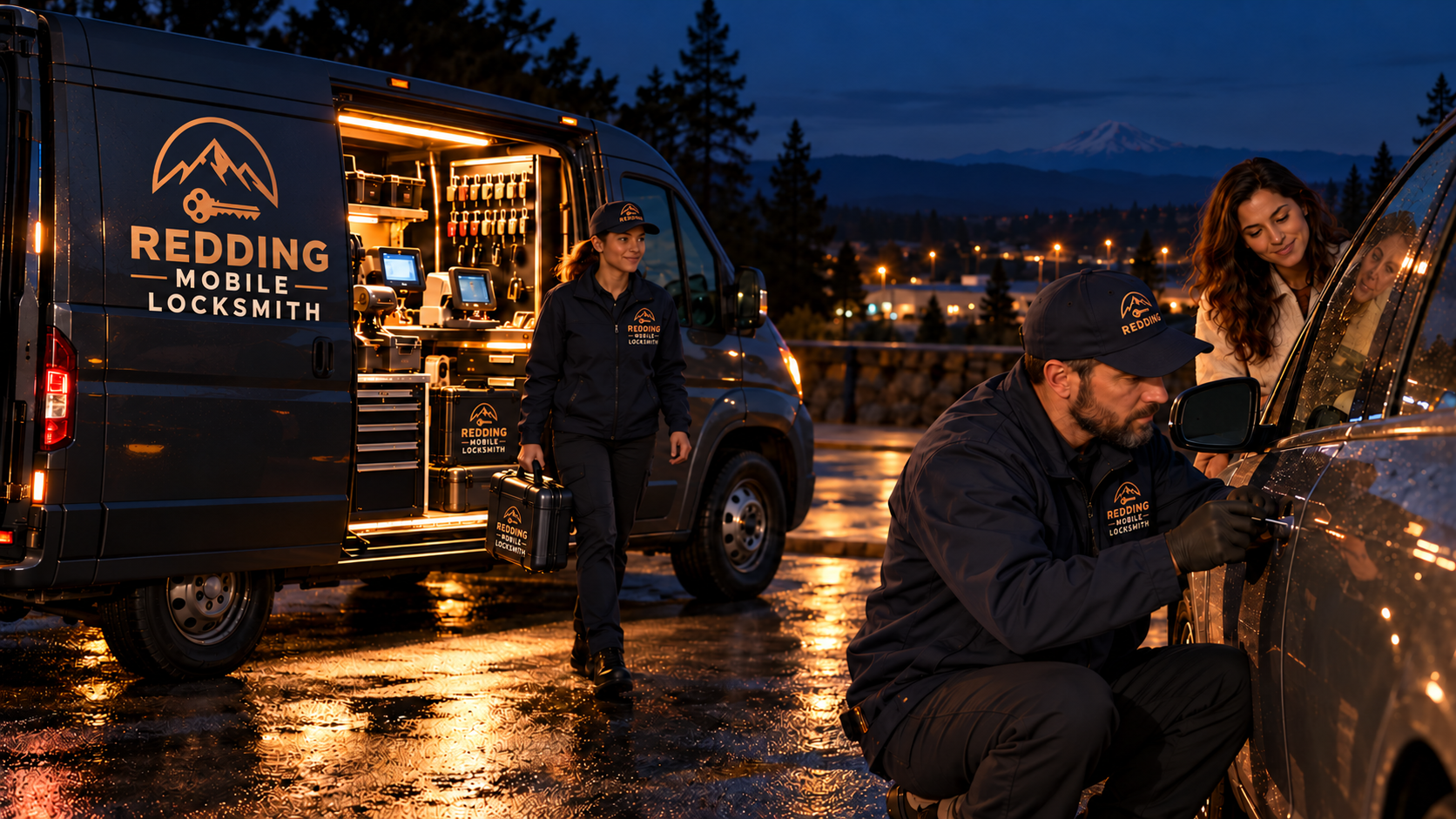
Do not accept help from a stranger who offers to open the door. Someone who appears from the dark with a tool and a suggestion is not part of your plan. Wait for the branded team in uniforms and the branded service van that you contacted. Read confirming who is arriving at your door so you know what to look for.
Minute ten: set up for arrival
Move to the door the technician will need. Clear the path. Turn on a porch light if you can reach the switch. If there is a gate, hold it open, or give the dispatcher the code. Put a pet in a safe spot if you can reach it.
Think about where the technician will park. A narrow street or a shared drive may need a word of warning. If a neighbor's car blocks the way, a quiet knock now saves a delay later. These small acts of preparation are the most useful thing you can do while you wait.
When the van arrives, let the technician introduce themselves. Ask who they are and what company they represent. Check that the van and the uniform match what you expected. Then show your proof and describe the lock again in your own words.
Ask the technician to explain what they plan to do before they start. A calm professional will tell you the plan, what could go wrong and what the options are. If the lock is damaged, ask about repair or replacement. See after hours emergency for the wider picture of how the service works.
Who needs this most in Shasta Lake
Shasta Lake sits near Shasta Dam and Lake Shasta along Interstate 5. It has family homes, rental housing, visitors who come for the lake and many people who commute to Redding. Each group meets a lockout differently. A family at home may have a child inside. A renter may have a landlord to call. A visitor may be far from anyone who knows them.
Visitors face the hardest version. They are away from home, they may not know the street name and they may be in a rental where the owner is off site. If you are a visitor, keep the rental details in your phone, including the address and the name of the owner or manager. That information is gold on a dark night.
Commuters have their own pattern. A late return from Redding, a tired mind and a door that gets locked automatically can all lead to a lockout. Keep the key in the same pocket every time. Keep a spare in a safe place with a trusted person. For nearby towns, see Redding and Anderson.
Lake visitors should also think about water and gear. A key that goes in a swim bag, a tackle box or a pocket of wet clothes is a key that goes missing. Choose a single dry spot for it, such as a zipped pocket in a bag that never leaves your side. If a boat trailer or a camper is involved, read lakeside parking lockouts for the added steps.
If the lock is not simply locked
Sometimes the problem is not a missing key. The key goes in and will not turn. The knob spins freely. The deadbolt sticks halfway. In these cases the lock itself has a fault, and the answer is repair, not entry. Tell the dispatcher exactly what the key does and what the lock does.
A lock that fails often shows warning signs first: a key that grows stiff, a bolt that drags, a handle that rattles. If you noticed any of these in the past week, say so. The history helps the technician guess the fault before opening the case. It also helps you decide on repair versus replacement.
Cold and damp can play a part near a lake. A door that swells in wet weather can press the bolt against the strike and make a lock feel stuck. A technician can tell the difference between a swollen door and a failing cylinder. Our guide to broken lock repair describes what each looks like.
Whatever the cause, ask the technician to make the home secure before they leave. That may mean a repair that night, a temporary measure or a new lock. You should not be left with a door that opens but cannot lock. Say that plainly at the start, and the plan will include it.
After the door opens
Step inside, lock up and take a breath. Check on everyone in the home. If anything feels off, such as a window open that should be closed, step back out and call emergency services. A lockout is a key problem, but you should always trust what you see.
Ask the technician about the lock. If the key was lost, a rekey may be wise. If the lock failed, a repair or replacement may be needed to make the door secure for the night. Learn about rekey locks and broken lock repair on the service pages.
Before you sleep, fix the cause. Put the spare in a known place. Move the key hook to where you will see it. Read night house lockouts in Shasta Lake and night car lockouts in Shasta Lake for deeper steps on each kind of lockout.
Common questions
What is the first thing to do in a lockout at night?
Stop, find a lit place and check whether anyone inside is in danger. If a child or a person who cannot cope alone is inside, call emergency services first. If everyone is safe, try the other doors, check your pockets and vehicle, and call anyone who holds a spare before contacting us.
Should I break a window if I can see my keys inside?
No. A broken window creates a repair, a safety risk and an unsecured home. A trained technician can usually open a working lock without any damage. Unless someone inside is in danger, which is a call for emergency services, wait for help.
I am visiting and do not have an ID with this address. What then?
Reach the resident or owner if you can and ask them to confirm by message or call. A photo, a message thread or a rental confirmation can also help. The technician will decide what is reasonable. Ask when you contact us what proof they will want.
Can I wait inside my car while the locksmith arrives?
If the car is unlocked and safe, yes. It is often the safest shelter, with the doors locked and the engine used only as needed. Park under a light and keep your phone charged. If the car is also locked, wait in a lit, visible place near the door.
What information does the dispatcher need most?
The street, the nearest cross street, the door you are at and the type of lock. Add any gate, dog, dark stretch or safety concern. Say if anyone inside needs care. Clear details let the technician bring the right tools and find you without delay.
Where is your phone number?
The phone line is coming soon. For now, use the request form on the contact page to send your location and details. Keep your phone nearby so the team can reach you.