
Home / Weed / After Hours Emergency in Weed
Night dispatch in Weed
After Hours Emergency Locksmith Service in Weed
A night call to a locksmith is a short, orderly conversation. This page walks through what the dispatcher asks, what the technician needs from you, and how to prepare in Weed before the van arrives.
What an after hours call actually sounds like
The call is calmer than most people expect. The dispatcher is not there to hurry you or to scare you. The dispatcher is there to collect a small set of facts in a steady order so a technician can come with the right tools.
You will be asked where you are, what is locked, and whether anyone is in danger. If a person is hurt, or a child or pet is trapped in a vehicle, the answer is emergency services first. A locksmith is the second call in those cases, never the first.
After safety, the questions turn practical. What kind of door is it. What kind of lock. Has anything been forced or broken already. Each answer shapes what the technician loads into the van, so short honest answers help more than long explanations.
A landlord turning over a unit at night
Picture a landlord in Weed who has just handed a unit to a new tenant, or just taken one back. The previous tenant returned one key but not the spare. The landlord arrives after dark to check the unit and finds the key does not turn the way it should.
This is a common after hours situation, and it is rarely a true emergency in the life safety sense. It is still a real problem. A unit with an unknown key in circulation is a unit that is not secure, and nobody wants to leave it that way overnight.
The dispatcher will ask the landlord some plain questions. Is the door open or shut. Is the landlord standing outside it now. Is anyone living inside. The answers decide whether this is a lockout, a lock repair, or a rekey that can be done on the spot.
A turnover also raises the matter of the other doors. Many units have a front door, a back door and sometimes a slider or a side entry. Each can hold its own lock and its own key. A landlord who has handled only the front door has handled a third of the job. Tell the dispatcher how many entries the unit has so the technician can plan for all of them.
Timing matters in a different way here. Because nobody is inside, the work can be done calmly and in the right order. Open the door, check the hardware, decide about rekeying, and test every key before the technician leaves. A turnover handled this way leaves a unit that is ready for the next tenant, with keys that you can account for.
- Say whether you are the owner, the manager or the tenant.
- Say whether the unit is occupied right now.
- Say whether the key turns, sticks or does not enter the lock at all.
- Say whether the door is a single lock or has a separate deadbolt.
- Say whether you can show something that ties you to the property when the technician arrives.
The first questions, and why each one matters
Location comes first because a technician cannot plan a route without it. Give the town, the road or the nearest cross road, and anything you can see that stands out. In Weed that might be a spot near the Interstate 5 and Highway 97 junction, a lot behind a shop, or a house set back from the road.
Lock type comes second. A pin tumbler cylinder in a standard knob behaves differently from a keypad deadbolt or a commercial mortise lock. Describe what you see, even if you do not know the proper name. Words like round knob, lever handle, single deadbolt and glass door are enough.
Condition comes third. A lock that has been kicked, a frame that has split, or a latch that has been pried changes the job from opening a door to repairing one. Tell the dispatcher honestly. The technician will bring hardware for repair if the damage calls for it.
Last, the dispatcher may ask about your own contact details and the way to reach you. Give a number that you will answer, and say so if your phone signal is weak. Open country around a highway junction can have patchy coverage. A technician who cannot reach you at the door loses time, and so do you.
You may also be asked whether the property has a gate, a code, a dog or any hazard at the entry. These are not nosy questions. A technician who walks up in the dark to an unlit step or an unleashed animal is at risk, and a safe visit is a better visit for everyone involved.
Describing where you are in a windy, open town
Weed sits north of Mount Shasta where Interstate 5 meets Highway 97, and the terrain around town is open. At night that means wind, a lot of dark between lights, and few landmarks to point at. A vague description costs time that nobody can recover.
Give the dispatcher a clear anchor. Name the highway or road you are nearest, the side of the road you are on, and what is next to you. A business sign, a lit entrance or a gate is the kind of detail that works. Please do not guess at street names if you are not sure.
If you are on the move, stop somewhere safe first. A lit parking area is better than a roadside shoulder. Turn on your hazard lights if you are in a vehicle. Tell the dispatcher if you are alone, because a technician who knows that will plan to confirm identity with extra care.
What the technician needs from you at the door
A technician opens locks for people who are entitled to have them opened. That is a rule of the trade, and a good one. Expect to be asked for some kind of identification and some link between you and the property or vehicle.
For a landlord, that link might be a lease, a property management document, a utility bill or simply a tenant who can confirm the arrangement. Rules vary, and the technician will tell you what is acceptable at the time. If you are unsure, ask the dispatcher during the call so you can have it ready.
Do not be offended by the request. It protects you as much as anyone. A locksmith who opened any door for any caller would be a danger to every tenant and owner in Weed. If you want to know more about why this happens, the guide on why a locksmith may ask for identification explains it.
What to prepare while you wait
Waiting is the easiest part to do well. Pick a safe place, keep your phone charged, and gather the documents the technician may ask to see. Turn on the porch light if you can reach the switch. A lit door makes the work safer for everyone.
If you are a landlord, bring or locate the tenant file. If you are a tenant, find your lease or an envelope with your name and the address. If you are the driver of a vehicle, find the registration or insurance card in the glove box if you can reach it, or a photo of it on your phone.
Keep other people calm. Children, relatives or a tenant who is upset do not need a running commentary. Tell them a technician is on the way and that the door will be opened without damage. That is the usual outcome, and it is the one to expect.
Think about the weather too. Weed is known for wind, and a cold gust at a door is no place to stand for long. If you have a coat in the car or a blanket in the hall, use it. Comfort keeps your head clear, and a clear head gives better answers when the dispatcher calls back.
- Keep your phone on and the ringer up so the dispatcher can reach you.
- Stay in a lit place and avoid wandering around the outside of the building.
- Gather identification and any document tied to the property.
- Note which keys you do have, even the ones that do not work.
- Clear a path to the door and move vehicles that block the entry.
Safety rules for a night on the road or in a lot
Weed draws highway travelers as well as residents, and the Interstate 5 and Highway 97 corridors carry traffic at all hours. If your problem began on a roadside, move to a lit, level, legal place before you do anything else. Never stand in a travel lane to wait for help.
If you feel unsafe for any reason, say so on the call. The dispatcher will ask whether you can go into an open business, a lit lobby or a trusted neighbor's home while you wait. Safety comes before the lock. A door can always be opened later, and a person cannot be replaced.
Keep a record as you go. Write down the time you called, what you were told, and the name of the technician if one is given. The notes are useful if plans change or if you need to explain the visit to an owner or a manager afterward. For more on this, the guide on locked out at night: a safety first plan sets out the steps in order.
Finally, tell someone you trust where you are. A text to a friend or family member adds a second pair of eyes to a late night problem. If the technician is delayed or the plan changes, that person can help you decide what to do next.
Things not to do before the van arrives
The most common mistake is forcing the lock. A screwdriver, a credit card, a hammer or a shoulder against the door each cause damage that costs more than the lockout. A deadbolt that is bent or a frame that has split turns a short job into a repair.
Do not spray anything into the lock cylinder. Oil and household lubricants can attract dust and gum up the pins. A graphite based product is acceptable for a sticking lock, but not as a stand in for a technician when you are locked out.
Do not call several companies and leave the technicians to sort out who is coming. Pick one, give the dispatcher your details, and wait. Two vans at the same door help no one. If your situation changes, call back and say so.
When the technician arrives
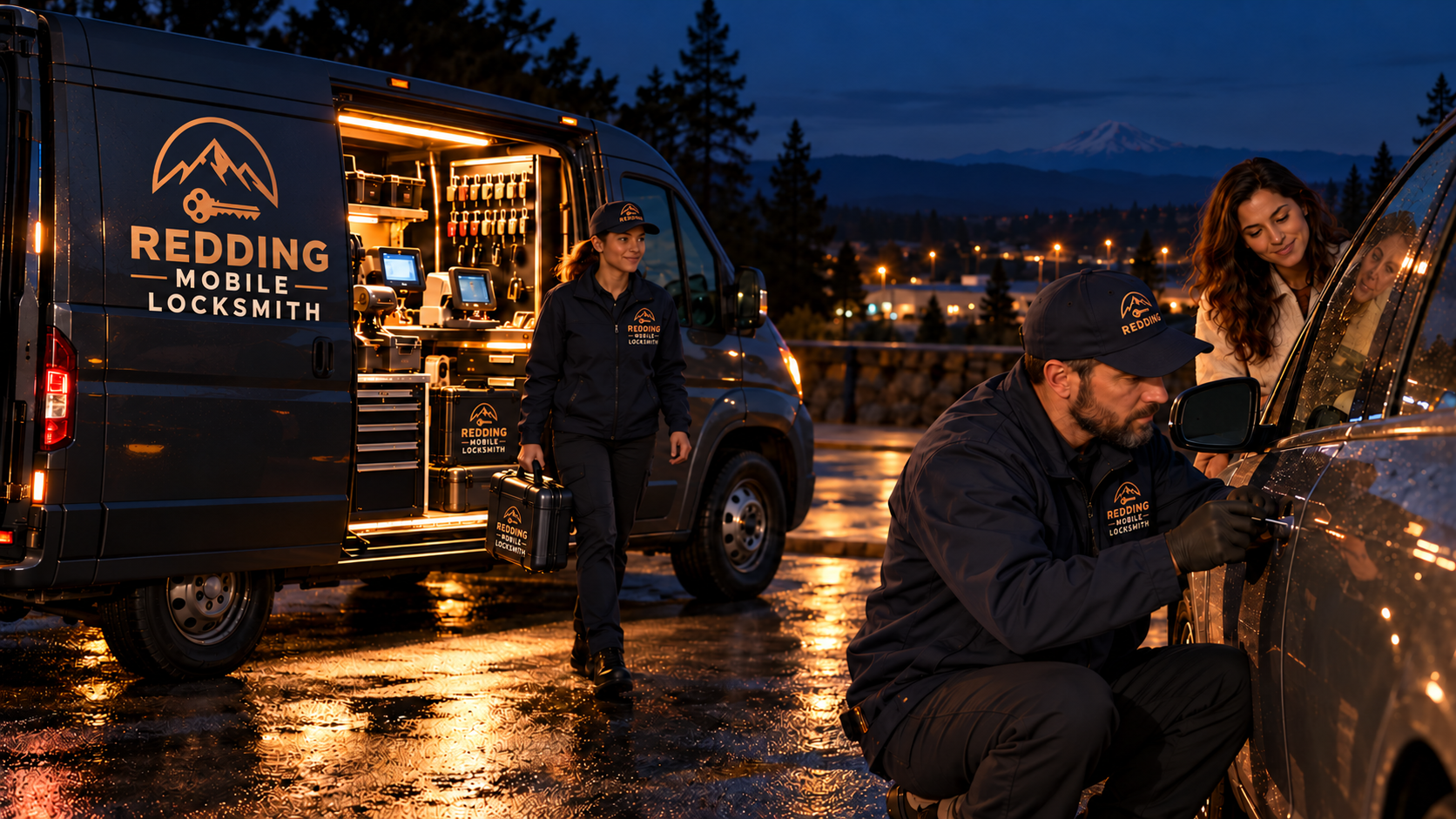
The branded service van and the uniformed technician are there so you can recognise who is arriving. Look at the vehicle and the uniform before you open the door to anyone. If something does not match what the dispatcher told you, ask a question before you let anyone in.
The technician will look at the door first. A short inspection tells them whether a non destructive opening is possible, whether the hardware is worn, and whether the lock should be repaired or replaced after the door is open. You will be told what is planned before work begins.
The van carries key cutting and programming equipment, common hardware, and professional tools. That means many problems can be handled on the spot. If a part is not on the van, the technician will say so and explain the sensible next step. The guide on confirming who is arriving at your door gives a fuller checklist.
After the door is open: what a landlord should do next
Opening the door is only half the task for a landlord. The bigger question is who else holds a key. If the previous occupant kept a copy, or if a key went missing at some point, the lock is no longer under your control.
The standard answer is rekeying. A technician replaces the pins inside the cylinder so that old keys stop working and new keys take over, without replacing the whole lock. It is a clean way to reset access between tenants. You can read how it works on the rekey locks page and in the local note on rekeying in Weed.
If the hardware itself is worn, bent or loose, repair or replacement may be the better choice. The broken lock repair page covers that decision. Ask the technician to explain the options in plain words and to tell you what each one changes.
Other help close to Weed and how this site fits together
This page is one of six local notes for Weed. The same town has its own pages for a night car lockout, a night house lockout and business security. The broader Weed coverage page explains who we serve there.
Mount Shasta is the next community along Interstate 5, and its coverage page may help if you are near the town line. For the whole service in one place, the after hours emergency service page gives the general view.
Our phone line is coming soon. For now, use the request form to describe the problem. Include your location, the kind of lock, and whether anyone is in danger. If someone is, call emergency services first and use the form afterward.
Common questions
What does the dispatcher need to know first when I call?
The dispatcher needs your location, what is locked, and whether anyone is in danger. After that come the lock type, the condition of the door, and whether you can show proof that you belong at the property. Short, honest answers are better than long explanations. If anyone is hurt or trapped, call emergency services before anything else.
Can a landlord request an after hours opening for a rental unit?
Often yes, but the technician will ask for something that connects you to the property, such as a lease, a management document or a utility bill. Rules vary by property and by situation, so ask the dispatcher what to have ready. If a tenant lives inside, expect questions about whether they are present and aware.
Why does the technician ask for identification at night?
Because opening a door for the wrong person would harm the real owner or tenant. A check protects everyone, including you. The technician may ask for a photo identification and a document that ties you to the vehicle or property. The request is routine, and it is a sign of careful work.
Should I try to open the door myself while I wait?
No. Forcing a lock with tools or a shoulder usually bends the deadbolt, splits the frame or damages the cylinder. A simple opening can become a repair. Stay in a lit, safe place, gather your papers, and let the technician inspect the door before anything is attempted.
What should I do about old keys after a tenant moves out?
Treat any key you cannot account for as a risk. Rekeying changes the inside of the cylinder so old keys no longer work while the lock stays in the door. Ask the technician about it during the visit, since the van carries the tools to do it. Whether it fits your budget and building is your call.
How do I reach you if the phone line is not live yet?
Use the request form on the contact page. Describe where you are, what is locked and any safety concern. The form is the way to reach us while the phone line is coming soon. If there is any immediate danger to a person, call emergency services directly rather than waiting for a reply.